Amrit Udyan Mughal Gardens Delhi
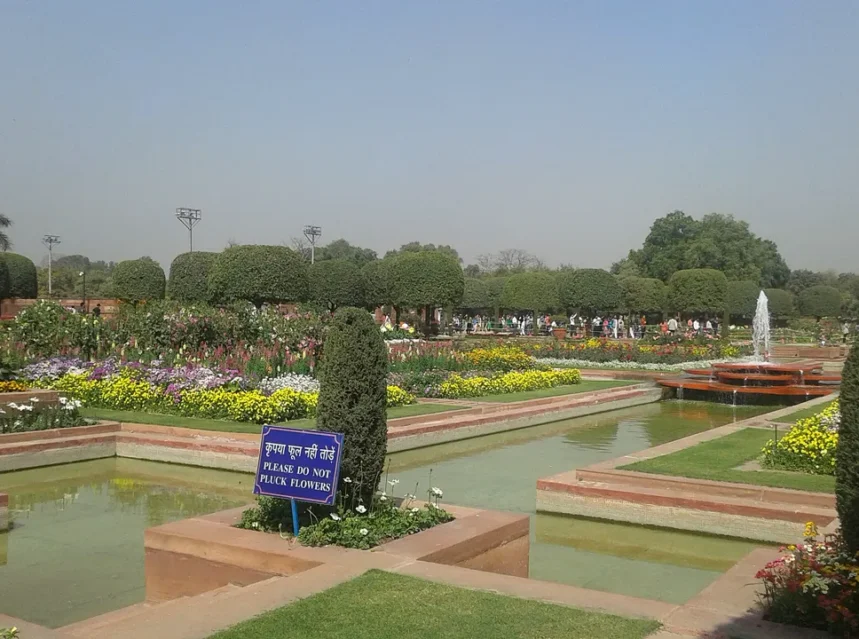
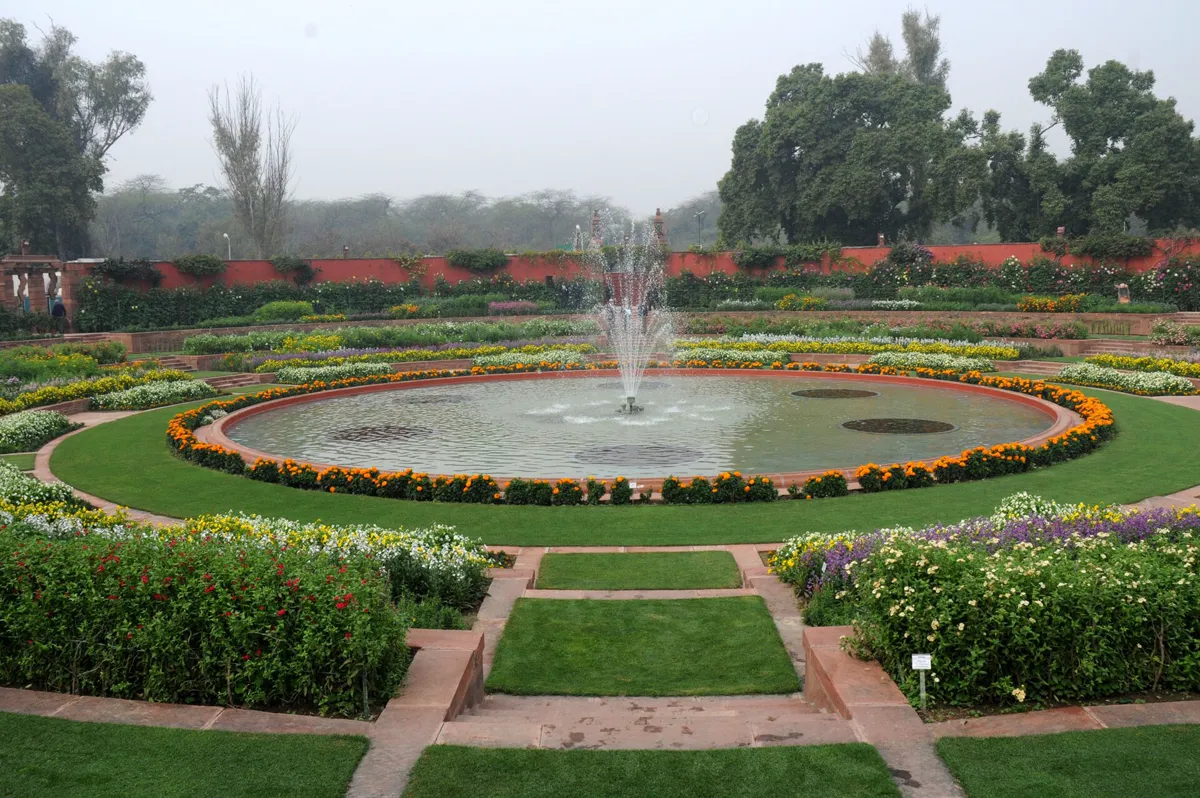
Amrit Udyan, the formal garden behind Rashtrapati Bhavan in New Delhi, is a Mughal charbagh crossed by two water channels and ringed by English flower borders. Until 2023 it was called the Mughal Gardens. So anyone searching for the Amrit Udyan Mughal Gardens Delhi is looking at one garden with two names. It is also the rare grand garden whose layout was a climate strategy first and a symbol second.
Quick answer: Amrit Udyan is the roughly 15-acre garden in the President of India’s estate in New Delhi. It was renamed from Mughal Gardens in January 2023. The main garden is a charbagh: two channels crossing at right angles, six lotus fountains, and sunken beds. It opens to the public for one announced season a year.
🧰 In a hurry? Jump straight to our tested picks for this guide ↓
Amrit udyan mughal gardens delhi at a glance
Most famous gardens are copied for their looks. This one is worth copying for its physics. The geometry that makes it beautiful is what made it survivable in a city where May afternoons pass 42 degrees Celsius.
| Feature | Detail |
|---|---|
| Official name | Amrit Udyan; called the Mughal Gardens until the rename in January 2023 |
| Location | Rashtrapati Bhavan, the President of India’s estate, New Delhi, India |
| Created | Laid out with the Viceroy’s House; Edwin Lutyens’ New Delhi work ran from 1912 to 1930 |
| Created by | William Robert Mustoe, a Kew-trained gardener, working inside Lutyens’ scheme |
| Size | Approx. 15 acres of garden; the wider estate is given as 320 to 330 acres |
| Garden style | Mughal charbagh geometry planted with English-style herbaceous borders |
| Plant collection | Approx. 159 rose varieties reported in 2023 press accounts; no official count is published |
| Signature feature | Two channels crossing at right angles, with six lotus-shaped fountains about 12 feet (3.7 m) high |
| Best season | The north Indian winter and early spring, when the annual public season falls |
| Climate | Köppen Cwa, bordering hot semi-arid BSh; roughly USDA zone 11 by average winter lows |
| Status | Working garden of the President’s estate, opened in an annually announced season |
| Managed by | The President’s Secretariat |
Two numbers deserve honesty. The area is widely given as 15 acres, and nothing we could open supports the 13 acres that circulates online. The rose count is shakier still: 2023 press accounts said 159 varieties, others say “over 100”, and the Secretariat publishes no figure. So treat rose counts as journalism, not record. Curious which of these plants would survive where you live? Our Plant Finder filters by climate and light first.
What makes Amrit Udyan famous
Three things, and only one of them is the flowers.
- It is the garden of a head of state. It sits inside the working estate of the President of India, so it is closed for most of the year. Scarcity does a lot of the work here.
- It is a genuine charbagh, not a nod to one. The record of the estate is specific: two channels cross at right angles on the cardinal directions and cut the main garden into a grid of squares. The Rashtrapati Bhavan record names the form outright, and adds the six lotus-shaped fountains standing at the crossings.
- It is a hybrid nobody expected to work. Mughal bones, English flesh. The channels and the grid are Persian. The deep herbaceous borders stuffed with roses, pansies and stocks are Edwardian England. Very few gardens hold both without looking confused.
Why is a charbagh built this way, and what changed in 2023?
Start with the name. In January 2023 the President of India renamed the Mughal Gardens to Amrit Udyan, marking 75 years of independence as Azadi ka Amrit Mahotsav. Nothing was rebuilt and nothing moved. Only the name changed. Older books, signage and photo captions still say Mughal Gardens, so both terms point to the same place.
Now the interesting part. A charbagh is a fourfold garden: two axial waterways cross in the middle and divide the ground into four. The form goes back to the paradise gardens of ancient Persia, and excavations at Pasargadae suggest it was already in use there. The four parts are usually read as the four rivers of paradise, and that reading is real.
But symbolism does not explain why the form spread across some of the hottest inhabited land on earth and stayed for two thousand years. Engineering does.
The channels are a cooling system
Water changing from liquid to vapour absorbs a lot of heat. Vaporising one kilogram takes roughly 2,257 kilojoules, and that energy comes out of the surrounding air. So a long, shallow, moving channel is not decoration. It is a heat exchanger with a very large surface area.
The effect is measurable. Records of passive cooling cite a field study where evaporative cooling dropped indoor air by 9.6 degrees Celsius. The record of Persian windcatchers puts the drop at 8 to 12 degrees. That tradition also produced the salasabil, a fountain shaped as a thin sheet of flowing water purely to maximise surface area. One was built at the Red Fort in Delhi.
There is a catch, and it is the honest half of the story. Evaporative cooling only works in dry air; humid air gives almost none. So a Mughal channel does its best work in Delhi’s bone-dry April and May. Once the monsoon lands around the end of June, the same channel is mostly just pretty.
The beds are sunk for a reason
Look at any Mughal parterre and the planting sits below the path. The record of paradise gardens explains it plainly: the ground was sunken, or the walkways raised, so passers-by could reach the fruit and flowers easily. Flower heads end up at eye level instead of at your ankles.
There is a second benefit the Persians used deliberately. Persian practice set trees in a sunken ditch called a juy, which slowed evaporation and sent water straight to the roots. A sunken bed is a basin: it holds irrigation instead of shedding it, and its rim breaks the hot wind that dries leaves. The Zuni people of the arid American southwest reached the same answer independently with waffle gardens, described as the inverse of a raised bed, with low walls around each cell so it can be flooded.
So the charbagh is fourfold because four quadrants is what you get when two gravity-fed irrigation channels cross a plot at right angles. The symbolism made it beautiful. The water made it work.
History: how a Mughal garden ended up behind a British palace
The usual line is that Edwin Lutyens designed these gardens. That is not quite right, and the truth is better.
Lutyens designed the Viceroy’s House and shaped New Delhi between 1912 and 1930. But the garden was laid out by William Robert Mustoe, a Kew-trained gardener who had worked in India since 1905, picked to help Lutyens landscape the new capital.
The Mughal design came from somewhere else again. Vicereine Lady Hardinge pushed for it, and her source was a book: Gardens of the Great Mughals, published in 1913 by Constance Villiers-Stuart. Hers was the first full-length study of the subject, and the first in English to discuss charbagh and read it as a large garden split by four waterways. Lutyens and the Viceroy both took her seriously.
So the garden exists because a woman wrote a book, a Vicereine read it, and a Kew gardener built it. Later Presidents added themed sections, and the name changed in 2023.
What to see: the named parts of the garden
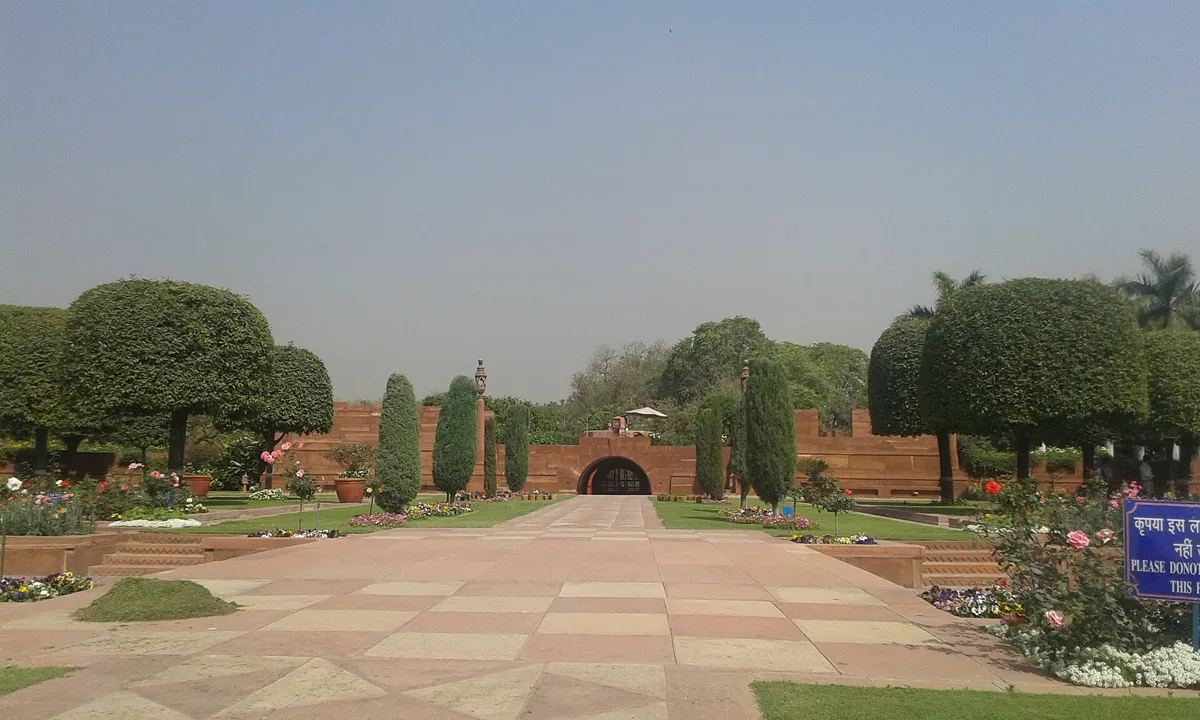
The official visitor portal of the President’s Secretariat lists the circuit itself, so these names are the garden’s own, not a travel writer’s.
- The Rectangular Garden — the main charbagh. Two channels cross at right angles and cut the ground into a grid of squares.
- The six lotus fountains — set at the crossings of the channels, rising to about 12 feet, or 3.7 metres. They are the single most photographed feature.
- The Long Garden, also called the Purdah Garden — a walled strip west of the main garden, running along the central pavement. It holds 16 square rose beds set inside low hedges.
- The sandstone pergola — at the centre of the Long Garden, covered in rose creepers.
- The Circular Garden — the terminus of the central walk, sunk below the surrounding level with a wide pool at its heart.
- The Herbal Garden and the Musical Garden — later themed additions on the visitor circuit.
- The Spiritual Garden — the last section on the circuit.
The walls carry the rest of the show. Jasmine, bougainvillea and vigorous creepers such as Petrea and Tecoma grandiflora are recorded on the boundary planting, with China orange trees among the standards.
Best time to visit Amrit Udyan
One season, and it is not a matter of taste. It is the only time the plants are alive.
Delhi has a dry-winter humid subtropical climate bordering on hot semi-arid. The city record gives a January average high of 19.3 degrees against a late-May average high of 42. Nothing in a European-style border survives the second number, so the whole display is built for the first.
That is why the public season falls in the cool months. Roses, pansies, stocks and tulips all flower in a Delhi winter and all collapse in a Delhi summer. The garden simply follows the plants.
Planning a year around a cold season rather than a warm one is a real skill. Work backwards from your local frost window with our frost date finder, then drop sowing and pruning jobs into a planting calendar. A February border is decided the previous September.
Planning a visit: what to know
The garden is not a public park. It sits inside a working presidential estate, so it opens to the public for a limited season announced each year, and access is managed. Treat any date you read on a blog as gossip until the Secretariat says so.
Opening times, ticket prices and booking rules change every season, so check the official site before you travel. The President’s Secretariat visitor portal is the only source worth trusting for current arrangements. It lists Amrit Udyan as one of the estate’s visiting circuits.
Signature plants of Amrit Udyan — and how to grow them at home
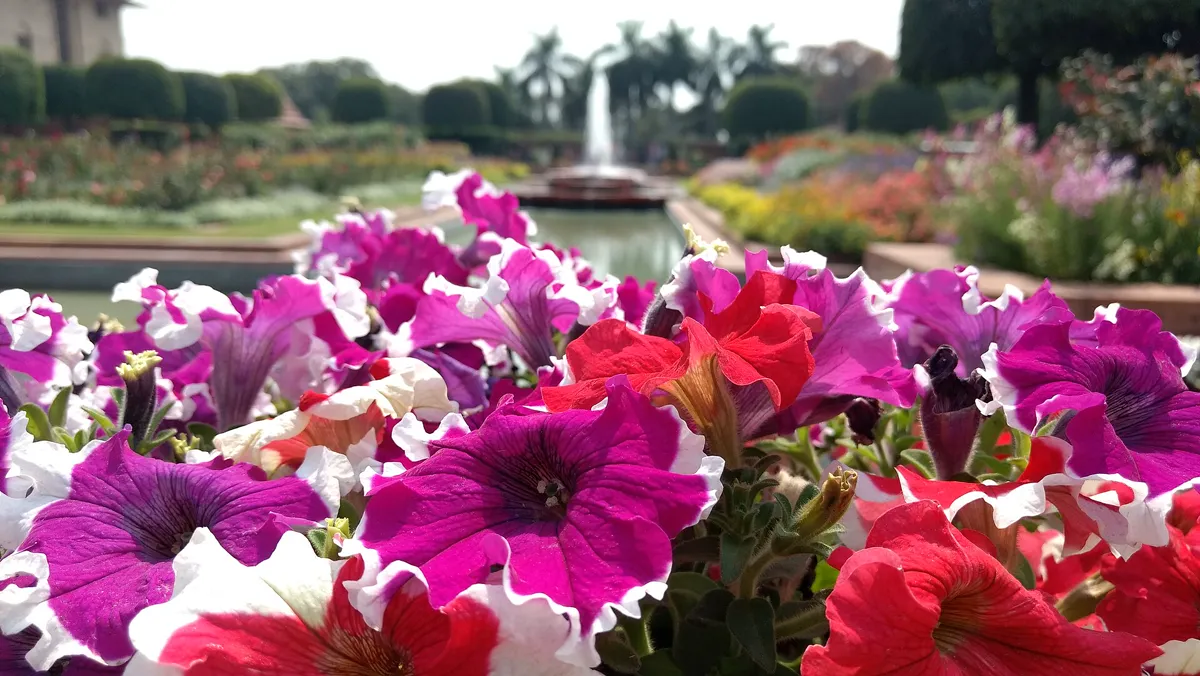
Two plants are documented here beyond argument.
- Roses — the backbone. The Long Garden alone holds 16 square rose beds, plus climbing roses over the pergola. Start with our guide to growing roses for beginners.
- Tulips — the crowd-puller, and the hardest thing here to repeat. See how to grow tulips and spring bulbs before you buy any.
The rest of the effect comes from massed cool-season bedding, and that is the part you can copy cheaply. These three do the heavy lifting in any dry-winter garden:
- Stock — heavily scented spikes, and the reason a Mughal border smells good at dusk. Ten-week types behave as quick annuals. Our stock growing guide covers sowing and support.
- Calendula — technically perennial, but grown as an annual almost everywhere. It withers in a subtropical summer and flowers in under two months from seed, so it is a natural cool-season crop. See the calendula guide.
- Dianthus — low, frilled and long-flowering, ideal as the front edge of a sunken bed. Our dianthus guide explains the drainage it insists on.
All want free-draining ground and steady moisture rather than floods. Work out the compost or grit your beds need with the soil calculator, then size the watering with the water calculator. Massed bedding in dry heat fails from drought stress long before it fails from pests.
Growing the Amrit Udyan look in your climate: US, UK and India
This garden is a dry-winter design. That single fact decides what each reader has to change.
India, and the northern plains especially. You can copy this almost exactly, provided you accept the calendar. Roses here are a winter crop. Indian agricultural-university guidance puts the ideal near 26 degrees by day and 15 by night, which is a Delhi January, not a Delhi June. Commercial rose guidance puts pruning in the dormant window from October, and notes flowering starts about 45 days later.
Do the arithmetic: an October prune lands you in bloom by mid-December, peaking through February. That is exactly when Amrit Udyan opens. Push it later and you lose the season. Heat during bud development also causes malformed centres, called bull heads, and washed-out colour. For proof the pattern is regional, Asia’s largest rose garden at Chandigarh peaks December to February too.
Tulips in India are a one-season purchase. They need an extended spell below 10 degrees to elongate the flower stalk. After flowering, a bulb needs about six weeks of leaf to rebuild next year’s flower, and in the plains those six weeks land in a 40-degree April. So the tulip record is blunt about warm-winter areas: plant in autumn, treat as annuals. Buy pre-chilled bulbs and do not expect a second year. Kashmir is the exception, which is why the tulip garden at Srinagar works on terraces above Dal Lake and Delhi cannot repeat it. Rooftop growers should read our terrace gardening in India guide first, because container soil in Delhi heat behaves nothing like ground soil.
United Kingdom and cool maritime climates. Reverse the calendar. Roses are a summer crop and tulips are genuinely perennial, so the plant list gets easier and the geometry gets harder. Evaporative cooling does almost nothing in damp air, so build the channel for sound and reflection, and keep it shallow. Winter wet is the enemy, so raise the beds rather than sinking them.
United States. Split it by region. Arizona, inland California, Nevada and west Texas are the closest match outside Asia, and the full charbagh logic transfers intact, cooling included. The humid southeast gets the layout but not the physics. Cold northern states can run the geometry, but must drain the channel before it freezes. Everywhere hot, mulch does half the work by forming a barrier that cuts evaporation; our mulching guide covers depth and the mistakes that matter.
5 design lessons from Amrit Udyan you can copy
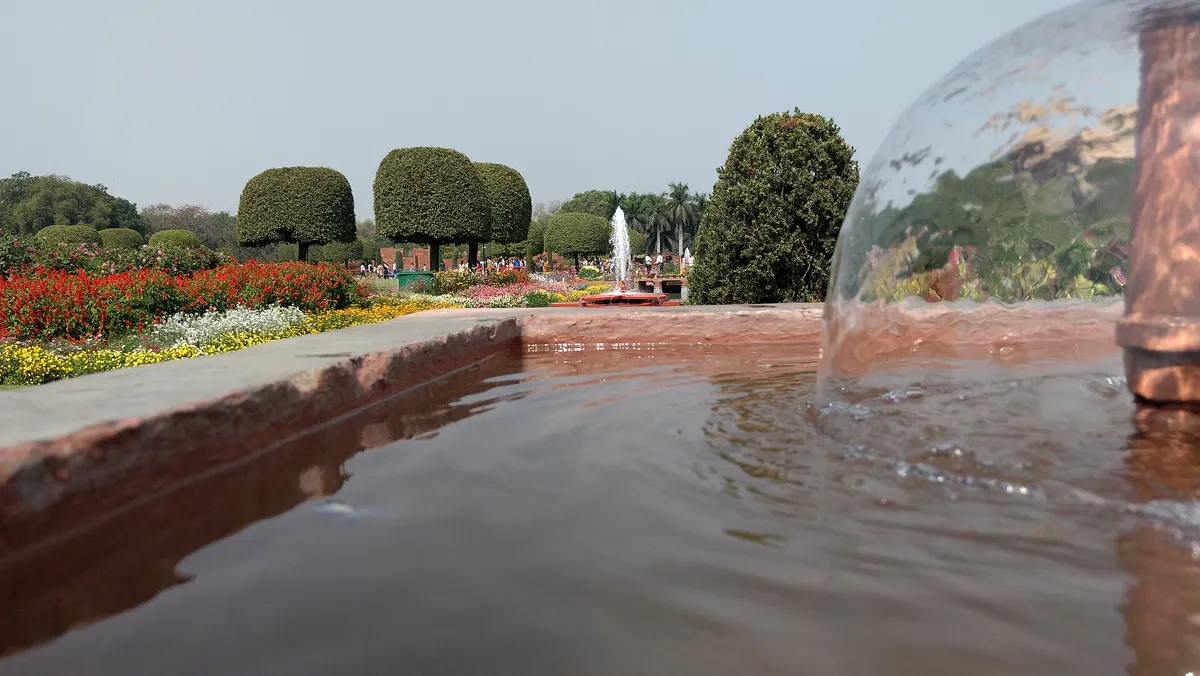
- Scale the charbagh down, do not shrink it. The fourfold plan works at any size because it is just two crossing lines. On a 6 by 6 metre plot, run a narrow path each way, put something small and vertical where they meet, and you have four beds. Resist unequal quadrants, because the whole effect depends on them matching. It is also the cheapest layout in gardening, since paths cost less than planting.
- Use water for cooling, not for spectacle. A big pond in a hot garden is a mosquito farm. A shallow moving rill is a machine. Keep it narrow and flowing, because surface area and movement do the cooling, not volume. Site it upwind of where you sit. In dry heat you feel the difference within a metre or two; in humid heat you will not, so spend the money on shade instead.
- Sink the beds if your problem is heat, raise them if it is rain. A bed set 15 to 20 centimetres below path level catches irrigation, shelters young plants from drying wind, and lifts flower heads to eye level as you walk past. There is one honest catch. Cold air sinks, so low ground frosts sooner and harder, as the record of microclimates notes. Sunken beds are for hot dry gardens, not for frost pockets. If your soil is heavy clay or your rainfall is high, do the opposite and raise the bed instead.
- Buy symmetry with repetition, not with money. Formal gardens look expensive because everything is paired. But paired does not mean costly. Take one cheap plant and use it forty times. Amrit Udyan does this with clipped domes along the axis and with concentric rings of a single bedding plant. Two matching pots at a path end, one plant repeated down both sides, or a single hedge line reflected across the centre will read as designed. Variety is what makes small gardens look messy.
- Grow roses on the cold season if you live somewhere hot. This is the lesson most home growers in warm climates get wrong. They fight for summer roses and get thin, pale, malformed flowers. Instead, prune into dormancy, feed, and aim the bloom at your coolest ten weeks. You get bigger flowers, deeper colour and far less disease, for less water.
Any of this needs a plan on paper before a spade goes in, because symmetry cannot be fixed later. Sketch the axes and the quadrants in our garden planner. Then check your shrubs will still fit the geometry in five years with the plant spacing calculator. Formal planting punishes overcrowding faster than any other style.
Who shaped India’s roses, and what the record actually says
Rose growing in India is not folklore. It has an institutional history, and it runs through one campus.
Dr Benjamin Peary Pal directed the Indian Agricultural Research Institute at Pusa in New Delhi from 1950 to 1965, then became first Director-General of the reorganised Indian Council of Agricultural Research. He was known for his work on roses, and founded the Rose Society of India and the Bougainvillea Society of India. A rose garden at the institute carries his name.
That is the honest version, worth stating precisely because the internet inflates it. The record does not credit him with breeding the roses at Amrit Udyan, and the Secretariat does not name its horticulturists publicly. What is documented is that the estate gardens are the Secretariat’s own responsibility, maintained by a large permanent staff.
Recreate the look at home: what you’ll need
The layout is free. The plants are not, and roses are where the budget goes. Buy bare-root or grafted stock suited to your heat, rather than whatever is flowering in the nursery on the day.
The bedding is much cheaper from seed, and cool-season annuals germinate fast. Work out when to start them for your own climate with the seed starting calculator.
Frequently asked questions
Are Amrit Udyan and the Mughal Gardens the same place?
Yes. They are one garden with two names. The Mughal Gardens at Rashtrapati Bhavan were renamed Amrit Udyan in January 2023. Nothing about the garden itself changed. Older signs, books and photo captions still use the old name.
What does Amrit Udyan mean?
Udyan means garden. Amrit means nectar, and carries a sense of immortality. The name was given during the marking of 75 years of independence, known as Azadi ka Amrit Mahotsav.
When is the Amrit Udyan open to the public?
It opens for a limited season announced each year, in the cool months when the garden is in bloom. It is not open year-round, because it sits inside a working presidential estate. Check the President’s Secretariat visitor portal rather than a blog, since arrangements change every season.
Why is Amrit Udyan famous?
Three reasons: it is the President of India’s garden and closed most of the year; it is a true charbagh with two crossing channels and six lotus fountains; and it fuses that Persian geometry with English herbaceous borders, which few gardens manage convincingly.
Where exactly is Amrit Udyan, and which city is it in?
New Delhi, India. It lies behind Rashtrapati Bhavan at the western end of the Lutyens’ Delhi axis. It is not in Kashmir or Lahore, despite what an image search for “Mughal garden” will show you.
What is a charbagh, in plain terms?
A garden split into four by two water channels crossing at right angles. The form comes from ancient Persia, and the four parts are read as the four rivers of paradise. Practically, it is what you get when you irrigate a square plot by gravity from the middle.
Do the water channels actually cool the garden?
In dry heat, yes, measurably. Evaporating water pulls heat out of the air, and studies of traditional evaporative cooling record drops of roughly 8 to 12 degrees Celsius. But the effect collapses in humid air, so a channel cools a Delhi April far more than a Delhi August.
How many roses are there at Amrit Udyan?
Nobody outside the Secretariat can say precisely. Press reports in 2023 gave 159 varieties, others say over 100, and no official figure is published. What is documented is the structure: 16 square rose beds in the Long Garden, plus climbers over the sandstone pergola.
Can I grow a charbagh in a small backyard?
Easily, and it suits small plots better than large ones. Two crossing paths, four equal beds and one focal point is the whole recipe. A rill is optional. Keep the quadrants identical, because the symmetry does all the work.
Can I grow tulips in Delhi or another hot city?
For one season only. Tulips need a long spell below 10 degrees to flower properly, then six weeks of leaf to rebuild the bulb. Hot plains give neither. Buy pre-chilled bulbs, plant in autumn, treat them as annuals and replace them yearly.
Why do my roses look terrible in summer even though the plant is healthy?
Heat during bud development, most likely. High temperatures cause malformed flower centres and faded colour, even on a vigorous bush. In hot climates the fix is timing rather than feeding: prune into the dormant season and aim the flush at your coolest weeks. If the symptoms look more like spots, mildew or pests, run them through our Plant Doctor first.
How is Amrit Udyan different from the Mughal gardens in Kashmir or Lahore?
Ground shape, mostly. Shalimar Bagh and Nishat Bagh sit on a hillside above Dal Lake in Srinagar and work as terraces, with water falling from level to level. Shalimar Gardens in Lahore, Pakistan, does the same across three terraces. Amrit Udyan is flat, so it uses a level grid instead of a cascade. That is also why photos of those gardens are so often mislabelled as this one.
Is Amrit Udyan the oldest Mughal-style garden in Delhi?
No, and not by centuries. The charbagh at Humayun’s Tomb was built in the 1560s and was the first of its scale in South Asia. Amrit Udyan is a twentieth-century garden built in a much older style.
Related gardens and guides
Amrit Udyan is one of twenty in our guide to the 20 most famous gardens in the world.
Formal geometry is a family, and the arguments differ. Compare this fourfold plan with the single vast axis at Versailles, which spends everything on one view instead of dividing the ground. For water used as terraced spectacle rather than as cooling, see the Villa d’Este gardens at Tivoli. And for a garden built entirely around the bulbs that Delhi can only borrow for one season, read our guide to Keukenhof.
Still stuck? Ask the Plant Doctor
Describe the problem — yellow leaves, holes, no flowers — and get a clear answer in seconds. FreeAI can make mistakes. Answers are guidance, not a guarantee — check anything important against the guide it links to, and always read the label on any product before you use it.