Boboli Gardens Florence
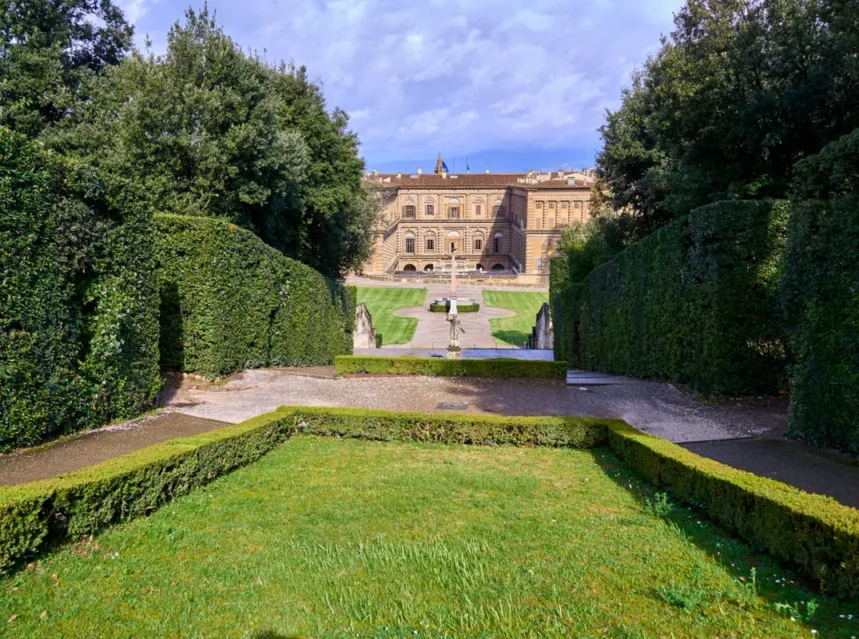
The garden behind Palazzo Pitti in Florence is the Giardino di Boboli, a terraced Medici hillside that became the working model for the Italian Renaissance garden. This Boboli Gardens Florence guide covers what to see, when to go, how the Medici kept citrus alive all winter, and how to copy that system at home.
Quick answer: Boboli is a 16th-century Medici garden on the hill behind Palazzo Pitti. Work began around 1549 for Eleonora di Toledo. It is a garden of terraces, avenues and statues rather than flower beds, and UNESCO lists it in its own right. Allow two to three hours.
🧰 In a hurry? Jump straight to our tested picks for this guide ↓
Boboli gardens florence at a glance
Boboli is not a flower garden. It is a piece of shaped ground, and almost everything memorable here comes from the landform rather than the planting.
| Feature | Detail |
|---|---|
| Official name | Giardino di Boboli (Boboli Gardens) |
| Location | Behind Palazzo Pitti, Oltrarno, Florence, Tuscany, Italy |
| Created | Begun about 1549–1550; extended into the 18th century |
| Created by | The Medici, for Eleonora di Toledo; first design by Niccolò Tribolo |
| Size | About 45,000 square metres, roughly 11 acres (see the note below) |
| Garden style | Italian Renaissance, in its terraced hillside form |
| Plant collection | Evergreen framework of holm oak, cypress, box, bay and olive, plus historic potted citrus and camellias; no official plant count is published (as of 2026) |
| Signature feature | The amphitheatre behind the palace, with an Egyptian obelisk on its axis |
| Best season | April to early June, and late September to October |
| Climate | Köppen Csa (Mediterranean); broadly USDA zone 8b–9 as an approximation |
| UNESCO status | A component of Medici Villas and Gardens in Tuscany, inscribed 2013; also inside the Historic Centre of Florence, inscribed 1982 |
| Managed by | Gallerie degli Uffizi (the Uffizi Galleries) |
One number deserves a warning, because published figures disagree wildly. Encyclopaedic sources give about 45,000 square metres, which is 4.5 hectares or roughly 11 acres. Other guides quote 30 hectares, 75 acres or 111 acres for the same place.
Two things are probably happening. Some writers measure only the formal core behind the palace, while others count the whole enclosed park stretching to Porta Romana. On top of that, 45,000 square metres gets misread as 45 hectares, which inflates the figure tenfold. Treat any single acreage you see as an estimate, and note which boundary the writer used.
Want to know which of these plants suit your own conditions? Our plant finder filters by climate zone, light and space.
What makes the Boboli Gardens famous
Three things keep this garden on every serious list.
- It set the pattern. The Uffizi Galleries, which run the site, describe the Medici layout here as a model for many European courts. Later court gardens across the continent borrowed its logic.
- It is a garden of ground, not flowers. Terraces, avenues and clipped evergreens do the work. So the garden looks designed in January as much as in May.
- It kept tender plants alive for centuries. The citrus collection survived Florentine winters only because every tree lived in a pot. That system is the most useful thing here for an ordinary gardener.
How did the Medici keep lemon trees alive through a Florentine winter?
This is the part of Boboli that most visitors walk past, and it is the part worth stealing. Florence has a Mediterranean climate, but it is not frost-free. January nights average around 2°C, and the city’s record low sits at −23.2°C.
A lemon tree planted in open ground would not survive that. Citrus roots and wood both suffer well before the air reaches those extremes. So the Medici never planted their citrus in the ground at all.
Instead, every tree lived permanently in a large terracotta pot. In autumn the gardeners wheeled the pots into a heated lemon house, the limonaia. In spring they wheeled them back out to their summer positions along the walks and terraces. Zanobi del Rosso built Boboli’s limonaia between 1777 and 1778.
Three things make the system work, and all three transfer to a modern garden.
- Root restriction is a feature, not a compromise. A confined root ball keeps the tree small enough to move, and a smaller tree needs less shelter space. Growers have used the same trick on citrus for centuries.
- The pot is the transport. Terracotta is heavy, so historic pots sat on low plinths or trolleys. Modern gardeners get the same result with a pot caddy on castors.
- Frost-free beats warm. A limonaia was never a hot house. It kept plants above freezing with good light, which is exactly what citrus wants in winter.
Because the plants stayed in pots, individual trees lived for generations and odd forms survived. The Florentine bizzarria is the famous case. It is a graft of citron onto sour orange, first recorded in 1640, and probably the first graft chimera ever produced. Growers lost it entirely, then rediscovered it in the 1970s.
One correction is worth making here, because guides repeat it constantly. The often-quoted figure of more than five hundred pots of lemons and oranges belongs to the Medici garden at Villa di Castello, not to Boboli. Neither the Uffizi nor any reference source publishes a plant count for the Boboli collection, so treat any specific number you read with suspicion.
The takeaway is simple all the same. If you can move a plant, you can grow it well outside its comfort zone. That single idea unlocks figs, olives, bay, citrus and half a dozen other Mediterranean plants in cold-winter gardens.
History: a quarry, a duchess and a blueprint
Eleonora di Toledo, wife of Cosimo I de’ Medici, bought Palazzo Pitti in 1549. The hillside behind it was not empty ground. It held a medieval quarry for pietraforte, the sandstone that built much of Florence.
Niccolò Tribolo drew the first design and turned that quarry hollow into the amphitheatre. He died in 1550, very early in the work. Bartolomeo Ammannati took over and built the retaining walls that hold the slope, mainly between 1561 and 1564.
Bernardo Buontalenti then supplied the theatrical set pieces, above all the Grotta Grande of 1583 to 1593. Later still, Giulio and Alfonso Parigi drove a second long axis, the Viottolone, down the hill and laid out the Isolotto around 1618. The cypresses along that avenue went in around 1637.
One popular claim needs care. People often say opera was born in the Boboli amphitheatre. In fact Jacopo Peri’s Euridice, the earliest opera that survives, was performed inside Palazzo Pitti on 6 October 1600, for the Medici–Bourbon wedding. The amphitheatre outside became the court’s great open-air stage a little later, from its 1637 inauguration onward. Both facts are true; the garden is the theatre, not the birthplace.
What to see: the named areas worth planning around
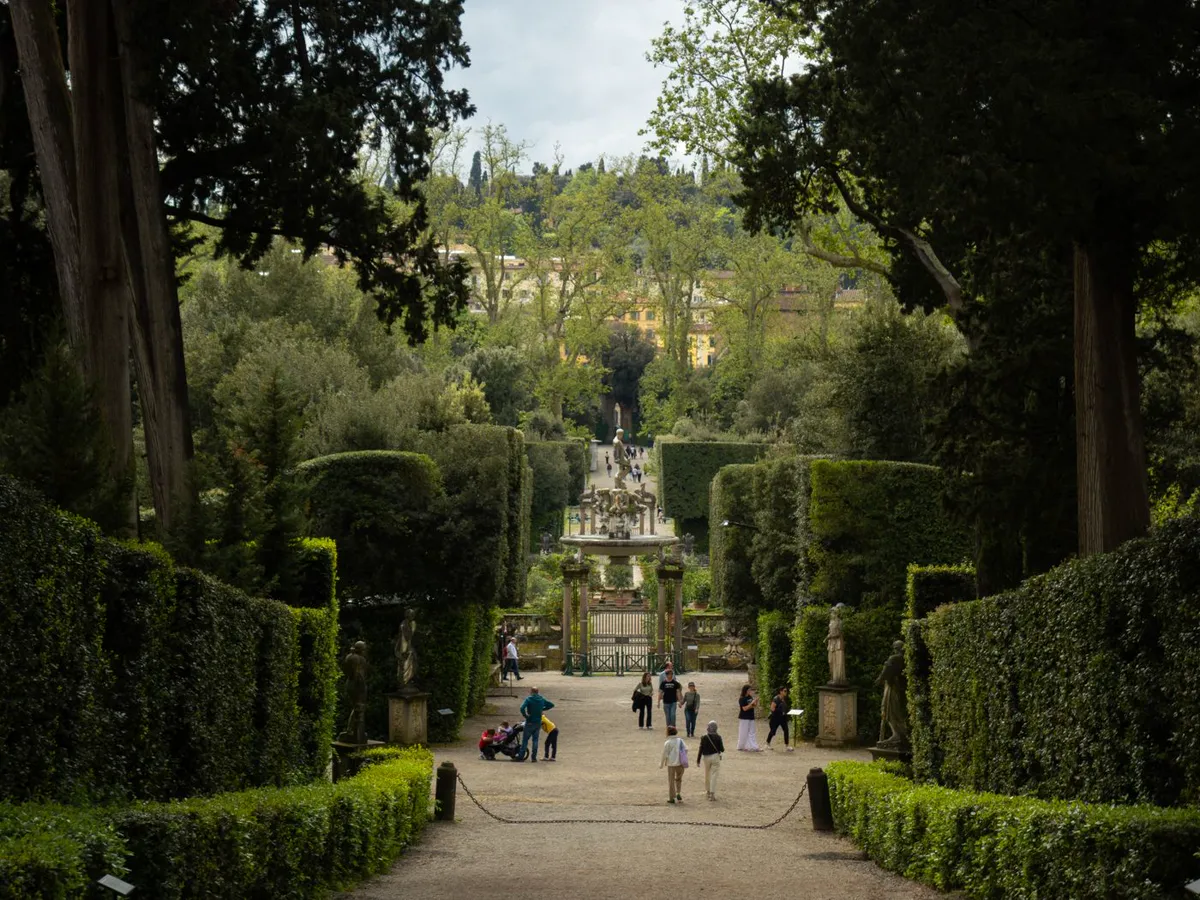
Boboli rewards a route rather than a wander. These are the parts to build a visit around.
- The amphitheatre and obelisk. A bell-shaped hollow cut straight into the hill behind the palace. An Egyptian obelisk from Heliopolis arrived in 1788 and took its place on the axis in 1790; a huge granite basin joined it in 1840.
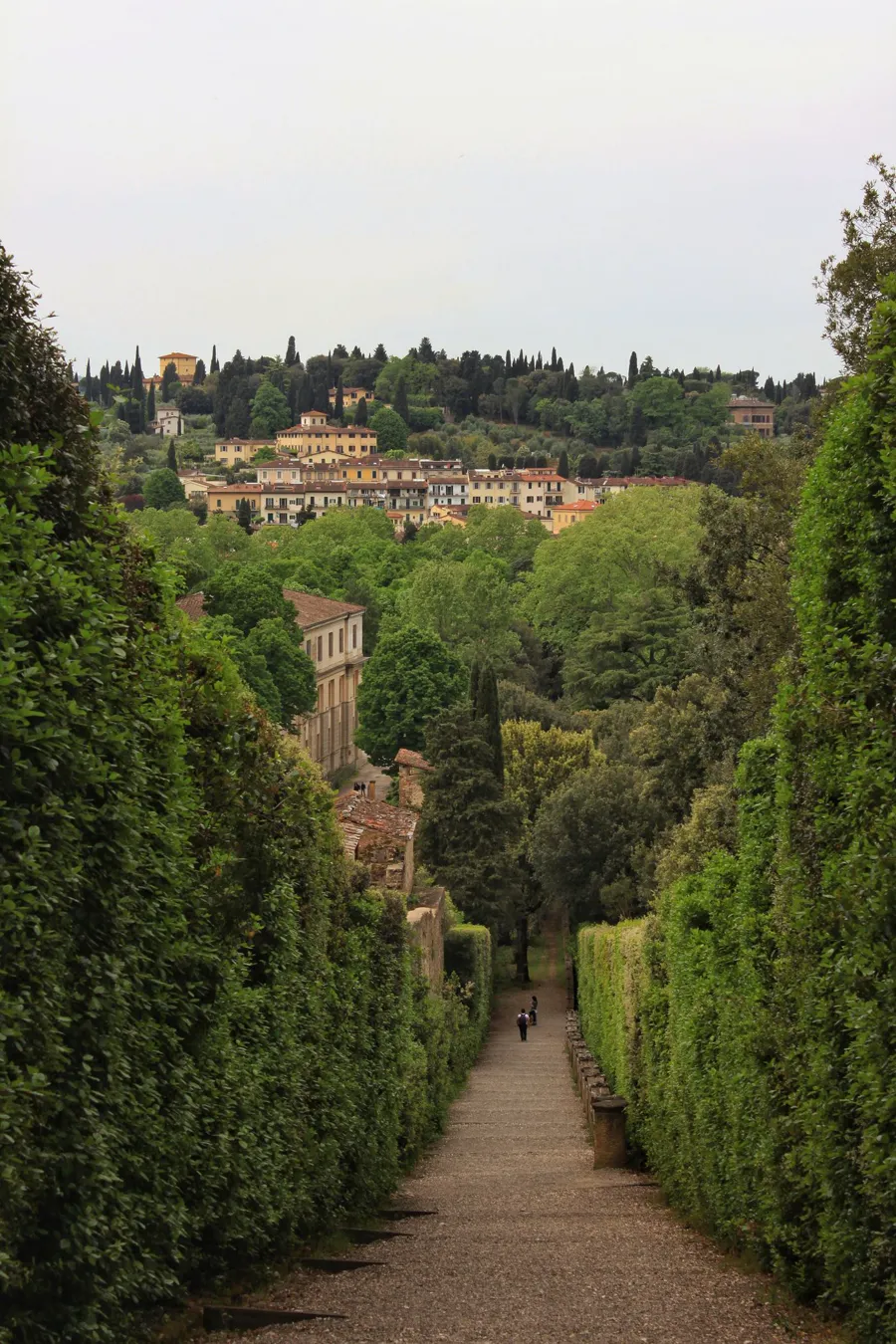
- The Viottolone. A long cypress avenue running downhill on the garden’s second axis. It is the best place to feel what a single sightline does to a slope.
- The Isolotto and the Fountain of the Ocean. An oval island in a pond, ringed by potted citrus in summer, with Giambologna’s Oceanus at the centre.
- The Buontalenti Grotto. Three chambers of Mannerist fantasy, holding copies of Michelangelo’s Prisoners and Giambologna’s bathing Venus.
- The Kaffeehaus. A green-and-white Rococo pavilion of the 1770s, and the finest view over the city from inside the garden.
- The Giardino del Cavaliere. The small walled Knight’s Garden at the top, beside the Porcelain Museum. It is the most intimate corner of the whole site.
- The Limonaia. The lemon house itself, where the potted citrus spend the winter.
- The Camellia Garden. A narrow enclosed strip beside the Meridiana wing. The Uffizi reopened it in 2023 after restoration, and it holds old Camellia japonica cultivars including ‘Candidissima’, ‘Anemoniflora’, ‘Lavinia Maggi’ and ‘Tricolor’.
That last one is worth a detour, because it answers a question travel guides skip. Boboli does have flowers; it simply hides them. The camellia strip started life as a bulb garden in 1688, then switched to camellias in the late 1700s when the light changed. Dahlias and roses appear in the Knight’s Garden at the top.
Best time to visit the Boboli Gardens
April to early June is the strongest window. The citrus have come back outdoors, the hedges have fresh growth, and the heat has not yet arrived. Late September into October works almost as well, with softer light and thinner crowds.
Now the honest warning. Much of the route runs across open lawn, gravel and terrace with little overhead cover, and it climbs throughout. Florence averages a July high of 32.3°C and an August high of 32.4°C, and the record stands at 42.6°C. A midday visit in high summer is genuinely punishing, so go at opening time or in the last two hours of the day.
Northern-hemisphere seasons apply here, which matters if you plan around an Indian calendar. Check your own dates with our frost date finder and planting calendar rather than copying Tuscany’s.
Planning a visit: what to know
Allow two to three hours as a minimum. The garden is steep, the paths are gravel, and the return leg is uphill whichever way you walk it. Wear flat shoes with grip and carry water, because refreshment points inside are limited.
Wheelchair users and anyone with limited mobility should plan a partial route. The terraces near the palace are manageable; the lower reaches towards Porta Romana are not. Opening times, ticket prices and booking rules change every season, so check the official site before you travel. The Uffizi Galleries page for the garden is the source to trust.
Signature plants of Boboli — and how to grow them at home
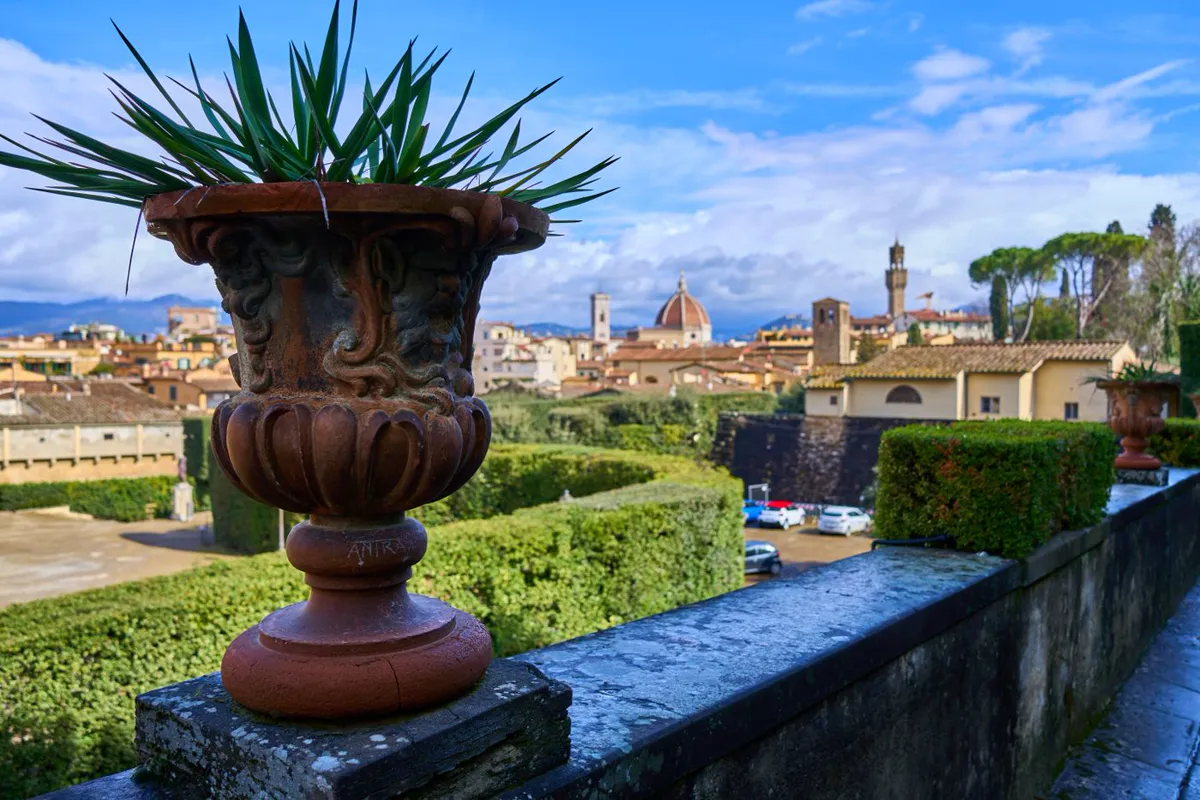
The plant list is short on purpose. Structure comes from a handful of evergreens, repeated until they read as architecture.
- Boxwood — the low clipped edging that draws every line in the garden. One species, cut twice a year, does more design work than a full flower border.
- Lemon and its citrus relatives — always in pots, never in the ground. Named accessions in the collection include Citrus medica ‘Florentina’. This is the garden’s signature and its most copyable idea.
- Olive — the grey-green counterweight to all that dark evergreen, and a Tuscan plant that grows happily in a large container.
- Bay laurel — clipped into balls and cones, useful in the ground or in a pot, and productive in the kitchen too.
- Yew — worth naming honestly. Reference sources list holm oak, cypress, box, bay and olive at Boboli, but not yew. It matters anyway, because yew is the standard substitute wherever box now fails, and it gives the same dark clipped wall.
Two more evergreens do quiet structural work here: holm oak, clipped into the great green walls that line the walks, and Italian cypress along the Viottolone. The Florentine iris, the city’s emblem, belongs to this landscape too, though as a wild-hillside plant rather than a bedding subject.
Every plant on that list wants drainage above all else. If your soil holds water after rain, fix that before you buy anything. Our soil calculator and watering calculator will tell you what you are actually dealing with.
Growing the Boboli look in your climate: US, UK and India
The palette is Mediterranean, so how far you can copy it depends on your winter, not your summer.
- US, zones 8–10: nearly all of it transfers. Olive, bay, box and yew go in the ground, and citrus can stay outdoors in zone 9 and warmer. In zone 8, keep the citrus mobile.
- US zones 5–7 and the UK: this is where the Medici system earns its keep. The RHS notes that some lemons cope down to about 5°C while limes and grapefruit want above 10°C. Overwinter pots in a frost-free greenhouse or a cool porch, not a heated living room, and let the compost dry a little between waterings.
- Box is under real pressure. Box blight, caused by Calonectria fungi, plus the box tree caterpillar that reached Britain in 2007 and spread through England by 2014, have made box a risky default. The RHS suggests either a different hedging plant or one of the less susceptible cultivars, naming ‘Faulkner’, ‘Rococo’ and ‘National’ among others. Clipped yew is the safest like-for-like swap for structure, and Japanese holly works too, though it wants acid soil.
- India: the whole problem inverts. Across most of the country citrus simply stays outdoors all year, so the limonaia becomes unnecessary and the shade question replaces the frost question. Lemons thrive in Indian gardens with grit in the mix and a spot that dodges the fiercest afternoon sun. Our terrace gardening guide for India covers the pot and drainage side, and container gardening basics covers the rest.
5 design lessons from Boboli you can copy
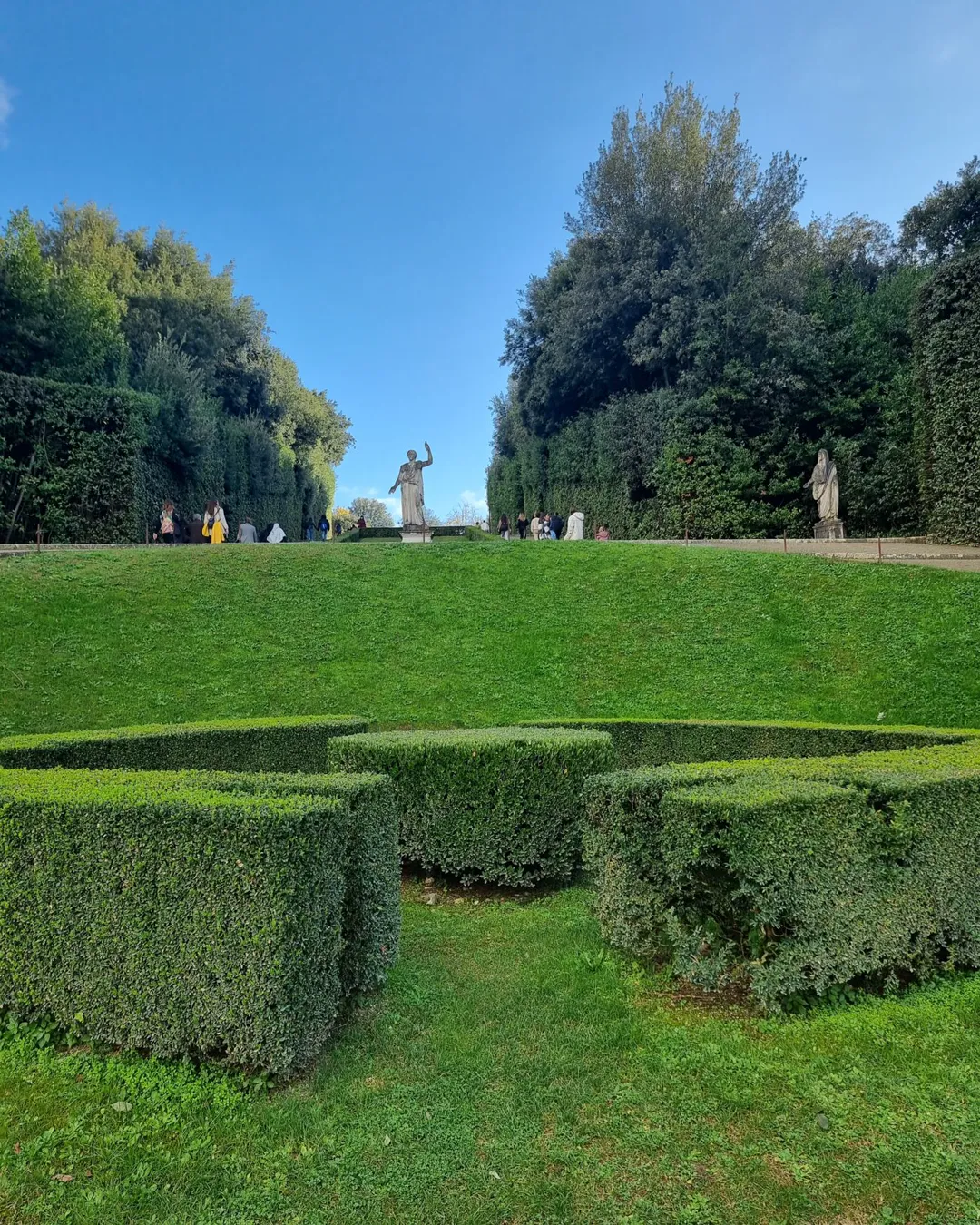
You do not need a hill or a duchy. You need the five ideas underneath the spectacle.
- Terrace the slope instead of fighting it. Boboli cuts the hillside into level rooms, each with its own character. A sloping back garden works the same way: two flat platforms and one retaining step will beat any attempt to grade the whole thing smooth. Sketch it first with our garden planner.
- Give a long narrow plot one strong axis. The Viottolone turns a very long strip into a single confident gesture. In a town garden, one straight walk with something worth reaching at the end reads as generous, while a wiggly path reads as fussy.
- Treat a garden space as a room for events. The amphitheatre exists because the Medici needed somewhere to put an audience. Build the same thing at ordinary scale: a level circle of gravel, a low wall to sit on, and a reason for people to gather there.
- Use sculpture as punctuation, not decoration. Boboli’s statues mark junctions, ends of walks and changes of level. One good object at a decision point does far more than six ornaments spread evenly about. Correct spacing matters more than the objects themselves.
- Make container overwintering a system, not an emergency. Decide in spring where the pots will spend the winter, and buy pots you can actually move. A rehearsed autumn shuffle is calm; a panicked one on the first frost night is how tender plants die.
What the Uffizi and garden historians say about Boboli
The Uffizi Galleries, which manage the site, present Boboli as the Medici layout that later European courts copied. That is an institutional judgement from the body responsible for the garden, and it explains why the place matters beyond Florence.
Academic garden history frames it more carefully. Claudia Lazzaro, Professor Emerita of art history at Cornell, wrote the standard study of the subject, The Italian Renaissance Garden, published by Yale University Press in 1990. Scholarship of that kind treats these gardens as designed art, governed by conventions of planting and ornament rather than by taste alone.
The distinction matters for one popular claim. Boboli is not the oldest Italian Renaissance garden; the garden at Villa Medici in Fiesole, laid out between 1455 and 1461, holds that position. Boboli’s real claim is influence.
Read it that way and the priorities reverse. The statues and grottoes are the ornament. The cut ground, the axes and the movable plants are the actual design.
Recreate the look at home: what you’ll need
Starting anything from seed for the scheme? Time it with our seed-starting calculator.
Frequently asked questions
Why is Boboli Gardens famous?
Because it set the pattern. The Medici turned a quarry hillside into a garden of terraces, axes and statues, and the Uffizi Galleries describe that layout as a model for later European courts. Its potted citrus tradition is equally famous among gardeners.
How long does it take to walk around the Boboli Gardens?
Two to three hours covers the main route at a comfortable pace. Add an hour if you want the Porcelain Museum and the Knight’s Garden at the top as well. The climb, not the distance, sets the pace.
Is Boboli Gardens worth visiting?
For anyone interested in garden design, yes. For anyone expecting flower borders, possibly not. Boboli is about shaped ground and evergreen structure, so it rewards visitors who look at the bones rather than the blooms.
How big is Boboli Gardens?
Published figures range from 11 acres to 111 acres, which is why this question keeps getting asked. Encyclopaedic sources give about 45,000 square metres. Larger numbers usually include the whole enclosed park down to Porta Romana, or repeat a unit error.
Is Boboli the oldest garden in Italy?
No, and that claim gets repeated too easily. Earlier Renaissance gardens exist, including other Medici sites. Boboli’s real distinction is influence rather than age: it became the prototype that others copied.
How do you pronounce Boboli?
Stress falls on the first syllable, so it sounds closer to BOH-boh-lee than boh-BOH-lee. Italians say Giardino di Boboli, with the same front-loaded stress on the name.
Are the Boboli Gardens still worth seeing in winter?
Yes, arguably more than most gardens. The design rests on evergreens and cut ground, so the structure survives the season intact. The citrus will be indoors in the limonaia, and the camellias flower late winter into spring.
Is the Boboli Gardens accessible for wheelchair users?
Partly. The terraces close to Palazzo Pitti are the realistic section, because the surface is firmer and the gradients gentler. The long descent towards Porta Romana is steep and gravelled, so a full circuit is not practical for most wheelchair users.
What is the best month to visit the Boboli Gardens?
May and early October are the two sweet spots. May gives you fresh growth and citrus back outdoors. October gives you low light, cooler air and far fewer people on the avenues.
Can you grow lemon trees in pots the way Boboli does?
Yes, and that is the point of the tradition. Use a container only slightly larger than the root ball, a gritty free-draining mix, and a frost-free but bright winter home. Move the pot out again once night temperatures settle in late spring.
Why are my potted lemon's leaves going yellow in winter?
Usually too much water, too little light, or a room that is simply too warm and dry. Let the surface dry before watering, and move the plant somewhere cooler and brighter. Our plant doctor can help narrow it down from a photo.
What garden style is Boboli?
Italian Renaissance, in its terraced hillside form. Expect cut levels, long axes, clipped evergreens, grottoes, classical statuary and containers, with flowers used sparingly if at all.
Is Boboli a UNESCO World Heritage Site?
Yes, and twice over. Boboli is one of the fourteen components of Medici Villas and Gardens in Tuscany, inscribed in 2013. It also sits inside the Historic Centre of Florence, inscribed in 1982. Many guides mention only the second listing.
Which is better for gardeners, Boboli or Villa d'Este?
They teach different lessons. Boboli teaches landform, axes and moving tender plants around the year. Villa d’Este teaches what water can do on a steep site. Visit Boboli for structure and Tivoli for spectacle.
Can Indian gardeners copy the Boboli look?
Yes, and more easily than you might expect. Citrus, bay and olive all grow across large parts of India, and the box hedging can give way to a locally suited clipped evergreen. Keep the geometry and the pots; swap the species to fit the heat and the monsoon.
Related gardens and guides
Boboli is one of twenty in our guide to the 20 most famous gardens in the world.
Two natural companions sit in this cluster: Villa d’Este at Tivoli, the water garden Boboli helped inspire, and the gardens of Versailles, where the Italian model went French and enormous. For the same ideas at ordinary scale, see our guides to small garden design and drought-tolerant planting.
Still stuck? Ask the Plant Doctor
Describe the problem — yellow leaves, holes, no flowers — and get a clear answer in seconds. FreeAI can make mistakes. Answers are guidance, not a guarantee — check anything important against the guide it links to, and always read the label on any product before you use it.