Fertilizer Calculator: How Much Fertilizer Do I Need?
 By
By The Fertilizer Calculator converts any NPK number into an exact safe dose for your bed or pot — organic or conventional.
More about this tool
Feed plants what they need, never burn them. 💚 Save your plants to My Garden in your free Gardening Guider profile — and get free care reminders & seasonal follow-ups for the plants actually growing in your garden.
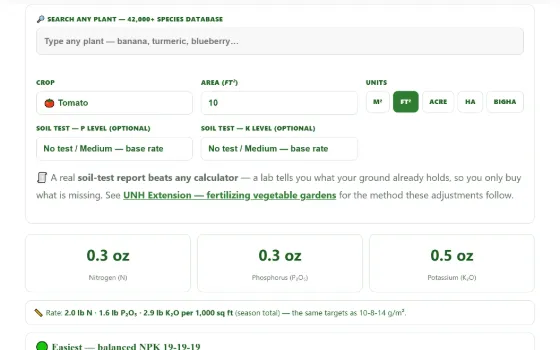
🧾 A real soil-test report beats any calculator — a lab tells you what your ground already holds, so you only buy what is missing. See UNH Extension — fertilizing vegetable gardens for the method these adjustments follow.
🍃 Organic equivalents — same nutrition, the natural way
🌱 Container / pot mode — dose per pot, in spoons
🎒 Use YOUR fertilizer — type the N-P-K printed on your bag
💧 Liquid feed — teaspoons per gallon → ppm nitrogen
Water-soluble feeds are dosed by ppm of nitrogen in the finished solution. Most vegetables and flowers do well at 100–200 ppm N for regular feeding; seedlings nearer 50–100 ppm.
🌱 Lawn mode — pounds of nitrogen per 1,000 sq ft
Lawns are fed on nitrogen alone, at a rate per 1,000 sq ft — not on a crop N-P-K target. Enter your lawn size and the N% from the bag; the bag’s middle and last numbers do not change the answer.
🗓️ Season feeding schedule — when to apply, how much each time
⚠️ General guidance only — these are typical home-garden rates by crop type. For best results do a soil test and split feeding into 2–3 doses through the season. Over-fertilising harms plants and waterways; follow product labels.
📐 How many plants fit → Spacing Calculator · 🧱 plan the bed → Bed Planner · 🗓️ feeding times → Planting Calendar
How much fertilizer does my garden need?
A fertilizer calculator turns one crop and one bed size into an exact dose. This one is a full NPK calculator: it works out how much fertilizer per plant or per bed you need, then converts that into grams of urea, DAP, MOP or balanced 19-19-19 — or into compost, FYM and neem cake if you prefer organic fertilizer for vegetables. Size the bed first with the soil calculator.
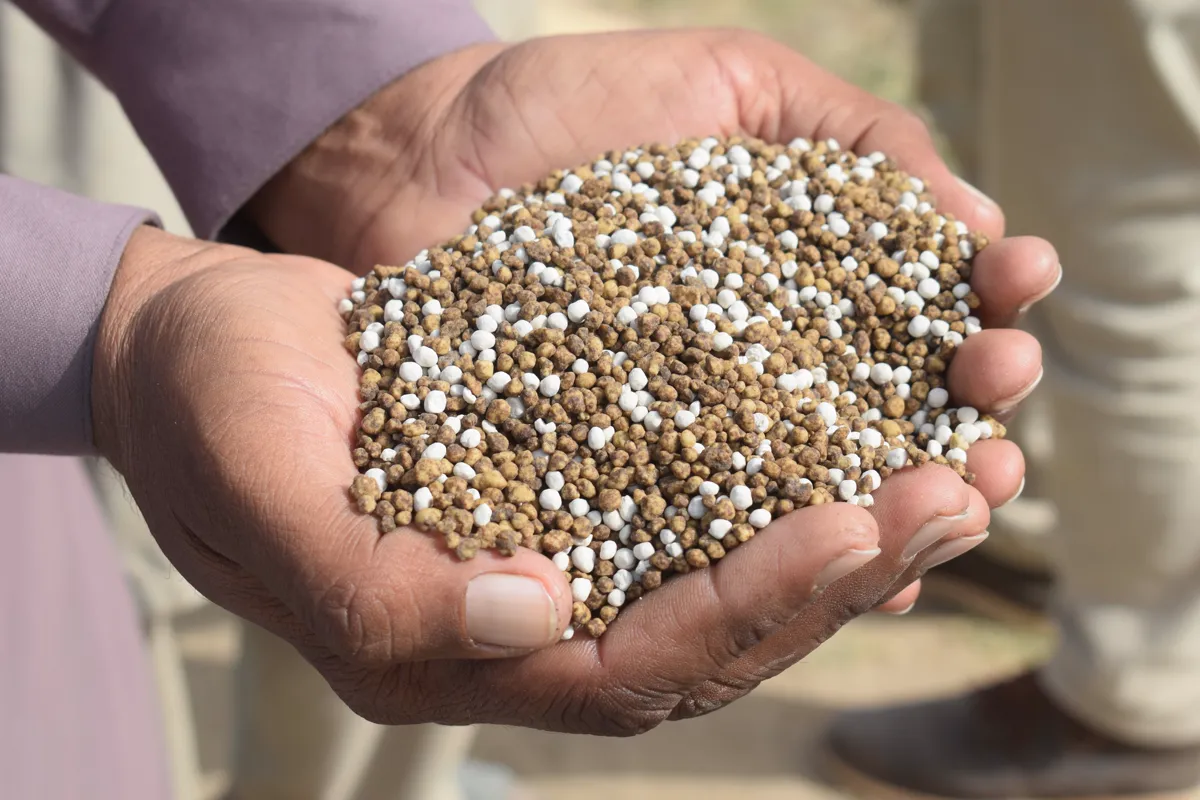
It depends on two things only: what the crop needs (grams of actual nitrogen, phosphorus and potassium per square metre or per 100 sq ft) and how concentrated your fertilizer is (the three N-P-K numbers printed on every bag). The calculator above joins the two: pick a crop and area to see the nutrient targets, then either use one of our suggested products or — the part most calculators skip — type in the N-P-K of the bag already sitting in your shed and get a dose for that exact product, plus an honest note on what it under- or over-supplies.
As a feel for scale: a 10 m² (108 ft²) bed of tomatoes wants roughly 100 g N, 80 g P₂O₅ and 140 g K₂O over the whole season — about half a kilo (~1.2 lb) of a balanced 19-19-19, topped up with a little potash. Leafy greens want more nitrogen and less potassium; root crops the reverse; peas and beans fix their own nitrogen and need very little feeding at all.
The most common mistake is over-feeding, not under-feeding. Excess nitrogen gives lush leaves, few fruits, aphid problems and nutrient run-off into waterways. When unsure, use the lower dose, split it through the season, and let the plants tell you.
How the fertilizer calculator works — the formula, openly
🧮 Show the exact formula we use
Step 1 — crop target: each crop group has a seasonal target in grams of nutrient per m² (e.g. fruiting veg: 10 g N, 8 g P₂O₅, 14 g K₂O). Multiply by your bed area to get total grams of each nutrient.
Step 2 — product dose: the bag’s numbers are percentages by weight. So: fertilizer needed = nutrient target ÷ (N% ÷ 100). A crop needing 100 g N from a 10-26-26 bag means 100 ÷ 0.10 = 1,000 g of product. This is the same method university extension services teach, just done for you.
Step 3 — balance check: that 1,000 g also delivers 260 g P₂O₅ and 260 g K₂O. We compare each against the crop’s target and flag shortfalls (with a gram-accurate top-up suggestion) and over-supply.
Step 4 — how the pros refine it (nutrient-use efficiency): field agronomists go one step further than the label maths: fertilizer = (crop requirement − soil-available nutrient) ÷ use-efficiency × 100 ÷ nutrient%. Not everything you apply reaches the plant — typical field efficiencies are roughly 50% for nitrogen, 20–30% for phosphorus and 50–70% for potassium, and the “soil-available” term is what a soil test measures. Our home-garden rates already build in sensible efficiency assumptions, and the soil-test selectors above handle the subtraction — but this is the formula behind every extension recommendation sheet.
Adjusting for a soil test: where a lab reports P or K as low, raise that nutrient by about 50%; medium is the base rate; high means halve it; very high / excessive means skip the maintenance dose entirely and feed nitrogen only. The calculator’s soil-test selectors apply exactly this. A $10–20 lab report beats any calculator table, including ours — see the UNH Extension fact sheet for the same fertilizer math from a university lab.
Note on P and K conventions: bag labels worldwide state phosphorus as P₂O₅ and potassium as K₂O, not the pure elements (elemental P = P₂O₅ × 0.44; elemental K = K₂O × 0.83). Our targets use the same label convention, so no conversion is ever needed on your side.
Targets: N 100 g · P₂O₅ 80 g · K₂O 140 g. Sized to nitrogen: 100 ÷ 0.10 = 1 kg (2.2 lb) of 10-26-26 over the season.
Balance check: it also supplies 260 g P (target 80 — over, fine occasionally) and 260 g K (target 140 — over). Verdict: this bag alone covers the crop; if anything, halve the phosphate next season or alternate with urea. The schedule card splits that 1 kg into 400 g at planting, 300 g at early flowering, 300 g at fruit set.
NPK needs by crop group (per m² and per 100 sq ft)
| Crop group | Examples | N per m² | P₂O₅ per m² | K₂O per m² | Per 100 sq ft (N-P-K) |
|---|---|---|---|---|---|
| Leafy | Spinach, lettuce, methi, coriander | 12 g | 6 g | 8 g | 4.0–2.0–2.6 oz |
| Fruiting | Tomato, pepper, brinjal, cucurbits, corn, brassica heads | 10 g | 8 g | 14 g | 3.3–2.6–4.6 oz |
| Root | Carrot, radish, beet, onion, garlic, potato | 6 g | 6 g | 14 g | 2.0–2.0–4.6 oz |
| Legume | Peas, beans | 4 g | 8 g | 10 g | 1.3–2.6–3.3 oz |
| Cereal | Rice, wheat | 12 g | 6 g | 6 g | 4.0–2.0–2.0 oz |
| Flowers / general | Mixed ornamental beds | 8 g | 8 g | 8 g | 2.6–2.6–2.6 oz |
These are typical home-garden season totals, not agronomic prescriptions — a soil test is the only way to know what your ground already holds. Rich, compost-fed beds often need only half these rates; brand-new sandy beds may need the full amount plus a mid-season top-up.
Pounds per 1,000 sq ft — the US label rate, converted
American fertilizer bags, extension fact sheets and lawn programmes all speak one unit: pounds of nitrogen per 1,000 square feet. Our per-square-metre figures are the same numbers in a different coat, because 1,000 sq ft = 92.9 m². The season totals above convert like this:
| Crop group | N per 1,000 sq ft (season) | P₂O₅ | K₂O |
|---|---|---|---|
| Leafy greens | 2.5 lb | 1.2 lb | 1.6 lb |
| Fruiting vegetables | 2.0 lb | 1.6 lb | 2.9 lb |
| Root crops | 1.2 lb | 1.2 lb | 2.9 lb |
| Legumes | 0.8 lb | 1.6 lb | 2.0 lb |
| Flowers / mixed beds | 1.6 lb | 1.6 lb | 1.6 lb |
| Lawn (per application) | 1.0 lb, 2–4 lb per season | only if a soil test asks | 0.5–1 lb |
Turning that into product: pounds of bag = (lb of N wanted ÷ N% on the bag) × (area ÷ 1,000). A 32-0-4 lawn feed at the standard 1 lb N rate is 1 ÷ 0.32 = 3.1 lb of product per 1,000 sq ft; a 10-10-10 garden fertilizer at the same rate is 1 ÷ 0.10 = 10 lb. The three bag numbers are percentages, so the maths never changes — only the divisor does.
A soil test beats every table on this page. University extension labs (roughly $10–20) report P and K as low / medium / high and tell you to cut or skip those nutrients where they are already high — which is common in beds that have had compost for years. Surplus phosphorus is not just wasted money: it washes into waterways and can lock up iron and zinc for the plant. Where a test says “high”, feed nitrogen only.
Spoon and cup equivalents — no kitchen scale needed
Granular fertilizers have fairly consistent densities, so spoons and cups work fine for garden-scale doses. Always use a level spoon, not heaped:
| Fertilizer | 1 tsp (5 ml) | 1 tbsp (15 ml) | 1 cup (240 ml) |
|---|---|---|---|
| Urea (46-0-0) | ~4 g | ~11 g | ~180 g (0.4 lb) |
| DAP (18-46-0) | ~5 g | ~14 g | ~230 g (0.5 lb) |
| MOP / potash (0-0-60) | ~6 g | ~17 g | ~260 g (0.57 lb) |
| Balanced granular (19-19-19, 10-10-10) | ~5 g | ~15 g | ~240 g (0.53 lb) |
| Bone meal | ~4 g | ~12 g | ~190 g (0.42 lb) |
The old extension-service rule of thumb — “1 cup of granular fertilizer ≈ ½ lb (~225 g)” — is accurate enough for any of the balanced products. For soluble feeds (20-20-20 types), the usual mixing rate is 1–2 g per litre of water, about ¼–½ tsp per litre or 1–2 tsp per gallon.
Feeding plants in pots and containers
Container plants play by different rules than beds: every watering flushes some nutrition out of the drainage holes, and the roots cannot forage beyond the pot. That is why the calculator’s 🪴 container mode doses by pot volume, not area — roughly 1–1.5 g of balanced granular fertilizer per litre of mix per season for an average feeder, scaled up for hungry crops like tomatoes and down for legumes, and always split into small monthly feeds rather than one big dose.
A practical anchor: a 10 L (2.5 gal) pot of tomato wants about a level teaspoon of 19-19-19 a month through the season; a 5 gal grow bag roughly double that. If you prefer liquid feeding, 1–2 g of soluble 20-20-20 per litre of water applied monthly does the same job and is even harder to overdose. Whatever the product, water the pot first — feeding bone-dry mix concentrates salts at the roots.
Organic equivalents — compost, FYM, bone meal, neem cake
Every synthetic dose above has an organic route. Organic sources are dilute and slow — that is a feature, not a flaw: they feed soil life, release over months and are nearly impossible to burn plants with. Typical nutrient contents:
- Garden compost / vermicompost: ~1-1-1. 2–3 kg per m² (4–6 lb per 10 sq ft) yearly covers most of a light feeder’s needs and improves the soil for free.
- FYM (well-rotted farmyard/cow manure): ~0.5-0.3-0.5. Use 3–5 kg per m², always fully rotted — India’s most economical base feed.
- Neem cake: ~4-1-1 plus a mild soil-pest deterrent effect; 100–200 g per m² worked in at planting is a classic Indian kitchen-garden dose.
- Bone meal: ~3-15-0; the standard organic phosphorus source, 50–100 g per m² at planting for fruiting and root crops.
- Wood ash: ~0-1-5; a light dusting supplies potassium but raises pH — skip it on alkaline soils and around acid-lovers.
A workable all-organic season for a fruiting bed: compost or FYM as the base dress, bone meal at planting, then a monthly liquid feed (diluted compost tea or 1:10 buttermilk/jeevamrut-style ferments popular in Indian organic practice) once flowering starts.
Over-fertilizing: the mistake that costs twice
Every extension service agrees on one thing: home gardeners over-feed far more often than they under-feed, and over-feeding costs twice — once at the shop, and again in the damage. Fertilizer burn shows up as brown, crisp leaf edges and tips, a white salt crust on the soil surface, and wilting that watering does not fix; in containers it can kill a plant within days. Excess nitrogen also gives lush, soft growth that aphids love, delays flowering and fruiting, and washes into waterways with the next rain.
If you have overdone it: stop feeding immediately, flush the bed or pot through with plenty of plain water to push the salts below the root zone, trim off badly burned leaves, and skip the next scheduled dose. To never overdo it: weigh or spoon-measure the dose instead of pouring by eye, split the season total into 2–3 feeds, water after every application, and when in doubt use half — half rate applied twice always beats a double dose applied once. Lawns follow the same logic: cool-season grasses (fescue, ryegrass, bluegrass) take most of their nitrogen in autumn, warm-season grasses (Bermuda, zoysia) in late spring and summer — feeding a dormant lawn is pure waste plus runoff.
When to feed: why split doses beat one big dose
Plants cannot bank nutrients; soil can only hold so much before rain leaches the rest. Splitting the season’s total into a base dressing plus one or two side-dressings — exactly what the schedule card above prints for your crop and product — keeps nutrition matched to demand: nitrogen early for frame-building, potassium later for flowering and fruit fill. Side-dress in a shallow band 10–15 cm (4–6 in) from the stems, scratch it in, and water immediately. In monsoon regions, avoid applying just before heavy rain — a season’s feed can leach away in one cloudburst; feed after the rain event instead, and lean on slow organic sources through the wet months.
Sources: UNH Extension — fertilizing vegetable gardens (fertilizer math) ·Rutgers NJAES — fertilizer rate tables · Wikipedia — fertilizer labeling (N-P-K convention)
Using the fertilizer calculator in 30 seconds
- Pick the crop group. Leafy, fruiting, root and legume crops want very different ratios.
- Enter the bed size. The fertilizer calculator scales the dose to your exact area.
- Type your bag N-P-K. You get grams of that product, not a generic answer.
Feed only what the bed needs. Size the bed first with the soil calculator, time the feeds against the planting calendar, and if leaves look wrong check the plant doctor before adding more. Rotation cuts fertilizer needs too — see the crop rotation planner.
Two habits make the fertilizer calculator worth using twice a season. Weigh the first dose instead of guessing it. Then re-run the fertilizer calculator at flowering, when fruiting crops switch from wanting nitrogen to wanting potassium.
Keep the bag. A photo of the N-P-K panel is all the fertilizer calculator needs next time, and it saves buying a product you already own. Pair it with the yield calculator to see whether extra feed is actually paying for itself.
🌍 Works worldwide — metric & imperial
🔄 Updated: 16 Aug 2026 💯 Free to read — no sign-up needed
NPK meaning — and how to calculate fertilizer dose
The three numbers on every fertilizer bag (like 10-10-10 or 19-19-19) are the percentages of Nitrogen, Phosphorus (P₂O₅) and Potassium (K₂O). So 100 g of 19-19-19 delivers 19 g of each nutrient. The dose formula: product needed = nutrient target ÷ (NPK% ÷ 100) — this calculator does it for urea (46-0-0), DAP (18-46-0), MOP (0-0-60), balanced NPK and organic compost, sized to your bed.
Nutrient targets by crop type (g per m² per season)
| Crop type | N | P₂O₅ | K₂O |
|---|---|---|---|
| Leafy greens | 12 | 6 | 8 |
| Fruiting (tomato, chilli) | 10 | 8 | 14 |
| Root & bulb | 6 | 6 | 14 |
| Legumes | 4 | 8 | 10 |
Golden rules: split the season’s dose into 2–3 feedings, water before fertilizing, and remember more nitrogen ≠ more fruit — excess N grows leaves at the cost of flowers and invites pests.
❓ Frequently asked questions
How much fertilizer does my vegetable bed need?
What do the three NPK numbers mean?
How do I convert NPK needs into urea, DAP and MOP?
Can I do it fully organic?
When should I fertilize — and how often?
Can too much fertilizer harm plants?
What is the difference between organic and synthetic fertiliser?
Why are my plants all leaf and no fruit?
Do I need to fertilise if I already add compost every year?
When should I stop fertilising?
Is fertiliser the answer when leaves turn yellow?
🧰 Explore all our free garden tools
Tools hub →Was this tool helpful?