Frost Dates 2026: First & Last Frost by ZIP or City
 By
By Find your first & last frost dates and your climate zone — the two numbers every sowing and planting decision depends on.
More about this tool
Location-based, worldwide, free. 💚 Save your plants to My Garden in your free Gardening Guider profile — and get free care reminders & seasonal follow-ups for the plants actually growing in your garden.
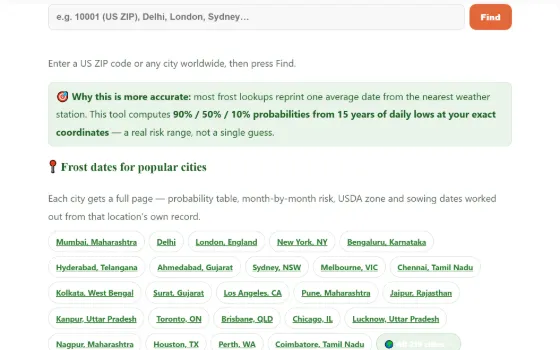
Enter a US ZIP code or any city worldwide, then press Find.
🎯 Why this is more accurate: most frost lookups reprint one average date from the nearest weather station. This tool computes 90% / 50% / 10% probabilities from 15 years of daily lows at your exact coordinates — a real risk range, not a single guess.
🎯 Frost probability table — 90% / 50% / 10%
Computed from the same 15 years of daily lows, at three freeze severities: light 0 °C / 32 °F · moderate −2 °C / 28 °F · hard −4 °C / 24 °F. “—” = most years never reach that severity.
📊 Monthly frost risk
Bar = % of the last 15 years with at least one frost night (≤ 0 °C / 32 °F) in that month.
📊 Based on your location’s own historical daily temperatures.
📍 Frost dates for popular cities
Each city gets a full page — probability table, month-by-month risk, USDA zone and sowing dates worked out from that location’s own record.
🗓️ Full sowing plan → Planting Calendar · 🌱 when to start seeds → Seed-starting Calculator · 🔍 what grows here → Plant Finder
What do frost dates actually mean?
Frost dates are the two dates that bracket your growing season: the last frost date in spring and the first frost date in autumn. Enter a US ZIP code or any city worldwide — this frost dates by zip code and city tool is also a growing zone finder, and it reads 15 years of your own local temperature records rather than a national average. Turn the answer into sowing dates with the planting calendar.
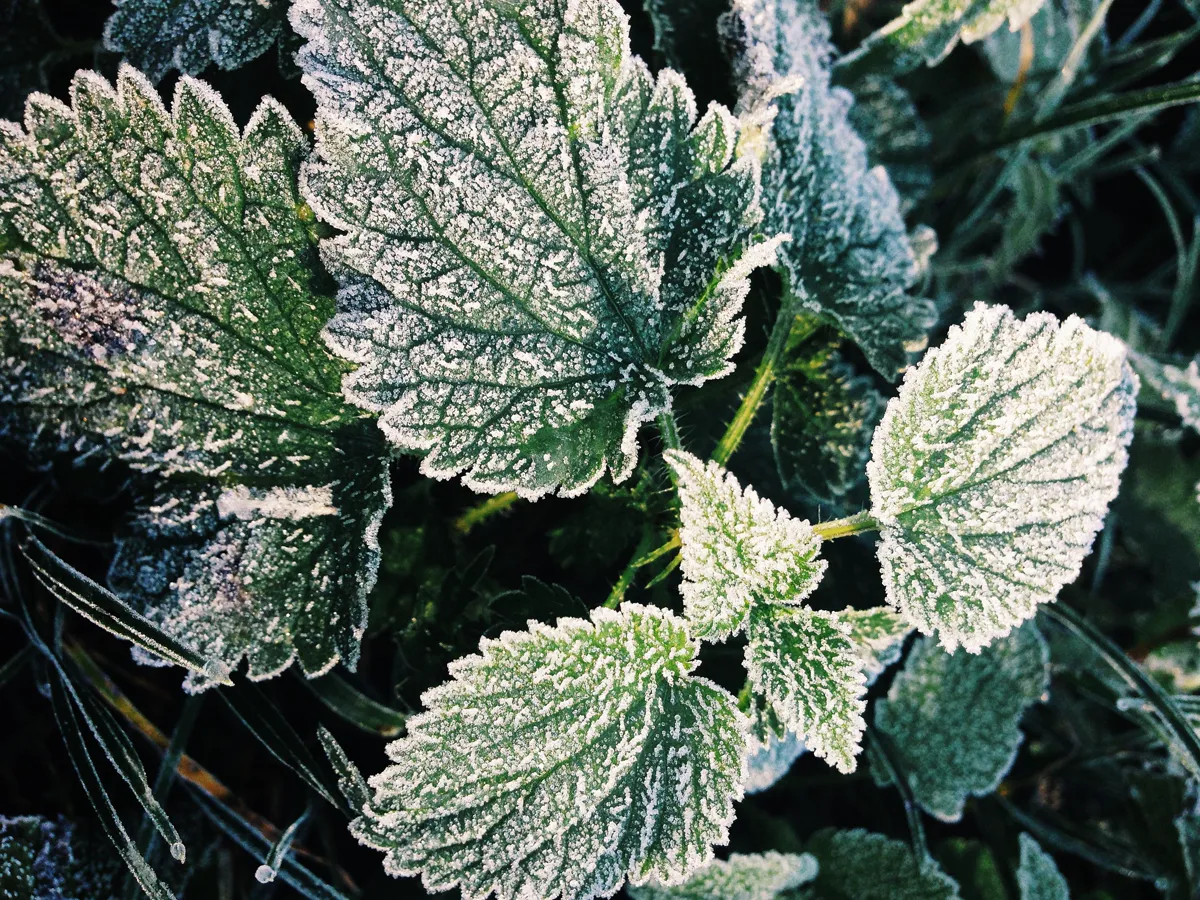
Your last spring frost date is the day after which a freezing night becomes unlikely, and your first fall (autumn) frost date is the day a freezing night becomes likely again. The stretch between the two is your growing season — the number of days you have to grow frost-tender crops like tomatoes, peppers, beans and cucurbits outdoors. Frost is conventionally defined as an air temperature at or below 0 °C / 32 °F, though tender tropical plants can be damaged a few degrees above that.
The crucial word is likely. Frost dates are probabilities, not promises — which is exactly why this tool shows you a full probability table rather than a single date. A “50% date” means half of recent years still had frost after that day; the “safe” date is the one only one year in ten crosses. Serious growers plant hardy crops against the 50% date and tender crops against the safe date, and keep fleece handy either way.
Meteorologists also grade freezes by severity, because plants respond very differently to each:
- Light freeze, 0 °C / 32 °F: kills tender plants (basil, tomato, squash); hardy vegetables are untouched.
- Moderate freeze, −2 °C / 28 °F: widely destructive to most unprotected vegetation; semi-hardy crops are damaged.
- Hard freeze, −4 °C / 24 °F: heavy damage to almost everything still growing; ends the season for all but the toughest crops (kale, leeks, parsnips).
Why a 15-year percentile method beats station normals
Almost every frost-date lookup on the internet works the same way: it matches your ZIP or postcode to the nearest official weather station and reads that station’s published 30-year climate normals. That approach has two quiet problems. First, the nearest station can be 30–50 km away, at a different elevation, nearer the coast, or inside a city heat island — any of which can shift frost dates by two weeks or more. Second, published normals are frozen snapshots of a past period, while recent decades have warmed measurably.
This tool instead pulls roughly 15 years of daily minimum temperatures for your exact coordinates (reanalysis data interpolated to your latitude/longitude, not a distant station) and computes the statistics live:
📐 How the numbers are computed
For each of the ~15 years we find the last day in the first half of the year (second half in the Southern Hemisphere) with a minimum at or below the threshold — that year’s last spring frost — and the first such day in the second half — that year’s first fall frost.
Sorting those 15 values gives a distribution, and percentiles of the distribution give the probability table: the median (50th percentile) is the typical date, the 90th percentile of last-frost dates is the “safe to plant” date (only ~10% of years frost later), and the 10th percentile of first-frost dates is the early-warning date. The same daily data is re-scanned at −2 °C and −4 °C to fill the moderate- and hard-freeze columns, and per month we count the share of years with at least one frost night — that’s the monthly risk chart. Locations where fewer than ~15% of years frost at all are reported as frost-free.
Because everything is computed from your own coordinates, the tool works identically for a Kansas farm, a Scottish glen, a Himalayan hill station or a frost-free Mumbai balcony — no ZIP-code lock, no country limit.
Typical frost dates in 32 cities around the world
The table below gives typical (median) frost dates for well-known cities, as a quick orientation. Type any of them — or your own town — into the finder above for the full probability table computed live.
| City | Country | Typical last spring frost | Typical first fall frost |
|---|---|---|---|
| Minneapolis | USA | late April | early October |
| Chicago | USA | mid April | early November |
| Denver | USA | early May | early October |
| New York | USA | early–mid April | early November |
| Seattle | USA | mid March | mid November |
| Atlanta | USA | mid–late March | mid November |
| Dallas | USA | mid March | mid–late November |
| Phoenix | USA | rare / early February | rare / December |
| Toronto | Canada | early May | mid October |
| Calgary | Canada | late May | mid September |
| Vancouver | Canada | late March | early November |
| London | UK | early April | mid–late November |
| Manchester | UK | late April | late October |
| Edinburgh | UK | early May | mid October |
| Dublin | Ireland | mid April | early November |
| Paris | France | mid April | late October |
| Berlin | Germany | late April | mid October |
| Warsaw | Poland | early May | early October |
| Stockholm | Sweden | mid May | late September |
| Moscow | Russia | mid May | late September |
| Madrid | Spain | late March | mid November |
| Rome | Italy | early March | early December |
| Istanbul | Turkey | mid March | early December |
| Tokyo | Japan | mid March | early December |
| Beijing | China | early April | late October |
| Delhi | India | rare / mid January | rare / late December |
| Shimla | India | mid March | late November |
| Srinagar | India | early April | early November |
| Sydney | Australia | rare / August | rare / June |
| Melbourne | Australia | early September | late May |
| Christchurch | New Zealand | late September | early May |
| Cape Town | South Africa | frost-free (coastal) | frost-free (coastal) |
Southern-hemisphere rows read in their own seasons: “last frost early September” in Melbourne is their spring. Tropical lowland cities — Mumbai, Singapore, Nairobi, Lagos, most of coastal Brazil — are frost-free and plan by rainfall and heat instead.
What should I plant before the last frost?
Hardy crops that go in 4–6 weeks before the last frost: peas, spinach, radish, kale, onion sets, broad beans, coriander, methi. 2–3 weeks before: carrots, beets, lettuce, chard, potatoes (earthed up against late frost), cabbage transplants. Only after the last frost: tomatoes, peppers, brinjal, beans, cucumbers, squash, okra, basil, melons — one killing night undoes everything, so hold them back until your safe date, or plant at the 50% date with fleece ready.
How do I protect plants from a frost?
When a frost night is forecast after you have planted, most damage is avoidable with a few hours of preparation:
- Cover before dusk. Horticultural fleece, old bedsheets, cardboard boxes or upturned buckets trap the day’s soil heat. Covers should reach the ground; remove them mid-morning.
- Water the soil in the afternoon. Moist soil stores and releases more heat overnight than dry soil — a counter-intuitive but well-documented effect.
- Move containers. Pots freeze from all sides; shift them against a house wall or indoors for the night.
- Know your cold spots. Cold air drains downhill and pools in hollows and behind solid fences — frost pockets can run several degrees colder than a slope 20 m away.
- After a surprise frost, don’t prune blackened growth immediately; wait until new growth shows what actually died, and water lightly once thawed. Many plants that look destroyed at dawn recover if thawed slowly in shade.
For timing everything against these dates, the Planting Calendar converts your frost date into per-crop sowing windows, and the Seed-starting Calculator counts back the indoor-sowing weeks for you.
Sources: Wikipedia — Frost · Wikipedia — Growing season · US National Weather Service — Frost/Freeze safety · University of Minnesota Extension — Protecting plants from frost
Can I look up frost dates by ZIP code?
Yes. Type any 5-digit US ZIP code — for example 90210 or 10001 — straight into the search box above and the finder resolves it to that ZIP’s own coordinates, then computes the full probability table from 15 years of daily temperatures at that exact spot. Everywhere else in the world, just type your city or town name: the same engine works for London, Delhi, Sydney, Nairobi or a Himalayan hill station. Either way you get identical output — last spring frost, first fall frost, the 90% / 50% / 10% table, monthly risk and growing-season length. Turn the result into per-crop sowing dates with the planting calendar.
Using the frost dates finder in 30 seconds
- Type a ZIP code or city. Frost dates are then read from 15 years of local records.
- Read both dates. Last spring frost and first autumn frost bracket your season.
- Use the probability table. The 10% column is the safe date for tender crops.
Turn those dates into sowing plans with the planting calendar and the seed starting calculator. Choose plants that suit the season length using the plant finder, and protect tender crops early rather than late.
🌍 Works worldwide — metric & imperial
🔄 Updated: 16 Aug 2026 💯 Free to read — no sign-up needed
Why frost dates decide your whole growing season
Two dates rule every sowing decision: the last spring frost (safe to plant tender crops after it) and the first autumn frost (harvest or protect before it). The days between them are your growing season — a crop fits only if its days-to-maturity fit inside. This finder estimates both dates for any city in the world from latitude and climate band, then checks any of 42,000+ plants against your window.
Growing season length by climate band
| Climate | Typical frost-free days | What thrives |
|---|---|---|
| Tropical (<23.5° lat) | 365 — frost-free | Year-round growing, plan by monsoon |
| Subtropical | ~270–300 | Two full vegetable seasons |
| Temperate | ~180–240 | Classic spring-to-autumn garden |
| Cold / boreal | ~90–150 | Fast varieties, season extenders |
Tip: "hardened-off" hardy crops (cabbage, peas, spinach) go out 2–5 weeks before the last frost; tender crops (tomato, chilli, cucumber) only after. Our Seed-starting Calculator turns your frost date into exact sowing dates.
❓ Frequently asked questions
When is my last frost date?
Does this work outside the United States?
What are frost-free days and why do they matter?
How accurate are the frost date estimates?
What if my crop needs more frost-free days than I have?
What growing zone am I in?
Is a frost date the same as a hardiness zone?
What temperature counts as a frost, and what is a hard freeze?
How do I protect plants from an unexpected late frost?
Where is frost most likely in my own garden?
What do I use instead if my area never gets frost?
🧰 Explore all our free garden tools
Tools hub →Was this tool helpful?