Planting Calendar: When to Plant What, by ZIP or City
 By
By The Planting Calendar tells you exactly when to sow, transplant and harvest every crop — matched to your country and climate, month by month.
More about this tool
Stop guessing sowing dates: pick your place, pick your crop, and get the right window in seconds. 💚 Save your plants to My Garden in your free Gardening Guider profile — and get free care reminders & seasonal follow-ups for the plants actually growing in your garden.
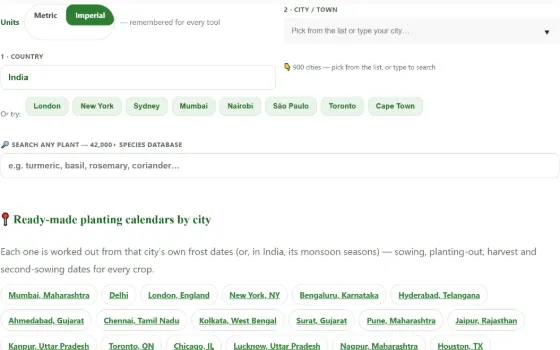
📍 Ready-made planting calendars by city
Each one is worked out from that city’s own frost dates (or, in India, its monsoon seasons) — sowing, planting-out, harvest and second-sowing dates for every crop.
👆 Enter a US ZIP code or search your city above (or tap an example) to see your personal planting calendar. Dates are typical guidance — adjust a week or two for your exact micro-climate and the season's weather.
How does this planting calendar work?
A planting calendar tells you when to plant vegetables where you actually live, not where the seed packet was printed. Enter a US ZIP code or any city on earth and this planting calendar by zip code or city builds your sowing calendar from real local frost dates — including a monsoon planting calendar with Kharif, Rabi and Zaid seasons for India. Start seeds on time with the seed starting calculator.
Most planting calendars are locked to one country: US tools want a ZIP code, UK tools want a postcode, and India has almost no interactive tools at all. This calendar takes a different approach — it works for any city in the world by combining three pieces of information about your location: your hemisphere, your climate band, and, where frost matters, your area’s real last-frost date computed from 15 years of daily temperature records.
Here is what happens when you pick a city:
- Hemisphere flip. Seasons south of the equator are the mirror of the north — October in Sydney is roughly like April in London. If your city is in the Southern Hemisphere, every sowing window is shifted by six months automatically, so the calendar reads correctly for Australia, New Zealand, South Africa, Argentina, Chile and southern Brazil.
- Climate band. Latitude (and monsoon geography) places your city in one of four bands — tropical, subtropical, temperate, or cold/short-season. A cold-band city gets a later, shorter window; a subtropical city gets an earlier, longer one; a tropical city drops the frost logic entirely and plans around heat and rainfall instead.
- Real frost calibration. For frost-prone northern cities the calendar does something no static chart can: it reads roughly 15 years of daily minimum temperatures for your exact coordinates and finds your area’s typical last spring frost. The whole grid then slides to match — so Minneapolis and Atlanta no longer share the same dates, and where a frost date is available you see exact date ranges (for example “Sow indoors Feb 17 – Mar 3”) instead of vague month bands.
📐 The date arithmetic, in plain terms
Every crop’s sowing window is stored as an offset from the last spring frost. Tomatoes, for instance, are started indoors about 6–8 weeks before the last frost and transplanted 1–2 weeks after it. Once the tool knows your real last-frost date (call it LF), each activity becomes simple arithmetic:
sow-indoors start = LF − 8 weeks · transplant start = LF + 1 week · direct-sow start = LF (for tender crops)
Hardy crops (peas, spinach, radish) tolerate frost, so their windows open 4–6 weeks before LF. In frost-free tropics the offsets are replaced by monsoon-season logic (see below). If the temperature history is temporarily unavailable, the tool falls back to month bands based on your climate band — clearly less precise, but always safe.
What are Kharif, Rabi and Zaid seasons?
Gardeners in India, Pakistan, Bangladesh, Sri Lanka, Nepal and much of Southeast Asia do not plan around frost — they plan around the monsoon. This calendar detects monsoon-climate locations automatically and switches to the three-season system used across the subcontinent:
- Kharif (monsoon season, roughly June–October). Crops sown with the arrival of the southwest monsoon rains and harvested as they retreat — okra, gourds, brinjal, cucumber, maize. The tool knows the normal monsoon-onset date for major Indian cities (Kerala around 1 June, Delhi around 27 June), so Kharif timing shifts correctly as you move north.
- Rabi (winter season, roughly October–March). Cool-season crops sown after the rains end and grown through the mild winter — peas, carrots, cauliflower, spinach, methi, coriander, potato, onion. For most of the Gangetic plain this is the most productive garden season of the year.
- Zaid (summer season, roughly March–June). A short, hot, irrigation-dependent window between Rabi harvest and the next monsoon — watermelon, muskmelon, cucumber and quick gourds.
North and South India are handled separately: the south (Kerala, Tamil Nadu, Karnataka) has milder winters and two rain seasons, so many crops get two or even three sowing windows a year, while the northern plains follow the classic single Kharif–Rabi cycle with occasional winter frost in Punjab and the hills.
Worked example: reading the calendar for a real city
Example — Denver, Colorado, USA. Denver sits at about 39.7°N at high elevation, so it lands in the temperate band, Northern Hemisphere. The tool reads ~15 years of daily minimums for Denver’s coordinates and finds a typical last spring frost in early May — two to three weeks later than a generic “zone chart” would suggest for that latitude. The whole grid slides later to match: tomatoes shift to “sow indoors early–mid March, transplant mid–late May”, and frost-hardy peas open in late March. The “What can I plant NOW” block then compares today’s date against every window and lists only the crops whose sowing window is open this week.
Same tool, Mumbai, India: no frost logic at all. Mumbai is detected as a monsoon climate; the calendar shows Kharif sowings keyed to the ~10 June monsoon onset, Rabi sowings from October, and warns that heavy June–September rain calls for raised beds and sharp drainage.
Crop reference: days to maturity and frost tolerance
Two numbers decide whether a crop fits your season: days to maturity (sowing or transplanting to first harvest) and frost tolerance. Hardy crops shrug off light frost, half-hardy crops take a touch of cold but not a freeze, and tender crops are killed by any frost at all.
| Crop | Days to maturity | Frost tolerance | Best sowing anchor |
|---|---|---|---|
| Radish | 25–40 | Hardy | 4–6 weeks before last frost |
| Spinach | 40–50 | Hardy | 4–6 weeks before last frost |
| Lettuce | 45–55 | Hardy | 2–4 weeks before last frost |
| Peas | 60–70 | Hardy | 4–6 weeks before last frost |
| Carrot | 70–80 | Hardy | 2–4 weeks before last frost |
| Coriander | 40–50 | Hardy | 2–3 weeks before last frost |
| Fenugreek (methi) | 25–40 | Hardy | around last frost |
| Cabbage | 60–90 | Hardy | indoors 6–8 weeks before last frost |
| Cauliflower | 60–85 | Half-hardy | indoors 6–8 weeks before last frost |
| Potato | 90–120 | Half-hardy | 2–3 weeks before last frost |
| Onion | 100–120 | Hardy | indoors 8–10 weeks before last frost |
| Garlic | 180–240 | Hardy | autumn, 4–6 weeks before ground freezes |
| Beans (French) | 55–65 | Tender | after last frost, soil ≥ 16 °C / 60 °F |
| Cucumber | 55–65 | Tender | 1–2 weeks after last frost |
| Okra (bhindi) | 50–65 | Tender | 2–3 weeks after last frost, warm soil |
| Tomato | 60–85 | Tender | indoors 6–8 weeks before, out 1–2 weeks after last frost |
| Pepper / chilli | 60–90 | Tender | indoors 8–10 weeks before, out 2 weeks after last frost |
| Brinjal / eggplant | 70–85 | Tender | indoors 8–10 weeks before, out 2 weeks after last frost |
| Bottle gourd (lauki) | 60–80 | Tender | after last frost / with monsoon onset |
| Watermelon | 80–100 | Tender | 2–3 weeks after last frost, warm soil |
Match the days-to-maturity figure against your growing-season length (the frost tool below computes it for your city). If a crop needs 100 frost-free days and your season gives 120, it fits — but start it promptly.
When should I start seeds indoors instead of direct sowing?
Start seeds indoors when a crop needs more warm days than your season offers outdoors, or when it hates cold soil: tomatoes, peppers, brinjal and onions almost always benefit. Direct-sow crops that resent transplanting — carrots, radish, beets, coriander, beans and most cucurbits (though cucurbits can be started in pots for 2–3 weeks in short-season areas). As a rule of thumb, transplants buy you 4–8 weeks of extra season; in cold-band cities that difference is what makes tomatoes possible at all. Pair this calendar with our Seed-starting Calculator for week-by-week indoor timing and with the frost-date finder to see the exact date everything is anchored to.
Sources: Wikipedia — Sowing · Wikipedia — Monsoon of South Asia · USDA Plant Hardiness Zone Map · Wikipedia — Growing season
The fall second sowing: one calendar, two harvests
Where a real frost climate exists, the calendar now shows both ends of the season. Pick your city and, alongside the spring windows, a fall & second-sowing table appears — built from your location’s median first autumn frost (the same 15-year temperature record that powers the spring dates). Each crop’s window counts back from that date: days-to-maturity plus a 14-day buffer, because shortening autumn days slow growth.
The table also surfaces each crop’s frost tolerance — hardy crops such as spinach, radish, peas, carrots and lettuce keep producing through light freezes and often taste sweeter for it, half-hardy crops need harvesting soon after the first frost, and tender crops are flagged as spring-only. Long-season crops like garlic get their own note: planted around the first frost, they overwinter and are harvested the following summer. Method as described by university extension services (University of Minnesota Extension — planting vegetables in midsummer for fall harvest).
How does your USDA hardiness zone relate to this calendar?
Your USDA hardiness zone and your planting calendar answer two different questions. The zone is built from the average annual extreme minimum temperature — the typical coldest night of the year — and tells you which perennials, shrubs and trees survive your winter. The calendar is built from your frost dates — the last freezing night of spring and the first of autumn — and tells you when to sow annual vegetables and herbs. Two cities can share a zone yet have last-frost dates weeks apart (elevation, coastlines and continental interiors pull frost dates around far more than they move the coldest night of the year).
This tool uses both, from the same 15-year temperature record for your coordinates: frost dates drive every sowing window, and where a zone is genuinely derivable for your location it is shown next to your city — computed, never looked up from a coarse national map. Use the zone when choosing what to plant permanently, and the frost-calibrated windows when deciding when to sow. For the full picture — probability tables, monthly risk and your zone in detail — see the frost dates & growing zone finder.
Can I use my ZIP code instead of a city name?
Yes. Choose United States as the country and type any 5-digit ZIP code — the calendar resolves it to that ZIP’s own coordinates and calibrates every sowing window to its real last-frost date. Everywhere else, just type your city or town name: the same engine covers any city worldwide, from London postcodes-country to monsoon India. ZIP or city, the output is identical — the “plant NOW” list, exact per-crop date ranges and the fall second-sowing table.
Using the planting calendar in 30 seconds
- Enter a ZIP code or city. The planting calendar works anywhere on earth.
- Read the NOW block. It lists only what can be sown this week where you are.
- Scroll to autumn. Most gardens can take a second sowing.
Start indoor crops on time with the seed starting calculator, check the frost maths behind the dates in the frost dates finder, and plan the beds themselves in the garden planner. Rotate families each year with the crop rotation planner.
🌍 Works worldwide — metric & imperial
🔄 Updated: 16 Aug 2026 💯 Free to read — no sign-up needed
🌙 Moon-planting guide 🌗 Last Quarter · tap to open
76% through the lunar cycle
🌾 Lunar planting is a traditional practice many gardeners enjoy — treat it as an optional bonus layer on top of your region's frost dates and the calendar above.
How a planting calendar works (and why location changes everything)
The same crop is sown in completely different months depending on where you live: tomatoes start indoors in March in London, June or November in North India, and September in Sydney. This calendar reads your hemisphere (southern seasons are flipped six months), your climate band, and whether you’re in a monsoon region — then draws month-by-month sow, transplant and harvest bars per crop.
India’s three cropping seasons
| Season | Months | Classic crops |
|---|---|---|
| 🌧️ Kharif (monsoon) | June–October | Okra, gourds, brinjal, chilli, rice |
| ❄️ Rabi (winter) | October–March | Peas, carrot, cauliflower, spinach, wheat |
| ☀️ Zaid (summer) | March–June | Cucumber, watermelon, pumpkin |
Tip: dates are windows, not deadlines — sowing 2 weeks into a window with warm soil usually beats sowing on day one into cold soil. Cross-check your exact frost dates with the Frost Finder.
❓ Frequently asked questions
How do I know when to plant vegetables in my area?
Does this planting calendar work outside the US?
What are Kharif, Rabi and Zaid seasons?
Can I look up one specific plant instead of the whole chart?
How accurate are the planting dates?
When should I start seeds indoors instead of direct sowing?
What is the difference between a hardiness zone and a frost date?
How long is my growing season?
What can I plant this month?
Can I plant vegetables in the middle of summer?
What is succession planting, and how do I schedule it?
🧰 Explore all our free garden tools
Tools hub →Was this tool helpful?