Kenroku-en Japanese Garden
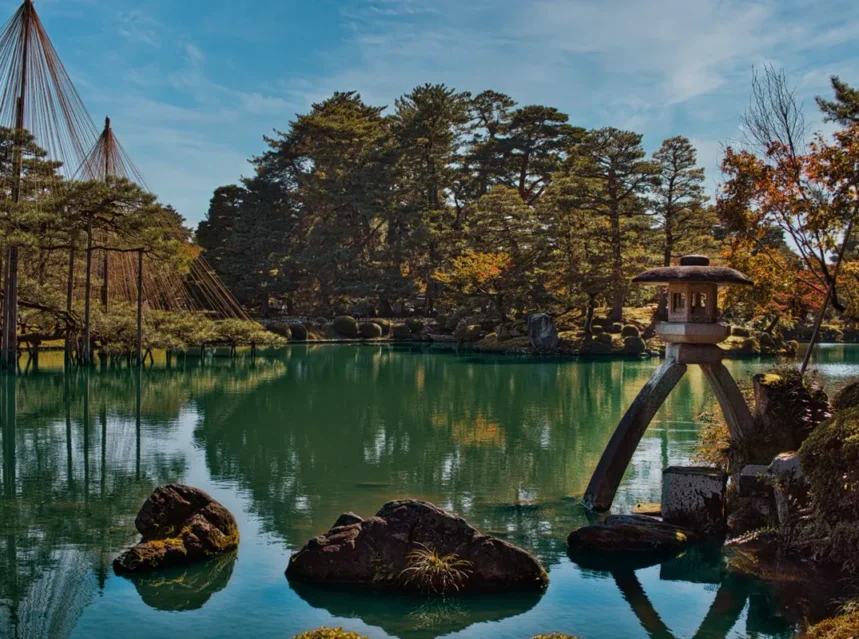
The Kenroku-en Japanese garden is an 11.4-hectare pond-and-stroll landscape in Kanazawa, Ishikawa. It is named after a checklist of qualities that a Chinese scholar said could never coexist in one place. The Maeda lords spent roughly two centuries proving him wrong, and the result still works as a design manual.
Quick answer: Kenroku-en is an 11.4-hectare Edo-period stroll garden in Kanazawa, Ishikawa, built by the Maeda lords beside their castle. Its name means garden of six attributes — six qualities Chinese garden theory said no site could hold at once. It opened to the public in the 1870s.
🧰 In a hurry? Jump straight to our tested picks for this guide ↓
Kenroku-en japanese garden at a glance
Most celebrated gardens are named for a place, a family or a flower. This one is named for an argument. The six qualities in its name come in three pairs.
Each pair contains a contradiction. That is why the garden repays study, not just admiration. Seen next to Ryoan-ji, which strips a garden down to fifteen stones and raked gravel, Kenroku-en is the argument for having everything rather than almost nothing.
| Feature | Detail |
|---|---|
| Official name | Kenroku-en (兼六園), “garden of six attributes” |
| Location | Kanazawa, Ishikawa Prefecture, Hokuriku region, Japan — next to Kanazawa Castle |
| Created | Developed in stages from the 1620s to the 1840s; named in 1822 |
| Created by | Successive Maeda lords of Kaga Domain, from Toshitsune (3rd) to Nariyasu (13th) |
| Size | Approx. 11.4 hectares (about 28 acres) |
| Garden style | Kaiyū-shiki — Edo-period circuit or stroll garden built around a pond |
| Plant collection | Approx. 8,750 trees across roughly 183 plant species (as of the 2026 Wikipedia record) |
| Signature feature | The two-legged Kotoji-tōrō stone lantern on the bank of Kasumiga-ike |
| Best season | All four; late April cherry blossom and mid-November to early December maple colour are the peaks |
| Climate | Köppen Cfa (humid subtropical), roughly USDA zone 8b–9a equivalent; record low −9.4 °C |
| National status | Designated a Place of Scenic Beauty in 1922 and a Special Place of Scenic Beauty in 1985 |
| Managed by | Ishikawa Prefecture Kanazawa Castle and Kenroku-en Administrative Office |
One number deserves a caveat. English sources round the area differently. Official prefectural and Japanese tourism material gives 11.4 hectares.
Some English write-ups say “over 25 acres”, which does not convert cleanly. In fact 11.4 hectares is about 28 acres. Treat 11.4 hectares as the figure to trust.
Want to know which of its plants would survive your conditions? Our Plant Finder filters by climate and light first.
What makes Kenroku-en famous
Three things put this garden on every list of Japan’s finest. Only one of them is beauty.
- It is one of the Three Great Gardens of Japan. The grouping also covers Kōraku-en in Okayama and Kairaku-en in Mito. It reflects scale and completeness, not a scored ranking. As the record of the three gardens shows, no historical text explains who drew up the list. So treat it as reputation, not a verdict.
- It was designed to hold contradictions. The six attributes in its name are three opposing pairs. Building a garden that satisfies all six is the whole point. It is also a useful test for your own plot.
- It is built for the worst season. Kanazawa gets around 157 cm of snow a year, most of it heavy and wet. Rather than treat winter as dead time, the garden’s staff turn snow protection into its most photographed feature.
What are the six attributes of Kenroku-en, and why does yukitsuri exist?
The name comes from a Song-dynasty Chinese text on the gardens of Luoyang, attributed to the scholar Li Gefei. His claim was that six desirable qualities exist in gardens. Because they cancel one another out, no garden holds all six.
In 1822 the retired shogunal councillor Matsudaira Sadanobu (1759–1829) gave the Kanazawa garden a name claiming all six anyway. He was a noted writer, so the choice was deliberate.
Here are the three pairs, and why each is a genuine conflict:
- Spaciousness against seclusion. A big open sweep reads as grand, but it also removes every hiding place. A garden full of intimate corners, meanwhile, feels small. Kenroku-en opens the view across one large pond. The paths that reach it stay enclosed and twisting.
- Artifice against antiquity. Visible craft looks new; weathered age looks unplanned. Heavy shaping should destroy the sense of a place that simply grew. The garden applies intense technique to very old material. Its pines have been trained for well over a century. So the craft and the age are the same object.
- Water-courses against panoramas. Running water needs a fall, which means low ground. A long view needs height. You cannot easily have both on one site. Kenroku-en stacks them instead. A diverted channel feeds ponds on the high terrace. The ground then drops away to a distant outlook.
Be aware that English translations of the six vary. One common set runs spaciousness, seclusion, artifice, antiquity, water-courses and panoramas. Another, used in some English summaries, gives spaciousness, serenity, venerability, scenic views, subtle design and coolness.
These are the same six Chinese terms rendered differently. So do not assume a source is wrong when its wording differs from the first version you read.
Yukitsuri: rope cones against the snow
Kanazawa’s snow is not light powder. Fresh snow is around a tenth the density of water. However, a settled snowpack compacts toward roughly 30 per cent of water density.
Wet coastal snow arrives heavy from the start. Loaded onto the horizontal branches of an old pine, that weight snaps limbs that took a century to form.
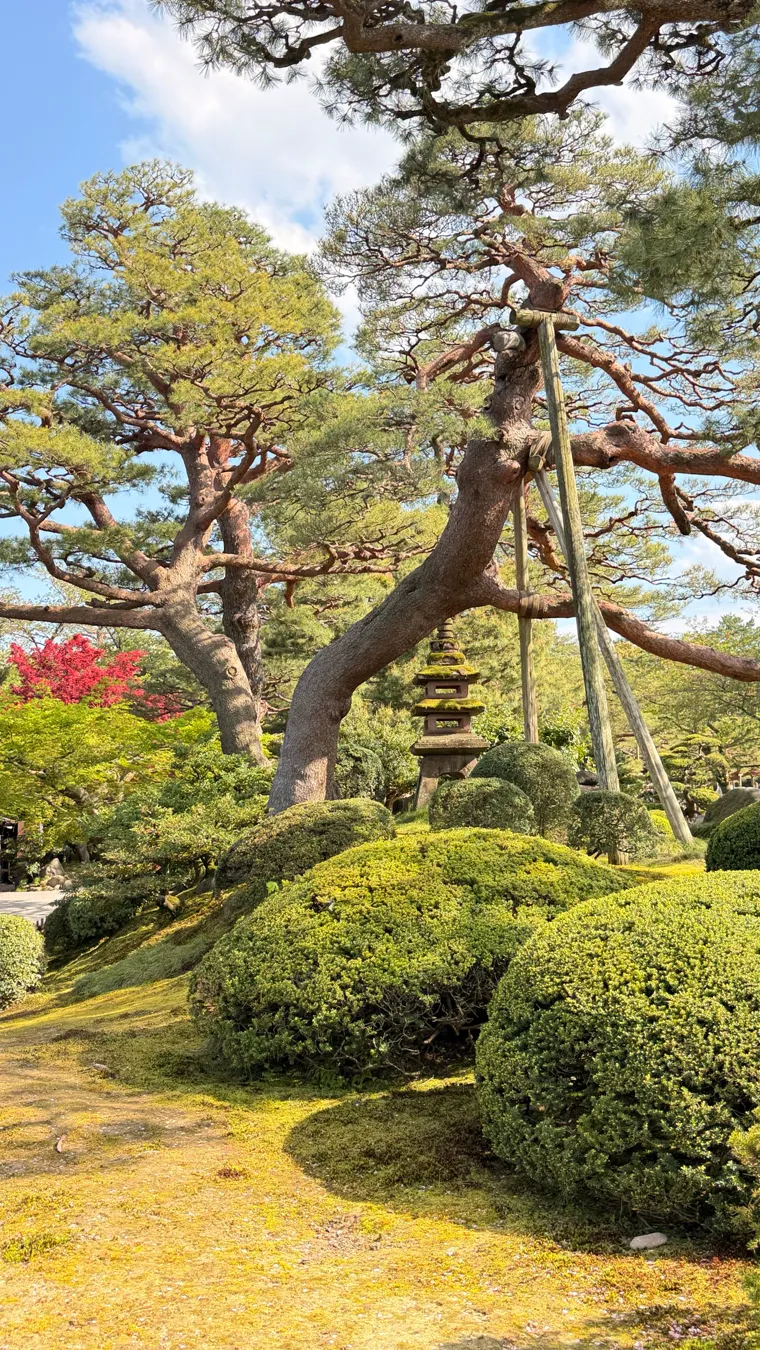
The answer is yukitsuri — “snow suspension”. Gardeners raise a pole at the trunk. Ropes then run from its top out to individual branches.
Each branch hangs from above rather than resting on a prop below. The result is a cone of straw ropes that has become the winter emblem of the city.
Japan’s national tourism organisation records that the Karasaki pine alone takes up to 800 ropes. The work is done before the first snow, from around the start of November.
Take both ideas home. First, the contradictions. Pick one pair you actually want. Then give each half its own zone rather than blending them.
An open lawn sits at one end, a narrow shaded path at the other. Blending produces neither. Second, snow and wind load.
On a young multi-stemmed shrub, tie the stems loosely into a column before winter. Snow then slides off instead of splaying them. On a small tree with wide low branches, run soft ties down from a stake above.
Both jobs take twenty minutes. Both prevent the split that no pruning repairs.
History: how a castle’s outer garden became a national treasure
The story starts with water. In 1632 the third Maeda lord, Toshitsune, completed the Tatsumi channel, which brought water to the castle terrace. Everything later depended on it.
In 1676 the fifth lord, Tsunanori, laid out a garden here and called it Renchitei. Fire destroyed most of it in 1759. Restoration began in 1774 under the eleventh lord, Harunaga, who built the Yūgao-tei teahouse that still stands.
The twelfth lord, Narinaga, added winding streams and expanded the grounds around 1822. That is the year the garden received its present name. The thirteenth lord, Nariyasu, enlarged Kasumiga-ike into the pond you see today.
The Maeda could afford this. As the castle record shows, Kaga Domain ran to well over a million koku. That made it the wealthiest domain after the Tokugawa themselves.
Cultural spending was also politically safer than military display.
The domain ended with the Meiji Restoration and the garden was opened to the public. Sources differ on the exact year.
The detailed record gives 7 May 1874. Several travel guides say 1871, the year the domains were abolished. Use 1874 for the garden itself.
What to see: the named features worth finding
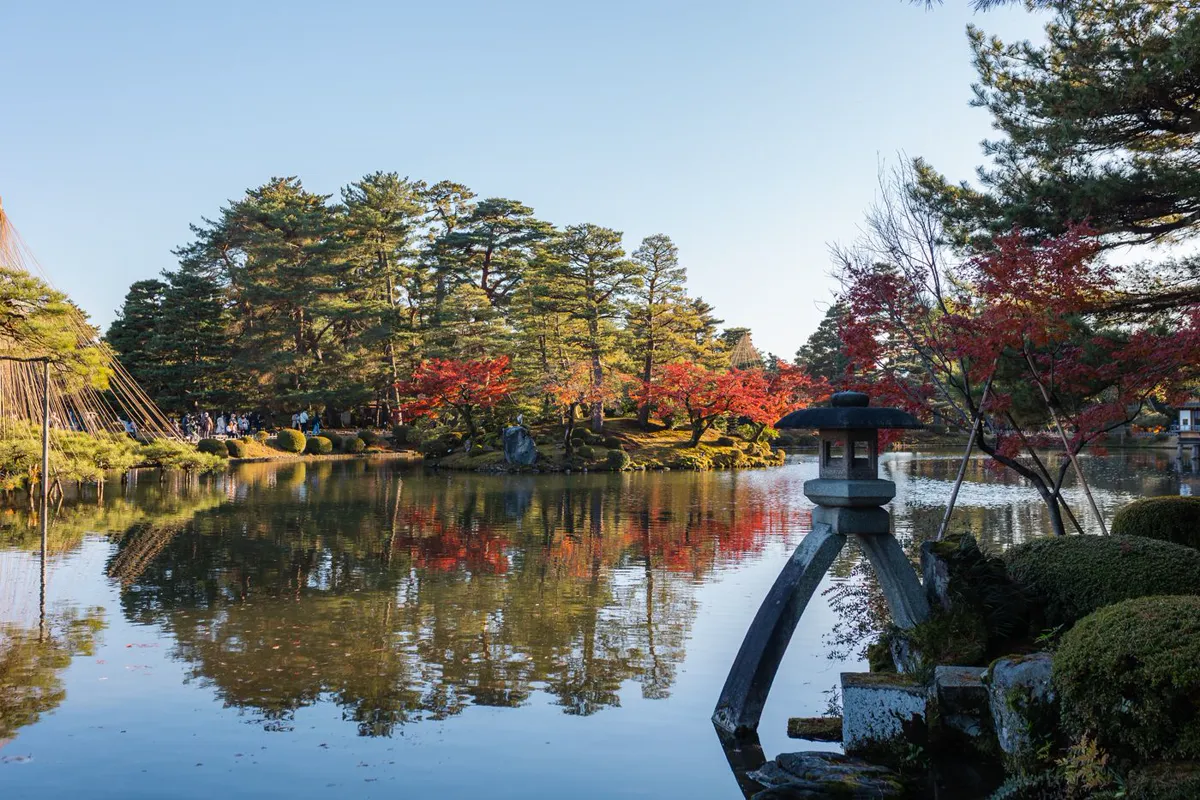
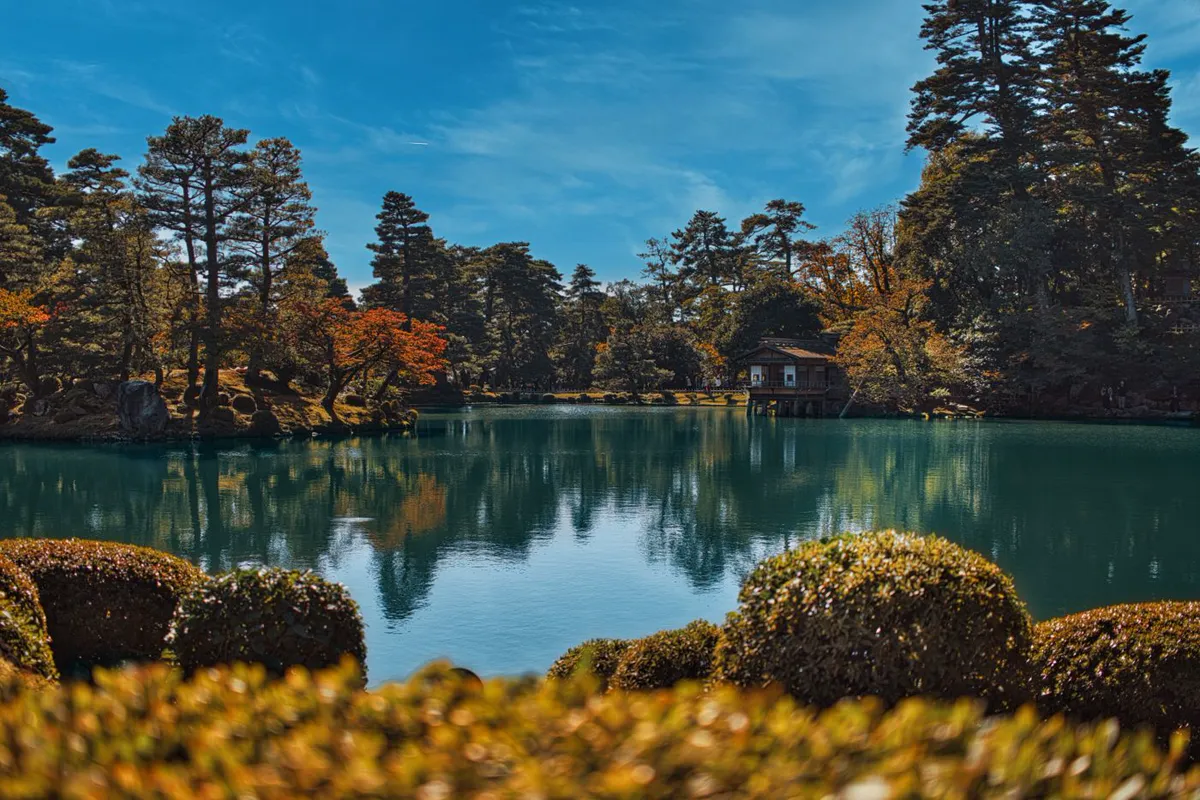
- Kasumiga-ike — the main pond, around 5,800 m². At its centre sits the small island of Hōrai. Its shape suggests a turtle’s shell, and it is named for the legendary isle of immortals.
- Kotoji-tōrō — the garden’s emblem. A stone lantern over two metres tall, standing on two splayed legs rather than one post. The legs resemble the movable bridges that support the strings of a koto. It is a yukimi-dōrō, or snow-viewing lantern. That type is made low and broad-capped, so settled snow becomes part of the composition.
- The Karasaki pine — a Japanese black pine, roughly 180 years old. Grown from seed, it has been trained so its branches reach far out over the pond. This is the tree that gets the full 800-rope treatment each autumn.
- Yūgao-tei — the oldest surviving building in the garden, dating from 1774. Shigure-tei, another teahouse, is older still at 1725 and survived the fire.
- Midori-taki — the “emerald waterfall”, part of the 1774 rebuilding.
- The fountain below Kasumiga-ike — reckoned among Japan’s oldest. It is driven entirely by the drop in level from the pond above. The jet rises about 3.5 metres with no pump.
- Gankō-bashi, the flying geese bridge — eleven reddish stones set in a staggered line across a stream. The pattern echoes geese in flight. Beside it, Hisago-ike carries a small pagoda on its island.
Just outside the garden’s eastern edge stands Seison-kaku. Nariyasu built this villa in 1863 for his mother. It is worth the detour for its unusually light, colourful interiors.
Best time to visit Kenroku-en
This is a genuinely four-season garden. Each season delivers something different, not a weaker version of the same thing.
- Late winter into early spring — plum blossom opens from around mid-February, well before anything else. Plums flower in the cold precisely because they evolved to.
- Spring — cherry blossom usually peaks in mid-to-late April here. That is later than Tokyo or Kyoto, because Kanazawa sits further north on the colder Sea of Japan coast.
- Early summer — azaleas, then Japanese iris along the water channels through the wettest, greenest weeks.
- Autumn — maple colour typically runs from mid-November into early December.
- Winter — the yukitsuri cones are up from early November until around mid-March. The garden under snow is the image the city trades on.
Want that four-season rhythm at home? The planning logic is the same. Work backwards from your own last and first frost using our frost date finder.
Then slot planting and pruning tasks into a month-by-month planting calendar. A garden that looks good in February was planned in the previous July.
Planning a visit: what to know
Kenroku-en sits in central Kanazawa, joined to Kanazawa Castle Park by a bridge. Loop buses run there from Kanazawa Station. Since the Hokuriku Shinkansen reached the city in March 2015, it has been an easy trip from Tokyo.
Allow around 60 to 90 minutes to walk the full circuit. Add time if you stop at a teahouse.
Opening times, ticket prices and booking rules change every season, so check the official site before you travel. The prefecture administers the garden. Current details appear on the official Kanazawa Castle and Kenroku-en site.
Signature plants of Kenroku-en — and how to grow them at home
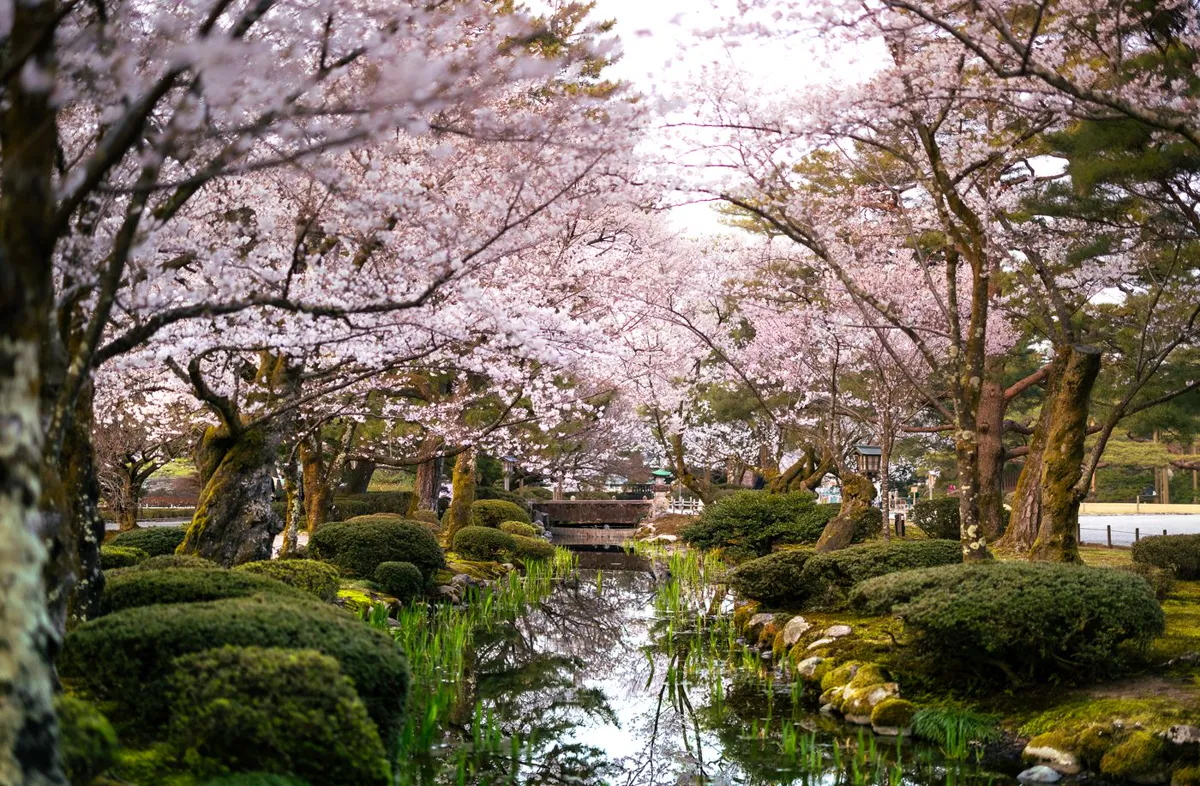
The planting here is deliberately narrow. Variety comes from training, not from collecting.
- Japanese maple — the autumn colour. It wants shelter from wind and relief from hot afternoon sun. See our guide on how to grow Japanese maple.
- Japanese black pine and other trained conifers — the permanent structure that carries winter. These are the trees that receive yukitsuri.
- Cherry — the spring event, and a tree that needs real winter chill to flower well. Our cherry tree guide covers siting and pruning.
- Azaleas — clipped into low mounds so they read as landform for eleven months and as colour for one. Start with our azalea growing guide.
- Tree peony — the aristocrat of the group. It flowers best in dappled shade with only three or four hours of direct sun. See the tree peony guide.
- Hakone grass — the shade-tolerant, cascading grass that softens stone edges. Our Hakone grass guide explains why it dislikes full sun.
Four of those six — maple, cherry, azalea and tree peony — want slightly acidic, humus-rich, free-draining ground. So test what you actually have first. Then calculate the compost or bark you need with our soil calculator.
None of them tolerate drought or waterlogging. Size your irrigation with the water calculator rather than guessing.
Growing the Kenroku-en look in your climate: US, UK and India
Kanazawa is humid. It is wet in every month, and cold enough in winter to matter.
Reproduce that and the plants are easy. Depart from it and you need honest substitutions.
Cool, damp climates (UK, Pacific Northwest, upstate US). This is the easy case. Japanese maples, azaleas, camellias and Hakone grass all behave. The Royal Horticultural Society’s guidance on Japanese maples is blunt about the real risk here.
It is wind, not cold. Scorched, crisped leaf margins usually mean an exposed position, not a disease.
Hot, dry or alkaline US regions (Texas, Arizona, inland California). Two problems compound. Afternoon sun scorches maple foliage. Meanwhile alkaline soil or hard tap water pushes pH up until iron becomes chemically unavailable.
That is lime-induced chlorosis, which yellows leaves between green veins. So water maples and azaleas with collected rainwater where you can. Mulch heavily, and place them where a wall or larger tree blocks the west sun.
India. Say it plainly: in most of India, Japanese maples, cherries and tree peonies will not work. Cherries and peonies need winter chill. Delhi, Mumbai, Chennai and Bengaluru do not supply it.
Maples, meanwhile, resent both intense sun and hot dry air. Hill stations are the exception. Shimla, Darjeeling, Munnar, Ooty and Gangtok can grow all of them.
Everywhere else, keep the structure and change the species. Use mondo grass instead of Hakone grass and instead of moss, because it takes far more heat and sun. Use clipped Ixora, Duranta or Murraya in place of azalea mounds.
Choose a clumping bamboo for vertical screening, never a running type. Then let a frangipani or a well-pruned guava play the sculptural role a pine plays in Kanazawa. Moss is a lost cause outside a humid, shaded microclimate.
It has no vascular system and absorbs water through its leaves, so it simply dries out. For balcony and rooftop limits, our terrace gardening in India guide covers weight, containers and summer watering.
5 design lessons from Kenroku-en you can copy
- Borrow scenery you do not own. Shakkei means composing the garden so an external feature becomes part of your picture. That could be a distant hill, a neighbour’s mature tree or a church spire. The technique is old. The Chinese manual Yuanye of 1635 already sorted borrowed views into distant, adjacent, upward and downward types. The practical move is editing. Screen everything ugly on that sightline with a hedge or trellis. Leave one clean gap, and the borrowed object reads as yours. It is the cheapest way to make a small garden feel large.
- Treat winter structure as the design goal, not the leftover. Kenroku-en’s most famous images are taken in its harshest month. Decide in advance what your garden will look like when everything deciduous has gone. Think evergreen mass, a good wall, bark, seedheads, a strong path shape. If the answer is “bare soil”, plant for December first. Summer will take care of itself.
- Use water as movement, not spectacle. The famous jet here is only 3.5 metres tall. It runs on gravity from a pond above, so there is no pump, no noise and no electricity bill. Small gardens do not need a feature. They need the sound and the flicker. A narrow rill, a shallow basin or a channel with a slight fall beats a large ornament.
- Frame a view through a deliberate gap. Stroll gardens stage their views. The path bends, planting closes in, then one opening releases a single composed scene. Do the same by planting to block rather than to fill. Choose the one view worth having. Deny it from everywhere else, then give it a doorway. Two shrubs, an arch or a gap in a hedge will do. A view you can see continuously stops being a view.
- Prune to reveal branch structure, not to reduce size. This is where Western and Japanese practice diverge most. Niwaki training thins a tree so the frame of trunk and main limbs becomes visible. It does not shear the outline to keep the tree small. Remove crossing and inward growth. Open the space between branch layers so light and air pass through, then stop. If you constantly cut a plant back because it is too big, the plant is wrong for the spot.
Applying these needs a plan on paper first. Sketch the sightlines and the winter skeleton in our garden planner.
Then check that your shrubs will still fit in ten years, using the plant spacing calculator. Overplanting is what forces the size-reduction pruning that lesson five warns against.
Who looks after Kenroku-en, and what the record says
The garden is not run by a trust or a private family. It is administered by the Ishikawa Prefecture Kanazawa Castle and Kenroku-en Administrative Office. That office publishes the garden’s own maps, seasonal notes and archive material on the official prefectural site.
Trust it for anything current. Travel articles drift.
The design thinking behind it is documented too. The oldest garden manual in the world is the Sakuteiki, written in eleventh-century Japan. It is generally attributed to Tachibana no Toshitsuna.
It already argued that a designer should read the site and the materials, rather than impose a scheme on them. That advice is nine hundred years old and still the most useful sentence in the field.
Recreate the look at home: what you’ll need
You need very little kit. Two things matter: clean cuts on shaped trees, and soft ties that will not girdle a branch under winter load.
On the planting side, buy the structure plants as young stock rather than raising them from seed. The ground-layer grasses and perennials are worth starting yourself. Work out sowing dates with the seed starting calculator.
Frequently asked questions
Why is Kenroku-en called the garden of six attributes?
A Song-dynasty Chinese text on the gardens of Luoyang said six qualities could not coexist. Those are spaciousness, seclusion, artifice, antiquity, water-courses and panoramas.
This garden claims all six. Matsudaira Sadanobu gave it the name in 1822.
Is Kenroku-en worth visiting?
Yes, and unusually so in winter, when most gardens are worth skipping. It is also compact enough to see properly in an hour and a half. It sits within walking distance of Kanazawa Castle and the city’s chaya districts, so it is easy to combine.
How long does it take to walk around Kenroku-en?
Around 60 to 90 minutes for the full circuit at a relaxed pace. Want only the main pond, the Kotoji lantern and the Karasaki pine?
Then 30 to 45 minutes is enough. Add 20 to 30 minutes for a teahouse stop.
What is yukitsuri, and when are the ropes put up?
Yukitsuri is a rope-suspension technique. It holds branches up from a central pole so heavy wet snow cannot break them.
At Kenroku-en the work starts around the beginning of November. The ropes stay up until roughly mid-March.
What is the best time of year to visit Kenroku-en?
Late April for cherry blossom, mid-November to early December for maple colour, and January to February for the snow-and-yukitsuri scenes. February also gives you the plum blossom starting. There is no dead season.
Where is Kenroku-en and how do you get there?
It is in central Kanazawa, Ishikawa Prefecture, next to Kanazawa Castle Park. Loop buses run from Kanazawa Station. The Hokuriku Shinkansen has connected the city directly to Tokyo since March 2015.
Can I create a Kenroku-en style garden in a small space?
Yes, if you pick one contradiction rather than all three. A courtyard holds seclusion and water very easily. It cannot hold a panorama.
Give the two halves of your chosen pair separate zones. The small space will then read as designed rather than crowded.
How is a stroll garden different from a dry gravel garden?
A kaiyū-shiki stroll garden like Kenroku-en is walked around. It uses real water, changes with the seasons, and stages a sequence of views along a path. A dry karesansui garden is a fixed composition of stone and raked gravel.
You view it from one place, and it barely changes. They are different art forms, not different budgets.
Is Kenroku-en the most beautiful garden in Japan?
No authority decides this. It is one of the Three Great Gardens by long-standing reputation.
However, no historical document explains who compiled that list or on what basis. Anyone stating a definitive ranking is expressing a preference.
How do Kenroku-en, Kōraku-en and Kairaku-en differ?
Kōraku-en in Okayama was built from 1687 and finished in 1700 by Ikeda Tsunamasa. It is famous for borrowing Okayama Castle into its view. Kairaku-en in Mito opened in 1842 under Tokugawa Nariaki.
It is a plum garden with about a hundred varieties, and it was unusually intended for others to enjoy. Kenroku-en is the winter garden of the three.
Can I make a Kenroku-en inspired garden in India?
In the hill stations, yes, more or less directly. In the plains, keep the layout and swap the plants. Use mondo grass for moss and Hakone grass.
Use clipped Ixora or Murraya for azalea mounds, and clumping bamboo for screening. Put a sculpturally pruned frangipani or guava where a pine would stand. Do not try to grow cherries or tree peonies without winter chill.
Why are my Japanese maple leaves brown and crisp at the edges?
Almost always leaf scorch from wind or hot afternoon sun. Dry roots or alkaline tap water locking out iron can make it worse.
Move or shelter the plant, mulch, and water with rainwater if your supply is hard. If the pattern looks different, run the symptoms through our Plant Doctor first.
How do I stop snow from breaking my shrubs?
Two low-tech methods, both used in Japan. For upright multi-stemmed shrubs, tie the stems loosely into a column before the first snow. The load then sheds sideways.
For small trees with wide low branches, run soft ties down from a stake or pole above. Never prop from below, because that concentrates the load.
Related gardens and guides
Kenroku-en is one of twenty in our guide to the 20 most famous gardens in the world.
Reading gardens as design rather than scenery unlocks others too. Compare Kenroku-en’s staged, walked sequence with the vast axial geometry of the gardens at Versailles. Versailles does the opposite and shows you everything at once.
For a garden built around one season, see Keukenhof. For the botanical approach to a great collection, read our guide to the plants of Kew Gardens. Closer to home, the camellia guide and the iris guide cover two more plants you meet along Kenroku-en’s water channels.
Still stuck? Ask the Plant Doctor
Describe the problem — yellow leaves, holes, no flowers — and get a clear answer in seconds. FreeAI can make mistakes. Answers are guidance, not a guarantee — check anything important against the guide it links to, and always read the label on any product before you use it.