Garden Planner: Free Drag & Drop Square-Foot Layouts
 By
By The Garden Bed Planner lets you design your beds and borders — drag in crops, get spacing right, and plan a layout that actually fits your plot.
More about this tool
Perfect for raised beds, kitchen gardens and balconies. 💚 Save your plants to My Garden in your free Gardening Guider profile — and get free care reminders & seasonal follow-ups for the plants actually growing in your garden.
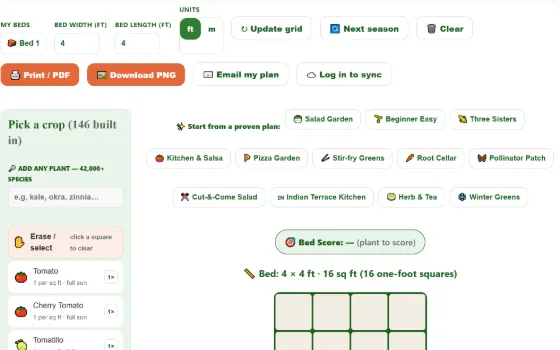
Pick a crop (146 built in)
🥕 Vegetables
🌿 Herbs
🍓 Fruits
🌸 Flowers
🖱️ Drag a crop onto a square — or drag a planted square to move it. Border glow: green = good companion · red = bad neighbour
Drag a crop from the palette onto a square — or tap a crop, then tap the squares.
🧺 Your planting list
🗓️ Know when to sow these → Planting Calendar · 🔍 more crops → Plant Finder
How to use the garden planner, step by step
A garden planner lets you try a vegetable garden layout on screen before you dig. This free garden design tool is a square foot garden planner and a raised bed planner in one: drag any of the 140+ built-in crops — vegetables, herbs, fruits and flowers, grouped in the picker — onto the grid, see the correct plants per square, and get a warning the moment two bad neighbours end up side by side. Need something rarer? The search box adds any plant from the 42,000-species database. Fill the finished bed using the soil calculator.
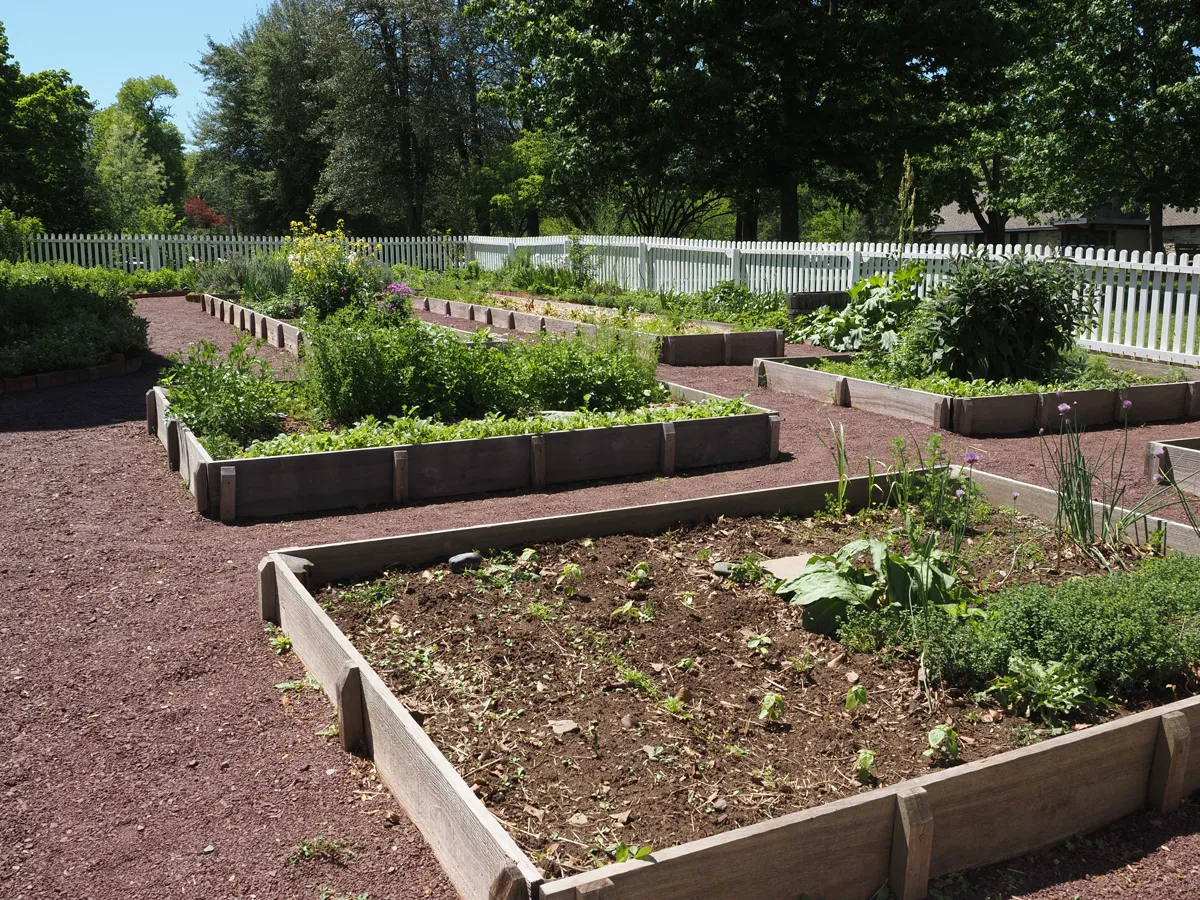
A good bed plan answers five questions before a single seed goes in: where the bed sits, how big it is, how deep the soil needs to be, which crops share it, and where each crop goes so neighbours help rather than fight. The planner above handles the last two automatically — the green and red borders are live companion-planting checks — but the first three decisions happen in the real garden. Here is the full sequence experienced growers follow, and the same order in which the tool is designed to be used.
- Pick the sunniest reasonable spot. Fruiting vegetables (tomato, pepper, cucumber, okra) want 6–8 hours of direct sun; leafy greens manage on 4–6. Watch the spot for one day before committing — a fence or tree that shades it from 2 pm changes what you can grow.
- Set the size in the planner. Enter the bed’s width and length (the ft | m toggle shows the same dimensions in metres). Keep at least one dimension reachable: you should never have to step on the soil, because compacted soil drains and roots poorly.
- Fill the bed with the right depth of soil for the deepest-rooted crop you plan to grow (table below).
- Place tall crops on the polar side — the north edge in the Northern Hemisphere, the south edge in the Southern Hemisphere — so corn, okra, trellised cucumbers and staked tomatoes never shade the short crops.
- Drag crops onto the grid and watch the borders. A green glow means the square’s neighbours are documented good companions; red means a documented bad pairing (move one of them). The planting list at the bottom becomes your shopping/seed list, and the Print/PDF and PNG buttons turn the finished grid into a sheet you can take to the garden.
Replant the same grid every season using the Next season button: the planner remembers which plant family grew in each square and warns you (amber ring) if you are about to repeat a family in the same spot — the simple crop-rotation habit that prevents most soil-borne disease build-up.
What size should a raised bed be?
The single most important rule: never wider than you can reach to the middle. An adult comfortably reaches about 2 ft (60 cm), so a bed accessible from both sides can be 4 ft (1.2 m) wide, and a bed against a wall or fence should stay 2–2.5 ft (60–75 cm). Length is limited only by your space and your patience walking around it — most gardeners find 8 ft (2.4 m) the sweet spot, because longer beds tempt you to step across them.
| Bed size | Metric | Squares | Best for |
|---|---|---|---|
| 4 × 4 ft | ≈ 1.2 × 1.2 m | 16 | Classic square-foot starter bed — feeds one salad-lover; the size all four templates above use |
| 4 × 8 ft | ≈ 1.2 × 2.4 m | 32 | The most common “serious” bed — a full salsa or salad garden for a household |
| 3 × 6 ft | ≈ 0.9 × 1.8 m | 18 | Small yards, kids’ gardens, and shorter reach |
| 2 × 8 ft | ≈ 0.6 × 2.4 m | 16 | Beds along a wall, fence or balcony edge (reached from one side only) |
| 2 × 4 ft | ≈ 0.6 × 1.2 m | 8 | Terrace and container-frame gardens — herbs, greens, chillies |
Leave 18–24 in (45–60 cm) of path between beds — enough to kneel — or 3 ft (90 cm) if a wheelbarrow needs to pass. Several small beds nearly always beat one huge one: rotation is easier, one disease outbreak stays contained, and watering needs can be grouped per bed.
How deep should a raised bed be, and how much soil is needed?
Depth is set by roots, not by looks. If the bed sits on open ground that roots can continue into, a shallower frame works; on concrete, gravel or a terrace, the frame must hold the full rooting depth.
| Soil depth | Metric | Grows well |
|---|---|---|
| 6 in | ≈ 15 cm | Lettuce, spinach, coriander, methi, radish, most herbs |
| 12 in | ≈ 30 cm | Beans, peas, onions, garlic, beetroot, chard, strawberries — the standard raised-bed depth |
| 18 in | ≈ 45 cm | Carrots, tomatoes, peppers, brinjal, okra, cabbage family |
| 24 in | ≈ 60 cm | Potatoes, parsnips, and any bed built over concrete where roots cannot go deeper |
📐 How much soil to buy — the formula
Volume = width × length × depth. Work in one unit: a 4 × 8 ft bed filled 1 ft deep needs 4 × 8 × 1 = 32 cubic feet ≈ 1.19 cubic yards ≈ 0.9 m³ (900 litres). In metric directly: 1.2 m × 2.4 m × 0.3 m = 0.86 m³. A common fill mix is roughly equal parts compost, topsoil and a drainage/aeration component (coarse sand, coco coir or fine bark), and the level drops a few centimetres as it settles — buy about 10% extra.
What is square-foot gardening, and how many plants fit per square?
Square-foot gardening (SFG), popularised by Mel Bartholomew in 1981, divides the bed into a grid of 1 ft × 1 ft (30 × 30 cm) squares and plants each square at its crop’s ideal density instead of in widely spaced rows. Row spacing in traditional gardening exists mostly so a hoe or tractor can pass — a raised bed you never step in doesn’t need it. The result is a bed that yields more from less space, needs less water and leaves less bare soil for weeds.
The numbers on this planner’s crop palette of 140+ vegetables, herbs, fruits and flowers (1×, 2×, 4×, 8×, 9×, 16×) are the standard SFG densities, matched to the same spacing figures our plant spacing calculator uses:
| Plants per square | Seed-packet spacing | Examples |
|---|---|---|
| 1 | 12 in / 30 cm + | Tomato, pepper, brinjal, cabbage, broccoli, potato, corn |
| 2 | ~9–12 in on a trellis | Cucumber (grown vertically) |
| 4 | 6 in / 15 cm | Lettuce, basil, marigold, garlic, chard, strawberry |
| 8 | ~4 in in a double row / on a frame | Peas, pole beans, sweet peas |
| 9 | 4 in / 10 cm | Bush beans, spinach, beetroot, onion, turnip |
| 16 | 3 in / 7.5 cm | Carrot, radish, coriander, spring onion |
🧮 Where those numbers come from
Plants per square = (12 ÷ spacing in inches)², rounded to a practical grid. Carrots at 3 in spacing: (12 ÷ 3)² = 4² = 16 per square. Lettuce at 6 in: (12 ÷ 6)² = 4 per square. When you add a plant from the 42,000-species database, the planner applies the same maths to that species’ real spacing to pick 1, 4, 9 or 16.
Which direction should a garden bed face?
Orient the long side of the bed east–west where possible, so every row gets sun as it arcs overhead, and sort crops by height. In the Northern Hemisphere the sun tracks through the southern sky, so tall crops (corn, okra, trellised gourds, staked tomatoes) go on the north edge and shorter crops step down toward the south. In the Southern Hemisphere it is the mirror image: tall crops on the south edge. Near the equator the midday sun is close to overhead most of the year, so height matters less than west-side afternoon-heat protection.
Shade cast by tall neighbours isn’t always the enemy — in hot-summer and tropical climates, lettuce, spinach and coriander last weeks longer with afternoon shade. The trick is to make shade a choice: put heat-tender greens where the tall row shelters them from the harshest afternoon sun, never where they lose the gentle morning light.
How do the starter templates work?
The twelve one-click templates above are complete, companion-checked 4 × 4 layouts — a proven starting point you can customise square by square. The four most popular:
- 🥗 Salad Garden — lettuce, spinach, radish and carrot around tomato and cucumber, with basil and marigold as the pest patrol. Continuous pickings from a single bed.
- 🌱 Beginner Easy — the hardest-to-kill line-up: radish, lettuce, beans, tomato and marigold. Fast wins (radish in ~4 weeks) keep new gardeners hooked.
- 🌽 Three Sisters — the centuries-old Native American guild of corn, beans and a sprawling cucurbit: corn is the trellis, beans fix nitrogen for the corn, and the vine’s big leaves are a living mulch that shades out weeds.
- 🍅 Kitchen & Salsa — tomato, pepper, onion, garlic, coriander and basil: one bed that maps directly onto a season of salsa, curry bases and pasta sauce.
The other eight cover a pizza garden, stir-fry greens, storage roots, a pollinator patch, cut-and-come-again salad, an Indian terrace kitchen bed, herbs & tea, and hardy winter greens. Loading a template replaces the current bed (the planner asks first). After loading, drag squares around to fit your own sun direction — templates assume tall crops belong at one edge, and the live companion borders re-check every move.
A worked example: planning a 4 × 8 ft (1.2 × 2.4 m) family salad bed
The situation: a household wants salads and cooking basics from one 4 × 8 ft bed in a Northern-Hemisphere backyard with full sun.
Step 1 — size and soil. Set width 4, length 8 in the planner (32 squares; the metres toggle shows ≈ 1.2 × 2.4 m). Deepest crop is carrot, so fill 18 in (45 cm): 4 × 8 × 1.5 = 48 cu ft ≈ 1.36 m³ of mix.
Step 2 — the tall north row (8 squares): 4 tomatoes and 2 trellised cucumbers (2 per square = 4 plants), with 2 squares of basil between the tomatoes — a documented good pairing the grid confirms with green borders.
Step 3 — the middle rows (16 squares): peppers, bush beans (9 per square), beetroot, chard and onions. The planner flags onion squares placed next to beans in red — a documented bad pairing — so the beans move two squares away with beetroot between them.
Step 4 — the sunny south row (8 squares): lettuce (4 per square), spinach, radish (16 per square) and carrots, plus marigold at each corner.
Result: roughly 120 plants in 32 sq ft, a printable plan sheet, and a planting list that doubles as the seed order. After harvest, one press of Next season stores every square’s plant family so next year’s layout automatically avoids repeating nightshades or brassicas in the same spots.
📚 Sources: Wikipedia — Square foot gardening · Wikipedia — Raised-bed gardening · Wikipedia — Three Sisters (agriculture) · University of Minnesota Extension — Raised garden beds. Spacing figures are standard square-foot-gardening practice; always check your seed packet for variety-specific spacing.
Using the garden planner in 30 seconds
- Set the bed size. The garden planner draws it to scale in feet or metres.
- Drag crops in. Plants per square are filled in for you.
- Watch the warnings. Bad neighbours are flagged as you place them.
Fill the finished bed with the soil calculator, space the plants with the spacing calculator, and plan next season with the crop rotation planner. Save the plan to My Garden so next year starts from this year.
Draw the paths first, then the beds. A garden planner that fills every square foot looks efficient and works badly, because you still need to reach the middle.
Save the layout before you plant. Next season the garden planner can shift each family one bed along, which is exactly what the crop rotation planner asks for. Store the plan in My Garden, and check watering for the finished bed with the water calculator.
🌍 Works worldwide — metric & imperial
🔄 Updated: 16 Aug 2026 💯 Free to read — no sign-up needed
Square-foot gardening in 3 steps (free, no subscription)
- Set your bed size — up to 12 × 12 ft, three separate beds saved free.
- Click a crop, then click squares — the planner fills the correct plants-per-square (1 / 4 / 9 / 16) automatically, or add ANY of 42,000+ plants and it derives density from real spacing data.
- Watch the borders — green glow = good companions beside each other, red = a pairing to avoid. Rearrange until the bed is all green, then print it.
Square-foot gardening (Mel Bartholomew’s method) typically doubles the harvest per area of row gardening because path space becomes growing space and every square is planted to its true density — the reason raised-bed gardeners swear by it.
Layout tips: tall crops (tomato, corn, trellised cucumber) on the north edge so they don’t shade the rest; herbs and daily-pick salads on the reachable edge; one marigold square per bed earns its keep against nematodes and whitefly.
❓ Frequently asked questions
Is there a free alternative to GrowVeg or the Almanac garden planner?
How many plants fit in one square foot?
How do the companion planting warnings work?
Can I plan more than one garden bed?
Is my bed layout saved?
What size should a raised bed be?
How deep should a raised bed be?
Which way should I orient beds, and where do tall crops go?
How wide should the paths between beds be?
Can I print my plan or use it away from the computer?
Should I plant the same crops in the same bed next year?
🧰 Explore all our free garden tools
Tools hub →Was this tool helpful?