Plant Finder: Search 42,000+ Plants by Zone, Sun & Size
 By
By 🌱 The Plant Finder is a free plant search engine — discover the perfect plant from 42,000+ species, with photos, care needs and growing data for every climate on Earth.
More about this tool
Filter by your country, room, sunlight, watering, soil, flower colour, pet-safety and 20+ more specs — or search any plant by name — and instantly see what will actually thrive in your garden, balcony or home. Every result opens a full growing spec — light, water, soil, size, propagation and what tends to go wrong — and where we have written a full care guide for that plant, it takes you straight there. No sign-up, no paywall: just the right plant, found in seconds.
💚 Growing it already — or planning to? Save any plant from here straight to My Garden in your free Gardening Guider profile, and get free care reminders & seasonal follow-ups for the plants actually growing in your garden.
⚠️ “Not flagged toxic” is not a clearance — read this
Toxicity data referenced from the ASPCA Toxic and Non-Toxic Plants list. No record = unassessed, not cleared. “Not flagged toxic” is not a clearance. Only 178 species here carry an authority’s explicit “non-toxic to dogs, cats and horses” verdict; for every other plant this chip only means our general toxicity field does not say “toxic”, and that field is not source-verified. Check the ASPCA list yourself before letting a pet near any plant.
🔎 Find your plant — search a name, pick a country, or filter
How to choose plants by growing conditions — light, water and climate first
A plant finder is a plant search tool for deciding what to grow — not for naming something you already have. Filter a 42,000-species plant database by sunlight, water, colour, height and season, list plants by USDA zone, or narrow the results to pet safe plants. Every result opens a full care guide, and you can save any of them to My Garden.
The most reliable way to pick a plant is to stop asking “which plant do I like?” and start asking “which plants like my spot?” Plants fail far more often from a mismatch with their conditions than from bad care, so read your location first, then filter for plants that genuinely fit it. Three conditions do most of the deciding:
- Light. “Full sun” means roughly six or more hours of direct sun a day; “partial sun/shade” means three to six; “shade” means under three. Indoors, a south-facing windowsill is the bright end and a room corner two metres from any window is genuinely low light — far dimmer than it looks to human eyes. Watch your spot across one day and count the direct-sun hours before you filter; guessing high is the classic mistake.
- Water. Match the plant’s thirst to what you can honestly sustain. Low-water plants (succulents, many Mediterranean herbs) rot under a daily-watering habit, while thirsty leafy vegetables sulk under a weekly one. If you travel often or forget, filter for low water need and drought-tolerant — that single choice prevents the most common plant death of all, overwatering.
- Climate and season. A plant that thrives in a cool temperate summer may collapse in tropical humidity, and vice versa. Use the country picker so results reflect what actually grows where you live, and the finder’s “plant now” markers to see what suits the current season rather than an idealised calendar.
Hardiness zones — what they are and how to find yours
A hardiness zone answers one question: how cold does your winter get, on average, at its coldest? The most widely used system, the USDA scale, divides the world into 13 numbered zones in 10-degree-Fahrenheit steps — zone 3 winters plunge far below freezing, zone 10 barely freezes at all. A plant rated “hardy to zone 6” survives a typical zone 6 winter outdoors; plant it in zone 4 and the cold will kill it, while in zone 9 it may instead miss the winter chill some species need.
To find yours: gardeners in the United States can look up their ZIP code on the official USDA Plant Hardiness Zone Map. Elsewhere, find your area’s average annual minimum temperature (your national meteorological service publishes it) and match it to the USDA scale — many countries also publish equivalent maps of their own. As a shortcut, our Frost Dates tool estimates your frost picture from real weather-station history for cities worldwide, which tells you the same practical thing: what your winter will and won’t let you grow.
What zones do NOT tell you
Zones measure winter cold only. They say nothing about summer heat, humidity, rainfall or monsoon seasons — a zone 9 coastal desert and a zone 9 humid subtropical city share a winter minimum and almost nothing else. Treat the zone filter as a hard floor for cold-survival, then let the climate, sun and water filters do the fine-tuning. Indoor plants ignore zones entirely: your living room is roughly zone 11+ all year.
Filtering around cats, dogs and children
A surprising number of common ornamentals are toxic to pets — lilies are dangerously toxic to cats, sago palms can be lethal to dogs, and popular houseplants like pothos, philodendron and dieffenbachia cause painful mouth irritation when chewed. If an animal in your home ever nibbles leaves, turn on the “Not flagged toxic (unverified)” filter to drop species with a recorded toxicity, then verify anything you shortlist — plants with no record are unassessed, not cleared, and double-check any specific plant against the ASPCA toxic and non-toxic plants list, the reference database our own toxicity data cross-checks against.
Three practical rules: treat “toxic” labels as applying to curious puppies, kittens and toddlers — adult animals usually leave plants alone, but you cannot count on it; remember that hanging a toxic plant out of reach fails the moment leaves drop; and if a pet does chew a suspect plant, identify the species first (our photo Plant Identifier flags toxicity right on the result card) and contact a veterinarian promptly rather than waiting for symptoms.
Getting the most from the finder
A few features that are easy to miss:
- Stack filters, then prune. Start with your non-negotiables (light, water, pet-toxicity), then add taste filters like colour, fragrance or height. If results hit zero, remove the last taste filter first — never the condition filters.
- Share any filtered view. The address bar updates as you filter — copy the link and whoever opens it sees exactly your filtered results, ready to refine. Handy for “which of these should we get?” conversations.
- Search names in your own words. The name search understands common names, Latin names and many regional names, so type whatever you call the plant.
- Save your shortlist. The save button on every card adds the plant to your free garden list, so a browsing session turns into a planting plan you can return to — and our care reminders can pick it up from there.
- Follow through to the guides. The finder narrows the field; the linked care guides carry the detail — planting depth, feeding, pruning and the problems to watch for, which the Plant Doctor can help diagnose later.
Sources & further reading: USDA Plant Hardiness Zone Map · Wikipedia — Hardiness zone · Wikipedia — Shade tolerance · ASPCA — Toxic and Non-Toxic Plants
Using the plant finder in 30 seconds
- Start with your hardest limit. Shade, drought or pets. The plant finder filters on all three.
- Add your zone. It can detect it from your city.
- Compare up to three. Side by side, on the numbers that matter.
Save what you like to My Garden, check the season length in the frost dates finder, and lay the bed out in the garden planner. Already own the plant and want its name? Use the plant identifier instead.
🌍 Works worldwide — metric & imperial
🔄 Updated: 23 Jul 2026 💯 Free to read — no sign-up needed
How to choose the right plant (the 4-filter method)
Nurseries sell what looks good today; a plant finder tells you what will still be alive next year. Filter in this order: 1) climate/zone — can it survive your winters and summers at all? 2) light — match your actual sun hours, not wishful ones; 3) water & care level — be honest about your watering discipline; 4) purpose & safety — pet-toxicity, edible, air-purifying, fragrant. Four filters in, the 42,000-species list becomes a shortlist that fits your life.
Zone note: a plant labelled zones 8–11 dies in a zone-6 winter outdoors but thrives there as a summer annual or houseplant — zone is about winter survival, not whether you may grow it. Unsure of yours? The Frost & Zone Finder estimates it for any world city.
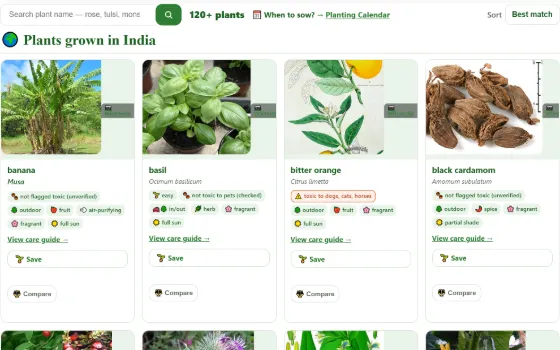
India & tropics: filter by climate instead of USDA zone — the finder maps tropical/subtropical/monsoon suitability that Western zone systems ignore, and understands Hindi names (tulsi, gulab, genda, kadi patta).
❓ Frequently asked questions
Is this plant finder free to use?
How do I find plants that grow in my country or climate?
Can I filter out plants that are toxic to pets?
What is a USDA hardiness zone and how do I find mine?
Can I search plants in Hindi names like tulsi or gulab?
How accurate is the plant data?
Did the USDA zone map change — am I in a different zone now?
My garden seems warmer or colder than my zone says — why?
Do USDA zones work outside the United States?
Can I find plants for a specific room or low-light corner?
Can I search by purpose — pollinators, edible, drought-tolerant?
🧰 Explore all our free garden tools
Tools hub →Was this tool helpful?