Brindavan Gardens Mysore Plants
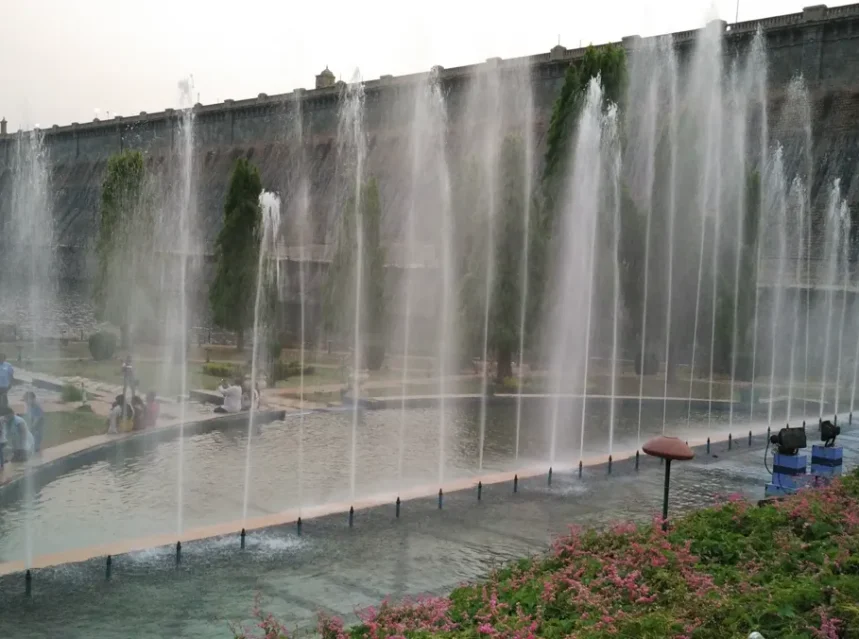
Brindavan Gardens Mysore plants are the mass-bedded annuals, clipped shrubs and ornamental trees laid out across three terraces on the slope below the Krishna Raja Sagara dam in Karnataka. The planting is bold, seasonal and built to be read from a distance. This guide covers what grows there, why the famous fountain depends on rainfall, and which ideas transfer to a home slope.
Quick answer: Brindavan Gardens is a terraced pleasure garden below the KRS dam near Mysuru, laid out between 1927 and 1932. Ficus, Duranta, Euphorbia, celosia, marigold and bougainvillea are the recorded mainstays. The musical fountain runs in the evenings when reservoir levels allow, so the display varies with the monsoon.
🧰 In a hurry? Jump straight to our tested picks for this guide ↓
Brindavan gardens mysore plants at a glance
This is not an ancient garden. It is a 20th-century public landscape, built on the working apron of a dam, and almost everything about the planting follows from that. Karnataka’s other headline garden is the opposite kind of place: Lalbagh in Bangalore is a botanical collection with a research history, where Brindavan is a designed spectacle.
| Feature | Detail |
|---|---|
| Official name | Brindavan Gardens |
| Location | Krishnarajasagara, Mandya district, Karnataka, India, near Mysuru |
| Created | Work began 1927; completed 1932 |
| Created by | Commissioned under Sir Mirza Ismail, Diwan of Mysore; design associated with Gustav Hermann Krumbiegel |
| Size | About 60 acres for the main garden; some travel sources claim 150 acres, which no official source confirms |
| Garden style | Formal terraced pleasure garden, symmetrical, water-led — a 20th-century revival style, not a Mughal garden |
| Planting | Approx. 60 acres of bedding, hedging and ornamental trees; no verified species count has been published (as of 2026) |
| Signature feature | The musical fountain, with water jets choreographed to music and lighting |
| Best season | Roughly October to March, after the south-west monsoon has filled the reservoir |
| Climate | Tropical savanna (Köppen Aw), bordering hot semi-arid; roughly USDA zone 11 equivalent |
| Status | Public garden, open all year |
| Managed by | Cauvery Niravari Nigama, the state irrigation corporation |
Wondering which of these plants would actually survive where you live? Our plant finder filters by zone, light and space.
What makes Brindavan Gardens famous
Three things, and the planting is only one of them.
- The musical fountain. Jets are choreographed to music and coloured light. It is the reason most visitors come after dark rather than at noon.
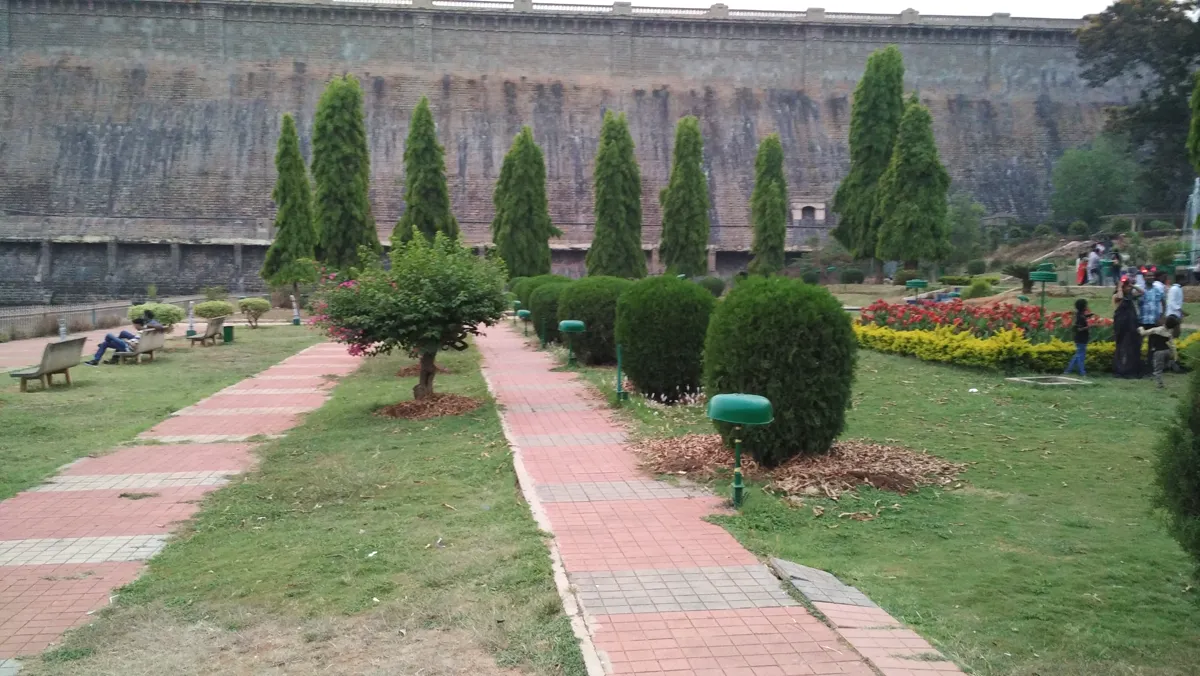
- The terraces. The garden climbs the slope below the dam in stepped levels, so you look down onto the pattern instead of across it.
- The setting. A pleasure garden sitting at the foot of a working irrigation dam is a genuinely unusual pairing. The Wikipedia entry on Brindavan Gardens records topiary, pergolas, gazebos and a boating lake alongside the beds.
Why does the Brindavan Gardens musical fountain depend on the KRS dam?
Because the garden has no water of its own. Every jet, channel and cascade draws on the reservoir held back by the Krishna Raja Sagara dam. That reservoir is filled by the Kaveri, and the Kaveri is fed mostly by monsoon rain.
So the headline feature is not a fixed attraction. In a strong monsoon year the display runs full and long. In a weak year, with storage low and irrigation demand first in the queue, the water show simply is not the same. Farmers downstream have the prior claim, and rightly so.
This is the part most guides skip. The Kaveri river is described as monsoon-fed, and monsoon rainfall across India swings by roughly a fifth either side of average. A garden plumbed into that river inherits the swing.
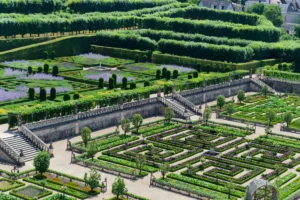
The terracing has the same engineering root. A dam apron is a steep, awkward face of ground. You cannot plant a lawn on it and you cannot walk it comfortably. Cutting the slope into level steps solved three problems at once: it created flat ground to plant, it slowed water running downhill, and it gave every level a view over the one below.
That is exactly the calculation a homeowner makes on a sloping plot. Fighting a slope is expensive and it never really works. Stepping it is cheaper, and the steps become the design.
History: the dam came first, the garden followed
Work on the Krishna Raja Sagara dam began in November 1911. It was commissioned by Maharaja Krishnaraja Wadiyar IV, and Sir M. Visvesvaraya served as chief engineer. The aim was irrigation and famine prevention, not scenery.
Sources disagree on the finish date. The Wikipedia entry on the dam gives completion in 1931 and opening in 1932. Several travel sites state 1924 instead. Treat the early-1930s figure as the better supported one, and treat 1924 with caution.
The garden came afterwards. Laid out between 1927 and 1932 under Diwan Sir Mirza Ismail, it turned the raw ground below the dam into a public landscape. The design is often called Mughal, and it does borrow the terrace-and-channel idea. But it was built in the 20th century, roughly two hundred years after the Mughal garden tradition ended, so the label is loose at best.
What to see: the named areas of Brindavan Gardens
The garden splits into a handful of distinct zones. Knowing the names helps, because signage is patchy and the site is large.
- North Brindavan. The terraced side most visitors rate highest, with stepped levels of lawn, flower beds and clipped hedging.
- South Brindavan. The other bank, with large fountains and its own terraces, plus a glass house showing ornamental plants used across the grounds.
- The musical fountain. The evening set piece, staged against the dam wall.
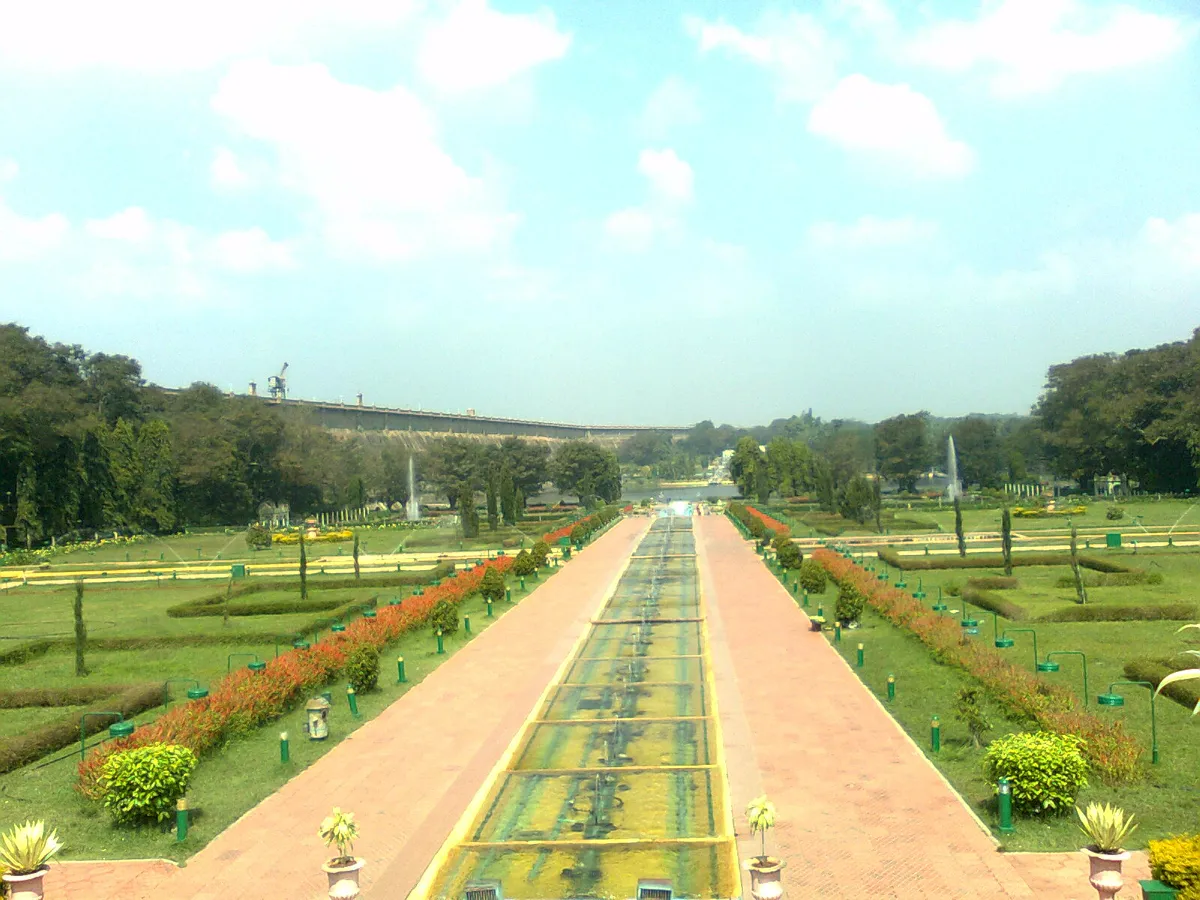
- The central axis and water channel. A long paved walk with a running channel down its spine, aimed straight at the dam.
- The boating lake. Boats cross the water between sections, run by the state tourism corporation.
- Topiary, pergolas and gazebos. Clipped shapes and shaded structures scattered through the beds.
- The children’s garden. A play area with slides and animal sculptures.
Best time to visit Brindavan Gardens
Come in the cooler, drier stretch that follows the monsoon, broadly October through March. The reservoir is usually well filled by then, and daytime heat is manageable.
Come in the evening rather than the middle of the day. The garden is lit, and the fountain runs after dark when reservoir levels allow. A midday visit gives you the layout but misses the point of the place.
Monsoon months bring the water that makes the display possible, but they also bring heavy rain and muddy paths. If the previous monsoon was weak, expect a quieter water show whatever the month.
Planning your own seasonal planting on the same logic? Check your local frost dates and build the year around them with our planting calendar.
Planning a visit: what to know
The garden is a public site managed by a state irrigation body, so arrangements shift with the season and with water availability. Do not rely on a blog for the details, including this one.
Opening times, ticket prices and booking rules change every season, so check the official site before you travel.
Start with Karnataka Tourism and the Karnataka State Tourism Development Corporation, which runs accommodation at the site. Both are government bodies, so their pages outrank third-party listings for accuracy.
One more practical note. Brindavan Gardens sits near Srirangapatna, so many visitors pair it with the island town in the same trip.
Signature plants of Brindavan Gardens — and how to grow them at home
The recorded planting list is short and repetitive, and that is deliberate. Public bedding works by repeating a few reliable performers, not by collecting rarities.
- Cannas. Big paddle leaves and hot flower spikes, grown from rhizomes. They love heat and moisture, which suits a garden beside a reservoir. Start with our canna lily guide.
- Celosia. The flame-shaped and crested annual that gives Indian public beds their intense red and gold. It thrives in humid heat. See how to grow celosia.
- Marigolds. The workhorse of Indian bedding, cheap by the tray and forgiving. Our marigold guide covers spacing and pinching.
- Bougainvillea. Grown here as mass colour on slopes and walls. It flowers best when kept a little dry, so do not overwater it. Read the bougainvillea guide.
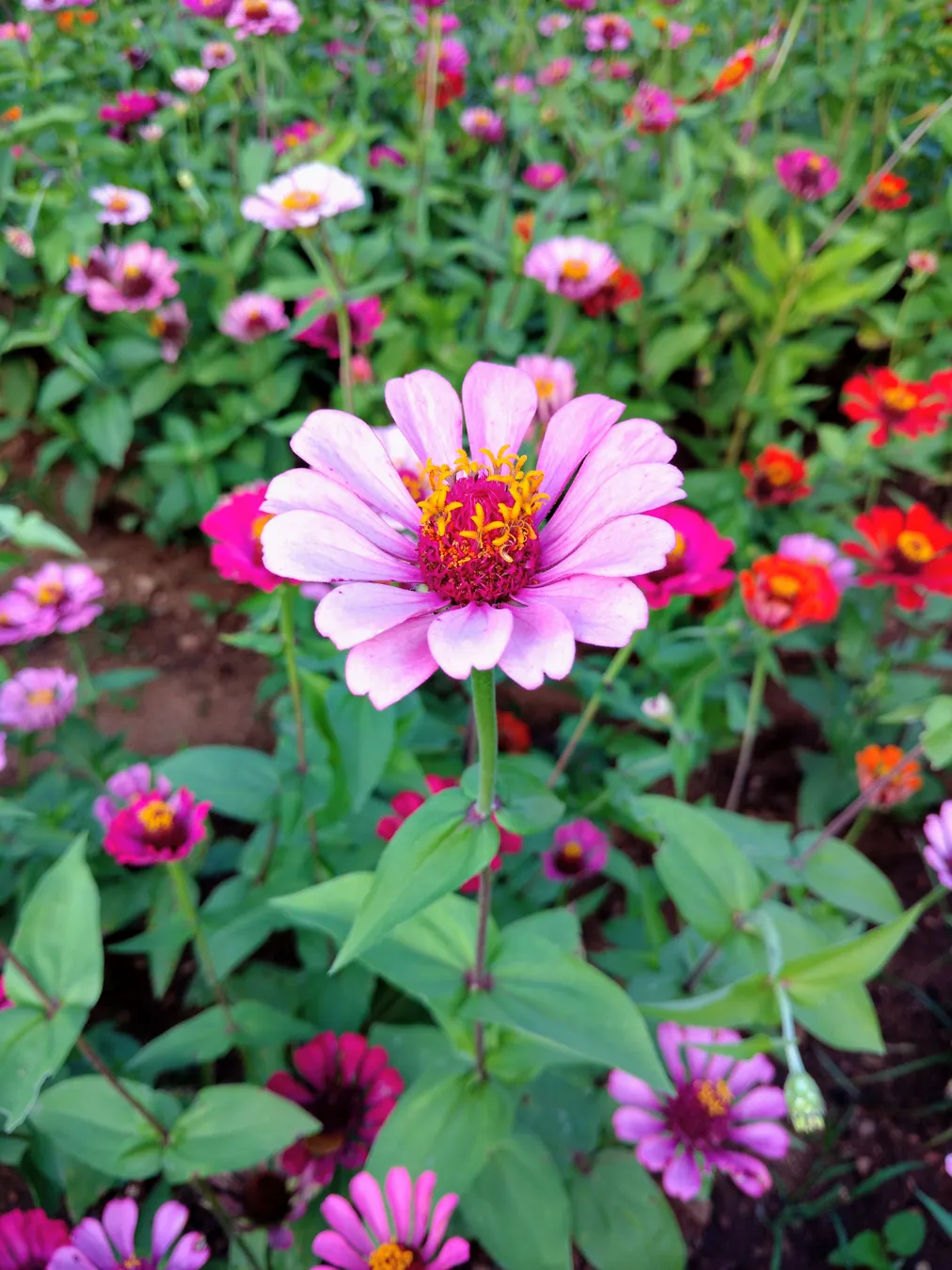
- Zinnias. A common companion in the same beds, sown direct and cut back for a second flush. See our zinnia guide.
All five want free-draining ground and full sun. Work out how much soil a raised terrace bed will swallow with the soil calculator, then set a realistic watering rate using the water calculator.
Growing the Brindavan look in your climate: US, UK and India
In most of India this look is genuinely easy. Cannas, celosia, marigolds and bougainvillea are all comfortable in tropical and subtropical heat, and nurseries sell them by the tray. Sow or plant after the worst of the summer heat, feed the beds, and the colour arrives fast.
In the UK and cooler parts of the US the substitutions matter. Bougainvillea is hardy only in roughly USDA zones 9b and 10, so treat it as a conservatory or patio plant and bring it under cover. Swap it outdoors for a vigorous climbing rose or a clematis on the same wall.
Celosia and marigolds still work as summer annuals in cool climates, but plant them out only after the last frost. They will run later and shorter than they do in Mysuru, so plant a little closer to keep the block solid.
Cannas need overwintering. Where winter minimums fall below about minus ten degrees Celsius, lift the rhizomes before the ground freezes and store them frost-free, above about seven degrees Celsius, then replant in spring. In mild coastal areas a deep mulch over the crown is often enough.
On a hot Indian rooftop the same palette works in containers, though pots dry out fast. Our terrace gardening guide for India covers weight, drainage and shade. On any slope, a mulch layer is the cheapest erosion control you can buy, and our mulching guide explains depth and material choice.
5 design lessons from Brindavan Gardens you can copy
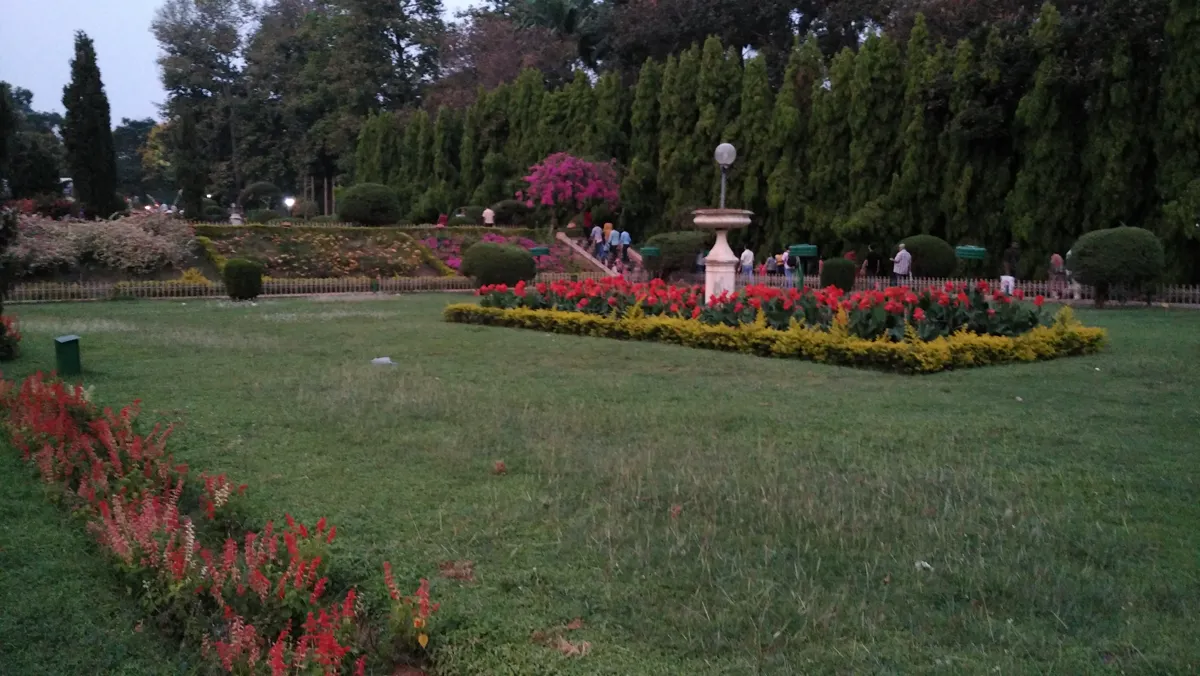
- Terrace the slope instead of fighting it. Cut the fall into two or three level steps and hold each one with a low wall. Keep home retaining walls low, drain behind them with gravel, and get anything above roughly a metre checked by a builder. Level ground is easier to plant, easier to water and far easier to walk.
- Design for the evening. This garden is built to be seen after dark, and that is a choice you can copy. Light the steps for safety, uplight one tree, and leave the rest dark. Low-voltage fittings and warm light do more than floodlighting, which flattens everything and annoys the neighbours.
- Plant bold single-colour blocks. Scattered mixed colour turns to mush at distance. A solid block of one marigold or one celosia holds its shape across a garden. Repeat the same block twice rather than adding a third colour.
- Anchor a long axis with water. The central walk here runs straight at the dam with a channel down its middle. At home the same trick works at a tenth of the scale: a straight path, a narrow rill or a simple bowl at the far end, and one thing worth looking at behind it.
- Scale the public look down. Municipal planting fails in small gardens when you keep the size and the fussiness. Keep the repetition and the crisp edges, but drop to one block instead of six, and use a soft evergreen edge rather than clipped bedding ribbons.
Sketch the terraces and the axis before you dig, using the garden planner. Then work out how many plants each block actually needs with the plant spacing calculator, because block planting fails when it is too thin.
Who shaped the planting, and who runs it now
The design is widely associated with Gustav Hermann Krumbiegel, the German botanist who came to Mysore state in 1907 and ran Lalbagh as superintendent. He introduced many ornamental and economic species to the region and founded India’s first horticultural training school, so the confident use of a small, repeated plant palette here reflects a professional hand rather than an amateur one.
Today the garden is managed by the Cauvery Niravari Nigama, the state irrigation corporation, which also operates the dam. That single fact explains a great deal. When an irrigation body owns a garden, water for crops comes first and the fountain comes second.
Recreate the look at home: what you’ll need
Time your sowing properly so the blocks all flower together, rather than in dribs and drabs. Our seed starting calculator works backwards from your planting date.
Frequently asked questions
Is Brindavan Gardens the same as Vrindavan near Mathura?
No, and this is the most common mix-up of all. Brindavan Gardens is a terraced garden below the KRS dam in Karnataka, in south India. Vrindavan is a pilgrimage town in Mathura district, Uttar Pradesh, about 15 km from Mathura, associated with Krishna. The names transliterate almost identically, and search engines conflate them constantly, but they are more than 1,800 km apart and have nothing to do with each other.
Does the musical fountain always run?
No. It runs in the evenings when reservoir levels allow. The water comes from the KRS reservoir, so a poor monsoon means a reduced display. Check locally before you make a special trip.
Who built Brindavan Gardens and when?
It was laid out between 1927 and 1932 under Sir Mirza Ismail, then Diwan of Mysore, on the ground below the dam. The design is associated with the botanist Gustav Hermann Krumbiegel.
How big is Brindavan Gardens?
About 60 acres for the main garden, with additional orchard and farm land alongside. Some travel sites quote 150 acres. That larger figure appears in secondary sources only, so treat 60 acres as the reliable number.
Is Brindavan Gardens a Mughal garden?
No. It borrows the terrace-and-channel idea associated with gardens such as Shalimar Bagh in Srinagar, but it is a 20th-century creation. The Mughal garden tradition belongs to roughly the 16th to 18th centuries, so calling this a Mughal garden is a stylistic shorthand rather than a historical fact.
How far is Brindavan Gardens from Mysuru?
Roughly 12 to 21 km depending on the route and which source you read, in Mandya district. Allow around 45 minutes by road, and longer at weekends when the evening crowd builds.
What is the best month to visit?
Any month between October and March is comfortable, once the monsoon has filled the reservoir and the heat has dropped. Evening visits beat daytime ones in every month.
Which Brindavan Gardens plants can I actually grow at home?
Cannas, celosia, marigolds and zinnias are straightforward almost anywhere warm, and they are cheap enough to plant in blocks. Bougainvillea needs a frost-free spot or winter shelter. If something you plant starts failing, our plant doctor helps you work out why.
How do I copy the terraced look on a small sloping garden?
Cut two or three level steps instead of one long ramp, hold each step with a low wall, and drain behind the wall with gravel. Plant the flat parts and keep the wall faces simple. Two clean terraces look far better than five fussy ones.
Is Brindavan Gardens the largest garden in India?
No. At roughly 60 acres it is modest by botanical-garden standards, and it is usually described as one of India’s best-known terraced and illuminated gardens rather than the biggest. Its reputation rests on the water display and the setting, not on area.
How does it compare with Lalbagh in Bengaluru?
They answer different briefs. Lalbagh is an older botanical garden built around its trees and collections. Brindavan Gardens is a younger ornamental landscape built around water, terraces and evening lighting, so it rewards a short evening visit rather than a long botanical wander.
Are there other Indian gardens worth pairing with a visit?
Yes. Srirangapatna, the river island town on the Kaveri, sits close by and works well as a half-day addition. Bengaluru’s gardens are within a comfortable drive if you are travelling on from Mysuru.
Related gardens and guides
Brindavan is one of twenty in our guide to the 20 most famous gardens in the world.
- Kew Gardens plants — what grows in each glasshouse, and what transfers home.
- Versailles garden design — the long axis and formal geometry taken to their limit.
- Flower bed design for beginners — how to plan the block planting described above.
Still stuck? Ask the Plant Doctor
Describe the problem — yellow leaves, holes, no flowers — and get a clear answer in seconds. FreeAI can make mistakes. Answers are guidance, not a guarantee — check anything important against the guide it links to, and always read the label on any product before you use it.