Dubai Miracle Garden Flowers
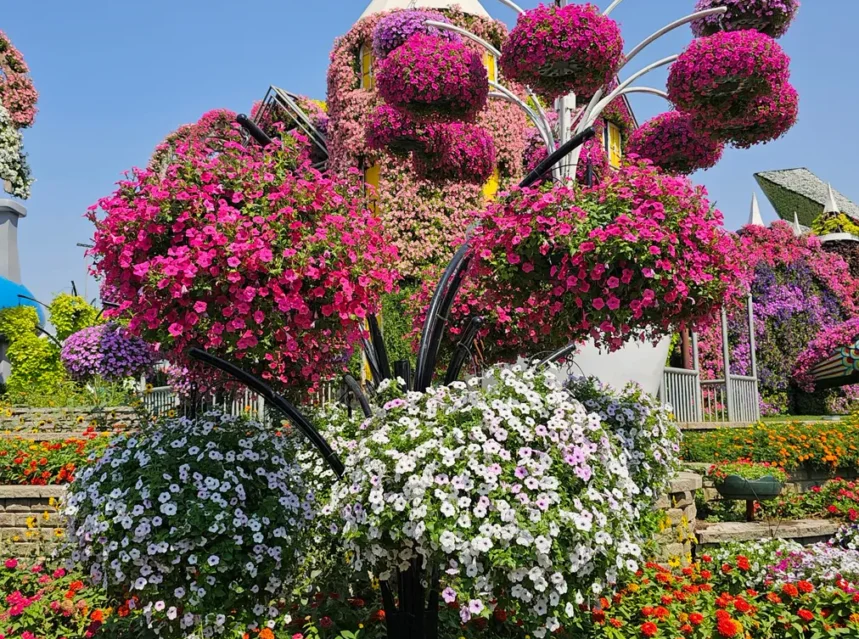
Dubai Miracle Garden flowers are mass-planted bedding annuals, mostly petunias, marigolds and geraniums, grown on a desert site and kept alive by treated wastewater fed through drip line. That last detail is the whole story. Most write-ups on Dubai Miracle Garden flowers count the blooms and stop there, when the interesting part is the plumbing underneath them.
Quick answer: The garden opened in Dubailand in February 2013 and covers about 72,000 square metres. It runs a cool season only, roughly autumn to late spring, then shuts through the hottest months. The beds are short-lived annuals, replanted repeatedly, and the water is recycled municipal grey water delivered at the roots.
🧰 In a hurry? Jump straight to our tested picks for this guide ↓
Dubai miracle garden flowers at a glance
This is a seasonal display garden, not a botanical collection. Nothing here is a long-lived specimen plant. Everything is bedding, and that single decision explains almost every other choice on the site.
| Feature | Detail |
|---|---|
| Official name | Dubai Miracle Garden |
| Location | Dubailand district, Dubai, United Arab Emirates |
| Opened | 14 February 2013, on Valentine’s Day |
| Created by | Akar Landscaping and Agriculture, led by Jordanian businessman Abdel Naser Rahhal |
| Size | About 72,000 square metres, or roughly 780,000 square feet. It started far smaller, at around 2,000 square metres |
| Garden style | Carpet bedding and vertical bedding, worked at theme-park scale |
| Planting | Approx. 50 million flowers and 250 million plants, per Wikipedia as of 2026. Press releases quote 150 million flowers instead. See the note below on why these disagree |
| Signature feature | Flowers grown on vertical frames and arches rather than only in flat beds |
| Season | Cool season only, roughly autumn to late spring. The garden closes through the hottest months, and exact dates are announced each season |
| Climate | Hot desert, Köppen BWh. July averages a high near 43 °C with under 100 mm of rain a year. No official USDA zone is published for the UAE |
| Record or status | Guinness World Records recognises it for the largest flower arrangement or structure, achieved 2 December 2016 |
| Managed by | The Miracle Garden group, a private operator |
Wondering which of these annuals would survive your own summer? Our plant finder filters by zone, light and space.
What makes Dubai Miracle Garden famous
Three things, and only one of them is the flower count.
- It is a flower garden in a desert. Dubai gets under 100 mm of rain in an average year and July highs sit around 43 °C. Nothing in these beds is native or drought-adapted, so every litre is delivered by hand-built infrastructure.
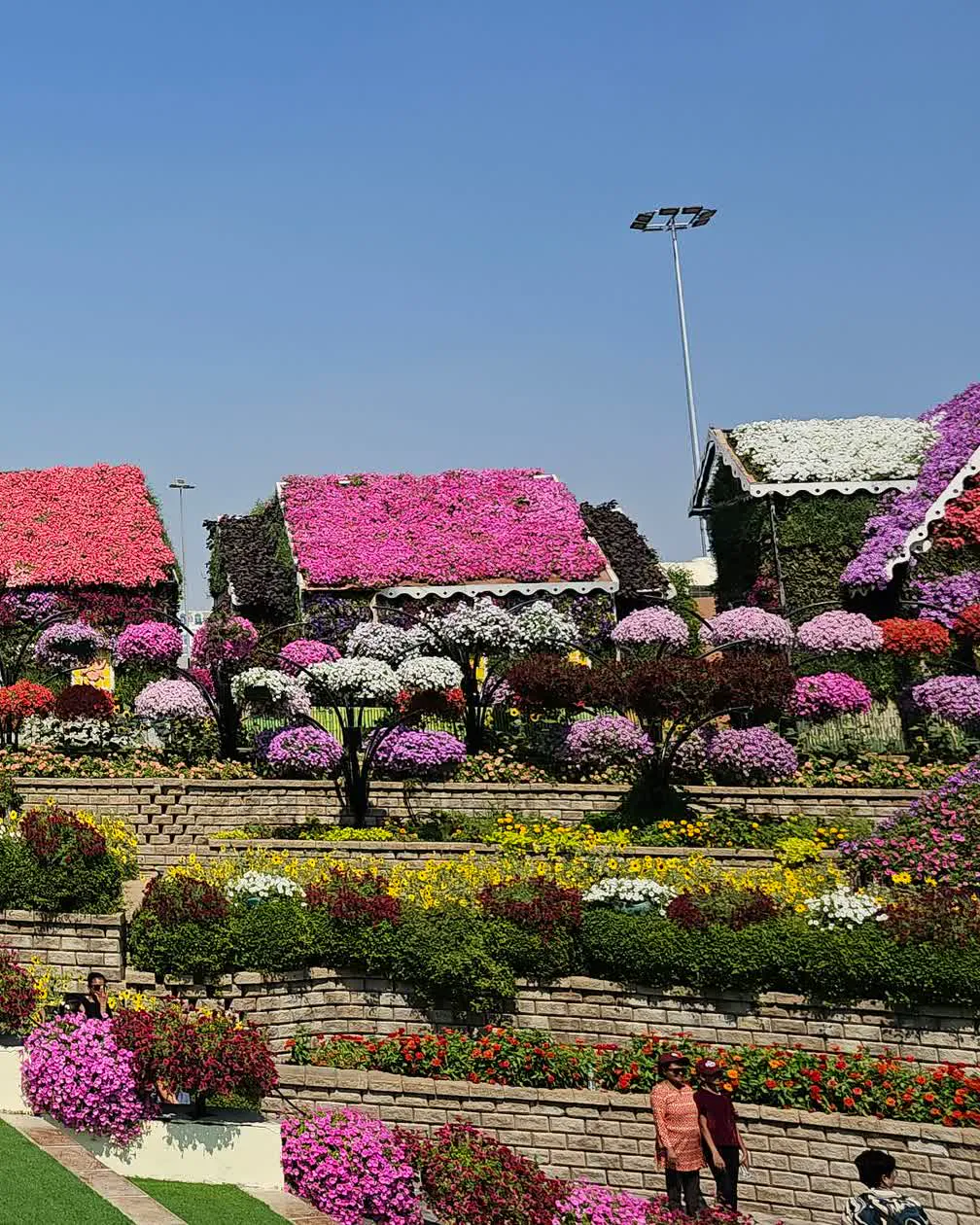
- The planting goes vertical. Instead of laying colour flat, the garden pins bedding plants onto frames, walls and arches. That multiplies the visible flower area without needing more ground.
- It holds a verified world record. Guinness World Records lists Dubai Miracle Garden as holder of the largest flower arrangement or structure, measured at 72.95 m by 78.34 m by 21.98 m on 2 December 2016.
Be careful with the numbers, though. Wikipedia says over 50 million flowers and 250 million plants, recent season announcements say 150 million across 120 varieties, and earlier press reports said 100 million across 70. These are operator-supplied marketing figures rather than audited counts, and they have grown season on season. The area, about 72,000 square metres, is the one figure every source agrees on. Several widely repeated Guinness titles deserve the same caution, because the record pages for a longest flower wall and a largest vertical garden do not resolve on the Guinness site.
How do you water a flower garden in the middle of a desert?
This is the question the garden actually answers, and it is the most useful thing on the site for anyone gardening in heat.
The water is not fresh. Wikipedia records that the garden uses about 757,082 litres a day of treated grey water from Dubai municipality, delivered by drip irrigation. One older horticultural profile puts the nightly volume closer to 1,000 cubic metres, so even that figure is disputed by roughly a quarter. What nobody disputes is the source and the method: recycled water, applied at the root.
That fits a much bigger municipal system. The Dubai Government Media Office reports that the city recycles around 90% of its wastewater and uses roughly 265 million cubic metres a year to irrigate some 10,400 hectares of green space. The garden is a showpiece for that system, not a one-off.
Why drip, and not sprinklers. Colorado State University Extension puts the difference plainly: drip irrigation exceeds 90 percent efficiency, while sprinkler systems run at 50 to 70 percent. In a hot, dry, breezy climate the gap widens, because the water a sprinkler throws into the air is lost to evaporation and wind drift before it lands. That loss is non-recoverable. It leaves as vapour.
Why recycled water has to go under, not over. Grey water carries soap residue, salts and bacteria. University of California guidance is firm that it should never be sprayed onto leaves, stems or edible parts, and should be delivered by drip or into a mulch basin instead. So sub-surface delivery is not an efficiency preference here. It is the safety requirement that makes reuse possible at all.
Why the timing matters. Clemson University’s Home and Garden Information Center measured the cost of watering at the wrong hour. Irrigating between roughly 10 a.m. and 4 p.m. loses 20 to 30 percent of what you apply, so an inch of water delivers about 0.7 inches of benefit. At night the loss drops to about 15 percent. Clemson’s recommendation is to finish every zone before 5 a.m., which captures the low evaporation of darkness while still letting foliage dry at daybreak.
Now take that home. Four transferable rules come out of it, and none of them need a municipal budget.
- Put the water where the roots are. A soaker hose or a cheap drip kit on a tap timer beats any overhead sprinkler in heat, and it beats hand watering for consistency.
- Run it before sunrise. Set the timer to finish at first light. You get night-time evaporation figures and morning leaf-drying at the same time.
- Mulch over the drip line. Utah State University Extension reports that mulching can give a ten-fold reduction in evaporative water loss, at 3 to 4 inches for organic mulch and 2 to 3 inches for gravel. Other extension services put the saving nearer 50 percent, so treat the range honestly. Either way it is the cheapest water you will ever save. Keep a few inches clear around stems.
- Reuse what you already have. Rinse water from washing vegetables, cooled cooking water and laundry rinse water can go on ornamental beds. Use it within 24 hours, keep it off foliage and off anything edible, and avoid detergents high in sodium, boron or bleach.
Our mulching guide covers depths and materials properly, and the watering calculator will size the volume for your bed.
History: how a flower garden reached Dubailand
The garden opened on 14 February 2013. The date was chosen for Valentine’s Day.
It was built by Akar Landscaping and Agriculture, a UAE landscaping contractor, led by the Jordanian businessman Abdel Naser Rahhal. The first phase was small, around 2,000 square metres. It has since grown to roughly 72,000.
Growth came through set pieces rather than expansion of the beds. The Airbus-shaped floral structure took the Guinness record in December 2016. A supported topiary sculpture followed in February 2018, and the neighbouring Butterfly Garden opened separately in 2015. The encyclopedia record of the garden tracks these additions season by season.
The wider context matters more than the timeline. The UAE draws a large share of its drinking water from desalination, which is expensive and energy-hungry. Reusing treated effluent for landscape irrigation frees that expensive water for people. A garden like this only becomes defensible once the recycled-water network exists.
What to see: the named areas of Dubai Miracle Garden
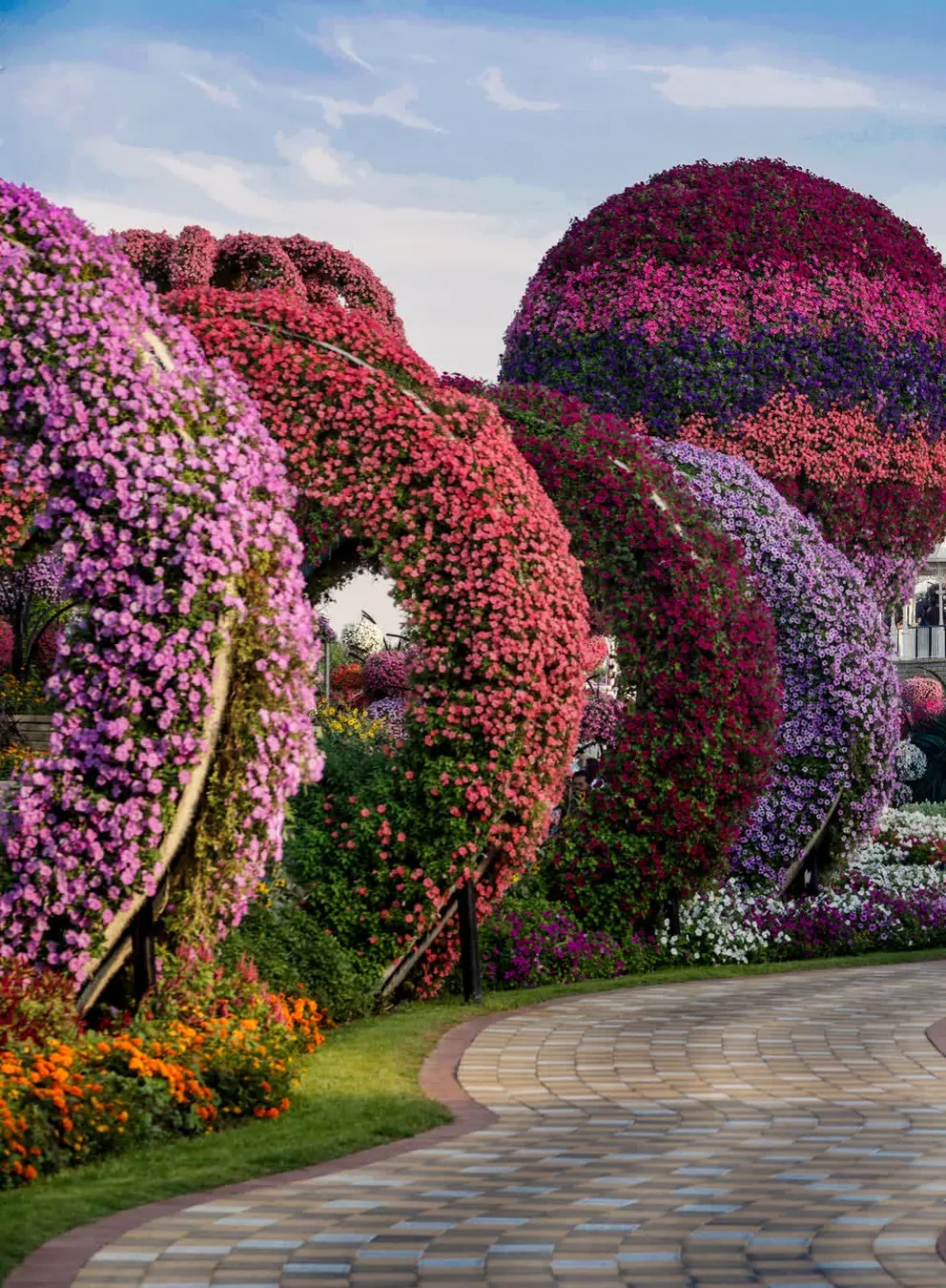
Layouts change between seasons, and installations are rebuilt rather than left standing. These are the areas that recur most often.
- The Heart Tunnel. A walk-through arch clothed in trailing bedding, and the most photographed thing on site.
- The Floral Castle. Towers and turrets planted on their vertical faces, showing off the frame-and-pocket growing method.
- The Aircraft Structure. The full-size floral aeroplane that carries the Guinness record for the largest flower arrangement.
- Disney Avenue. A themed walk of licensed character topiary, added in later seasons.
- Smurfs Village. A second character-themed area, aimed squarely at families.
- The Floral Clock and Umbrella Passage. Working set pieces built entirely from bedding plants.
- The Lake Park and shaded seating areas. Water features and planted shade structures, which are the parts a hot-climate gardener should study hardest.
Best time to visit Dubai Miracle Garden
The season is the answer, because there is no choice in it. The garden runs through the cool months only, roughly autumn to late spring, and closes through the hottest part of the year. Exact dates are announced season by season and have shifted noticeably between years.
Within the season, early is not always best. Group CEO Mohammed Zaher Hammadih has said that at opening the flowers were planted only two to three weeks earlier, and that displays change more than once during the season. So beds are still filling out at the start and at their fullest some weeks in. Time of day matters too, because the light is kinder early and late.
None of this transfers to your own beds. Dubai’s calendar is upside down compared with most temperate gardens, where the display season is summer. Work out your own window with our frost date finder and planting calendar.
Planning a visit: what to know
Allow more time than the map suggests. The interesting parts are the planted structures, and those reward slow walking rather than a circuit.
Dress for a desert. Even in the cool season the site is open, paved and reflective, so shade is limited between the installations. The neighbouring Butterfly Garden is a separate attraction with its own entrance, and it is not the same place as the flower garden, despite sharing a car park in most write-ups.
Opening times, ticket prices and booking rules change every season, so check the official site before you travel. The garden publishes its own dates at dubaimiraclegarden.com, and that is the only source worth trusting on logistics.
Signature plants of Dubai Miracle Garden — and how to grow them at home
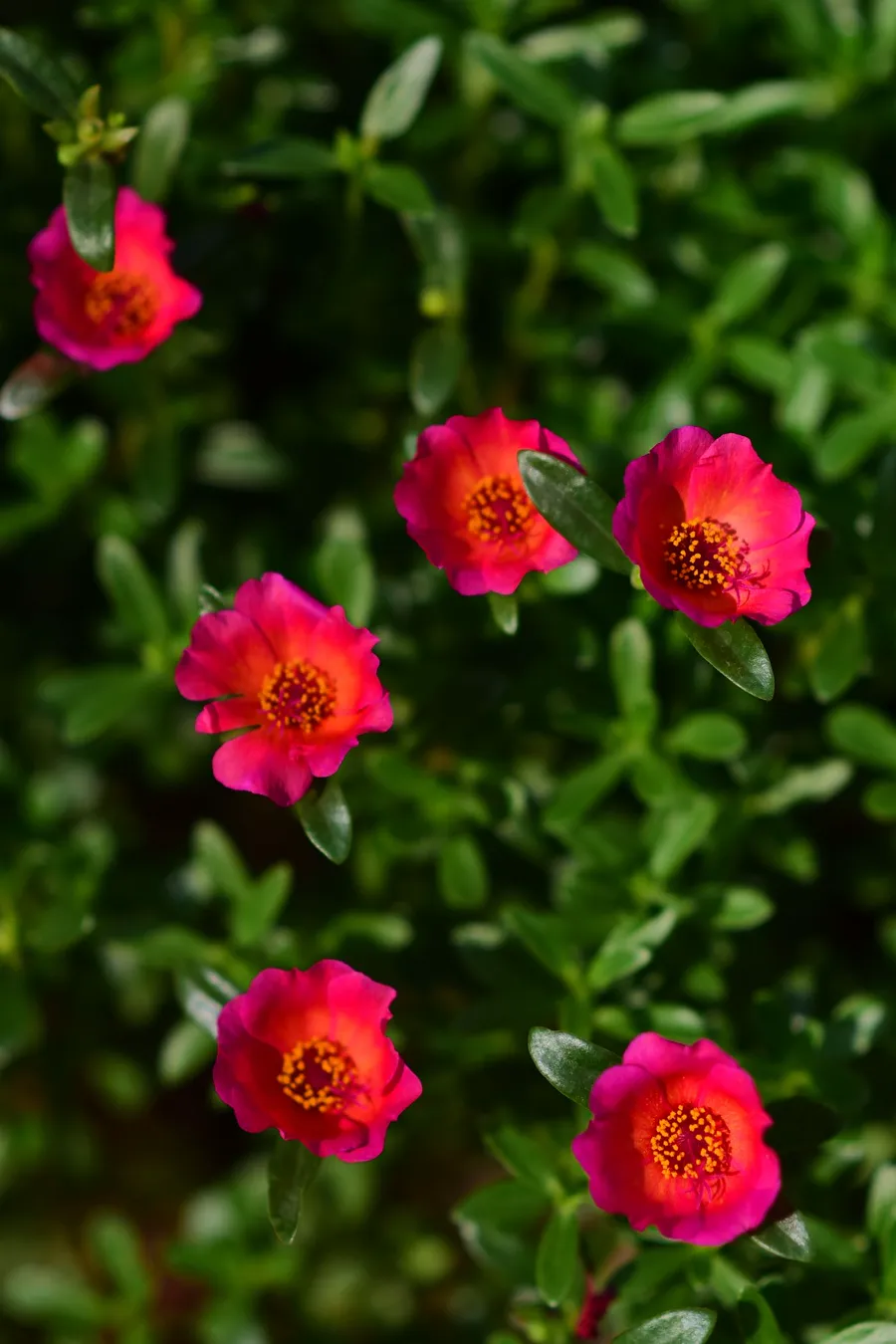
Reports consistently name the same short list at the garden: petunias above all, then marigolds, geraniums, sunflowers, roses and violas. Petunias dominate the vertical work because they trail, flower continuously and cover a frame fast.
- Petunias — the workhorse. They flower for months, trail well from height and come in every colour the design needs. They do go leggy by mid-season, so pinch them back hard rather than waiting for them to recover on their own.
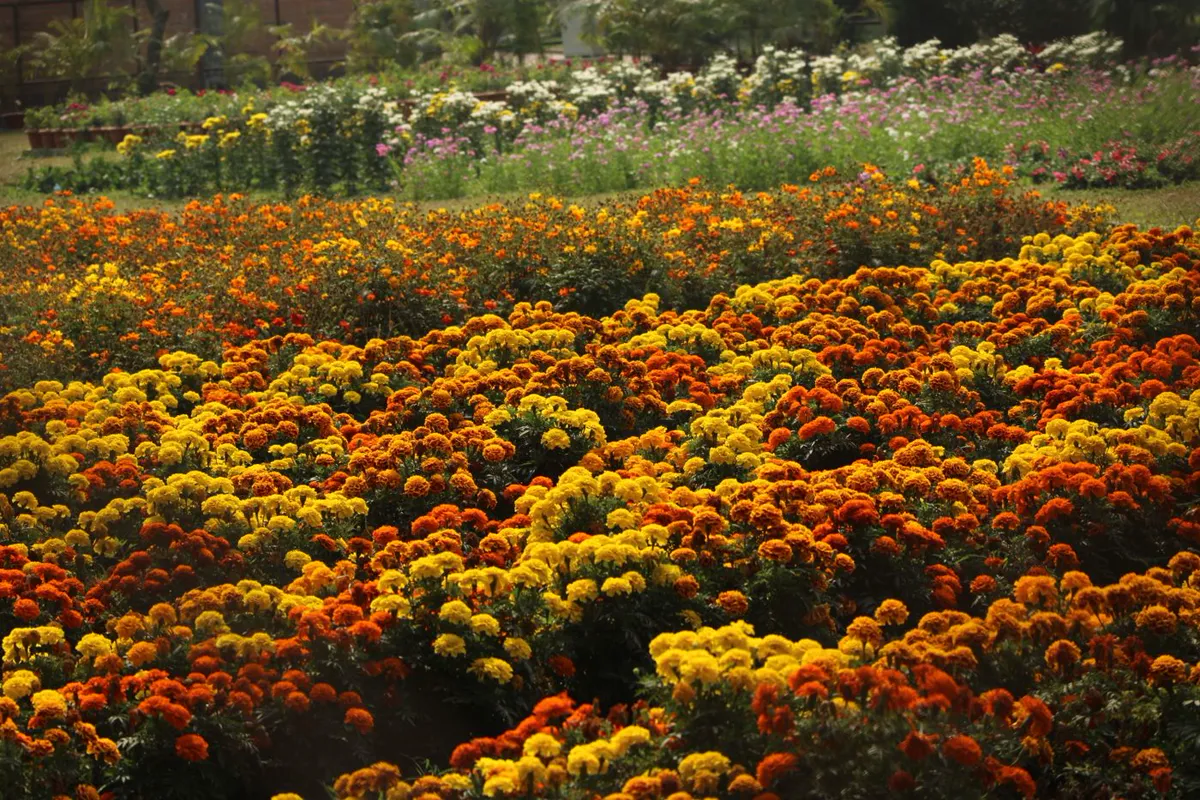
- Marigolds — the block colour. Tolerant of poor soil, happy in strong sun, and already grown at enormous scale across India for garlands and festivals.
- Geraniums — the structure. Useful, but the genuinely heat-limited one on this list. Michigan State University research notes that growing temperatures above about 85 °F bleach and yellow the leaves, with recovery once conditions ease.
- Impatiens — the one to avoid copying in heat. North Carolina State’s plant record is blunt: it performs best in part to full shade, is sensitive to heat, wilts in hot dry spells and has low drought tolerance. Grow it in shade, or not at all.
- Portulaca — the substitute nobody thinks of. Moss rose is succulent-leaved, needs full sun and thrives on the neglect that kills softer bedding. It is the plant to reach for when a bed bakes.
- Bougainvillea — the permanent version. Where petunias are a season, bougainvillea gives you the same saturated colour on a frame year after year in a warm climate, and it flowers better dry than wet.
Get the ground right before you plant any of them. Our soil calculator sizes the mix for a bed or a raised frame, and the watering calculator tells you what that volume actually drinks in heat.
Growing the Dubai Miracle Garden look in your climate: US, UK and India
Start by being honest about what the garden is doing. It is not beating the heat. It is avoiding it, by running its display in the cool months and shutting when the weather wins. Copy the avoidance, not the defiance.
United States. In the Southwest and the hot South the Dubai calendar is the right model. Run bedding in spring and again in autumn, and let high summer be a maintenance season rather than a display one. Elsewhere, summer bedding works normally, but the irrigation lessons still pay. Fit drip under mulch and set the timer to finish before sunrise.
United Kingdom. Water is rarely the limit, so take the structural idea instead. The vertical frames, arches and planted shade are what translate. British summers are dull enough that trailing petunias on a frame will flower less freely than they do under Gulf sun, so plant more densely to compensate.
India. This is the closest match anywhere, and the seasonal split is official. The Central Public Works Department horticulture list places petunia, pansy, snapdragon, dianthus, calendula and both African and French marigold on the winter flower list, while portulaca, vinca, zinnia, gaillardia and cosmos sit on the summer one. So the Dubai plant list is, almost exactly, an Indian winter bedding list.
That gives you a clear plan. Run petunias, marigolds, dianthus and calendula through the cool season, then hand the beds over to portulaca, vinca and zinnia when the real heat arrives. Do not try to carry petunias through an Indian May.
The technique that makes it work in an Indian summer is the same four-part stack the desert garden uses, scaled down.
- Drip, not a hose. Even 30 metres of budget drip line on a tap timer removes the single biggest variable, which is you forgetting.
- Water before dawn. Aim to finish by first light. Midday hand watering in 40 °C is throwing a third of it away.
- Mulch 3 to 4 inches. Coconut coir, straw, sugarcane trash or dry leaves all work. Keep it off the stems.
- Shade cloth over the worst of it. University of California guidance suggests about 40 percent density for home gardens, and notes anything denser is unnecessary. Use 30 to 40 percent over flowering plants, and 50 percent only for seedlings and leafy greens.
Containers need one more decision. Light-coloured pots run measurably cooler than black ones, and USDA Agricultural Research Service nursery work found white containers cut base-layer temperature by roughly 8 to 12 °F against black. Bigger pots also hold more water and swing less in temperature, so go up a size on a terrace. Our terrace gardening guide for India covers drainage, pot choice and monsoon protection in detail, and drought-tolerant garden ideas covers the planting side.
5 design lessons from Dubai Miracle Garden you can copy
- Spend your money on delivery, not volume. A bed on drip under mulch, watered before dawn, will outperform the same bed watered twice as often by hand in the afternoon. Fix the method before you increase the water.
- Make your shade grow. The planted arches and umbrella structures do two jobs at once: they shade the path and they are the display. At home that is a pergola with a vine on it, rather than a bare sail that shades nothing but soil.
- Accept a closed season instead of fighting it. The garden shuts rather than watching its beds die. Give your own garden a dormant window in whichever season defeats it. Cut back, mulch heavily, drop watering to survival level, and put the effort into raising the next round of plants. A garden with two good seasons beats one with four mediocre ones.
- Block your colour, and shrink the block, not the count. Every bed here reads from a distance because one variety is planted in quantity. On a balcony that becomes one long trough of a single petunia colour rather than six pots of six things. Get the plant spacing tight enough that the block closes into a sheet.
- Use annuals where perennials cannot survive. Nothing here is expected to live long, and that is the correct answer when the climate kills anything permanent. Annuals let you change the scheme each season, and they fail cheaply. Plan the changeover with our garden planner.
What water-wise researchers say about irrigating in extreme heat
The figures behind this article do not come from the garden. They come from people who study water-scarce horticulture for a living.
Heidi A. Kratsch, Ornamental Horticulture Specialist at Utah State University Extension, is the source of the strongest single number in water-wise landscaping: mulch can deliver a ten-fold reduction in evaporative loss from soil. Her guidance also sets the depths and insists on a clear gap around stems to prevent root collar disease.
Clemson University’s Home and Garden Information Center supplies the timing rule. Midday watering loses 20 to 30 percent to evaporation, and night watering halves that loss but risks disease, so the recommendation is to programme every zone to finish before 5 a.m.
For the desert side, the International Center for Biosaline Agriculture, a not-for-profit institute based in Dubai itself, works on growing productively where water is scarce and often salty. Its focus on salinity is the point home gardeners miss when they start reusing water. Sodium and boron accumulate in soil over years, and that, not the heat, is what eventually kills a reused-water bed.
Recreate the look at home: what you’ll need
Raising the annuals yourself rather than buying trays? Time the sowing with our seed-starting calculator.
Frequently asked questions
What months is Dubai Miracle Garden open?
It runs a cool season only, roughly autumn through to late spring, and closes through the hottest months. The exact dates are set season by season and have moved by several weeks between years, so check the official site rather than a date you read somewhere.
Why does Dubai Miracle Garden close in summer?
Because the plants cannot survive it. These are soft bedding annuals, not desert plants, and Dubai’s July averages a high near 43 °C. Closing also frees the summer for raising the next season’s seedlings, which is the real work of a bedding garden.
Which flowers are used in Dubai Miracle Garden?
Petunias dominate, especially on the vertical structures, because they trail and flower continuously. Marigolds, geraniums, sunflowers, violas and roses are the other names that come up repeatedly. Everything is bedding, chosen for fast cover and long flowering rather than rarity.
How many flowers are in Dubai Miracle Garden?
Nobody outside the operator knows. Wikipedia records over 50 million flowers and 250 million plants, while recent season announcements say 150 million flowers, and earlier reports said 100 million. These are self-reported marketing figures that have risen over the years, not audited counts, and they are worth treating as an impression of scale rather than a measurement.
How do the flowers survive the desert heat?
Mostly by not being there for it. The display runs in the cool season and shuts before the worst arrives. While it runs, the plants are fed treated grey water through drip irrigation at the root zone, which is both far more efficient than sprinklers and the only safe way to apply recycled water.
How much water does Dubai Miracle Garden use?
Reported figures are around 757,082 litres a day of treated municipal grey water, though one older account puts the nightly volume nearer 1,000 cubic metres. The two do not agree. What is well documented is the wider system: Dubai recycles roughly 90 percent of its wastewater and uses about 265 million cubic metres a year to irrigate public green space.
How long should you allow for a visit?
Two to three hours is realistic if you want to look at the planting rather than photograph one arch and leave. The site is flat and paved, so walking is easy, but shade between installations is limited and that shortens most people’s stamina more than distance does.
Is Dubai Miracle Garden really the world's largest flower garden?
It is widely described that way, and it does hold a verified Guinness record for the largest flower arrangement or structure. That record is about one installation, not the whole garden. The broader superlative is a marketing claim rather than an independently measured one.
How is Dubai Miracle Garden different from the Dubai Butterfly Garden?
They are separate attractions with separate entrances, often confused because they sit side by side. The Butterfly Garden is a set of climate-controlled domes housing live butterflies. The Miracle Garden is open-air bedding display. Photographs of one are frequently captioned as the other.
Can I grow a Miracle Garden style display at home?
Yes, at a fraction of the scale. Pick one or two annuals, plant them in solid blocks rather than mixed, add height with a simple frame or arch, and put the whole thing on drip under mulch. The design idea scales down far better than the flower count does.
How do I copy the colour-block look on a balcony?
Reduce the number of varieties, never the number of plants. One long trough packed with a single petunia colour reads as a block; six pots of six different plants reads as clutter. Repeat the same block twice along a railing and you have rhythm, which is most of what the big garden is doing.
Can I create a Dubai Miracle Garden look in India?
Yes, and the plant list barely changes. Petunia, marigold, dianthus and calendula are all official winter-season flowers in India, so run the display through the cool months. Then switch the beds to portulaca, vinca and zinnia for the summer, and mulch heavily.
Why do my petunias go leggy and stop flowering in the heat?
That is normal mid-season behaviour, not a disease. Petunias stretch and thin out after months of flowering, and heat accelerates it. Cut them back by about a third, feed, and keep water at the root rather than the foliage. If the plant is collapsing rather than stretching, our plant doctor can help identify the cause from a photo.
Related gardens and guides
See where it sits among the 20 most famous gardens in the world.
More famous gardens worth reading next: Keukenhof tulip garden for bedding at a similar scale in the opposite climate, Butchart Gardens flowers for the same mass-bedding discipline on a quarry floor, and Kew Gardens plants for the botanical opposite of a display garden.
Still stuck? Ask the Plant Doctor
Describe the problem — yellow leaves, holes, no flowers — and get a clear answer in seconds. FreeAI can make mistakes. Answers are guidance, not a guarantee — check anything important against the guide it links to, and always read the label on any product before you use it.