Plant Spacing Calculator: How Far Apart to Plant?
 By
By The Plant Spacing & Seed-rate Calculator tells you exactly how many plants fit in your bed and how much seed you need — no waste, no overcrowding.
More about this tool
Works in metric and imperial, for any bed size. 💚 Save your plants to My Garden in your free Gardening Guider profile — and get free care reminders & seasonal follow-ups for the plants actually growing in your garden.
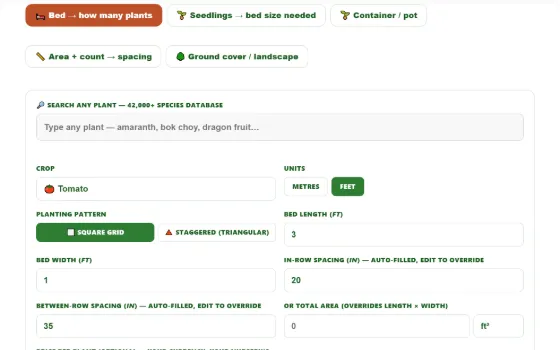
👀 Live preview — your bed at this spacing
🧱 Lay it out visually → Garden Bed Planner · 🤝 good neighbours → Companion Checker · 🗓️ when to sow → Planting Calendar
How Many Plants Can I Fit in My Garden Bed?
A plant spacing calculator answers one question: how far apart to plant. Enter your bed and your crop and it returns how many plants fit, the vegetable plant spacing in inches and centimetres, plants per square foot for square-foot gardening spacing, and a live picture of the layout. To fill the same bed with mix, use the soil calculator.
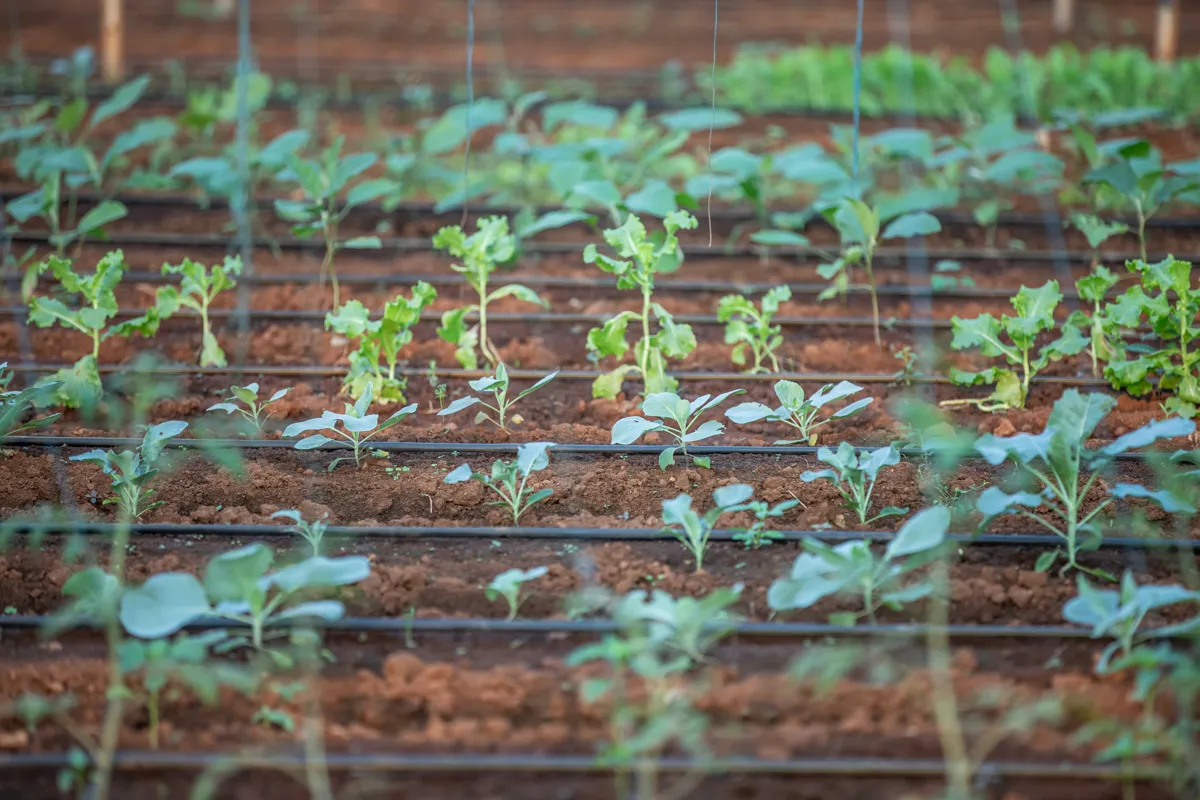
The calculator above answers the question every gardener asks at planting time: given a bed of a certain length and width, how many tomato, cabbage or carrot plants will actually fit without crowding? It works from two numbers that matter for every crop — the in-row spacing (the gap between plants along a row) and the between-row spacing (the gap between rows). Enter your bed size in metres or feet, pick a crop, and it returns the plant count three different ways: classic rows, an equal-spacing grid (square or staggered), and the intensive square-foot-gardening count for raised beds.
Why three answers? Because the right layout depends on how you garden. Traditional row planting leaves wide paths between rows so you can walk, hoe and pick — it fits the fewest plants but is easiest to manage in open ground. An equal-spacing grid drops the walking paths and spaces plants evenly in both directions, which suits raised beds you tend from the edges. Square-foot gardening pushes density further still for small, deeply-improved beds. The calculator also estimates how many seeds to buy, adding a 20% buffer because germination is never 100%.
How the Plant Spacing Calculator Works — the Formula
📐 Show the exact formulas the calculator uses
Row method: rows = bed width ÷ between-row spacing (rounded down); plants per row = bed length ÷ in-row spacing (rounded down); total = rows × plants per row.
Square grid (equal spacing): plants = bed area ÷ spacing² — each plant gets a square cell of spacing × spacing.
Staggered / triangular grid: plants = bed area ÷ (spacing² × 0.866). Offsetting alternate rows by half the spacing lets rows sit only spacing × 0.866 apart (the hexagonal-packing factor), so about 15% more plants fit at the same plant-to-plant distance.
Square-foot method: plants = bed area in sq ft × plants-per-square for that crop (e.g. 144 ÷ spacing-in² gives 16 for a 3-inch crop like radish, 9 for 4-inch, 4 for 6-inch, 1 for 12-inch).
Seed estimate: plants × seeds sown per station × 1.2 (a 20% germination buffer).
Bed area = 32 sq ft. Square grid: 32 ÷ 1 ft² = 32 plants. Staggered: 32 ÷ 0.866 = 36 plants — 4 more from the same bed, just by offsetting alternate rows by 6 in and pulling the rows to about 10.4 in apart. For lettuce at its recommended 25 cm in-row / 30 cm rows, the row method gives 3 rows × 9 plants = 27 heads, while the square-foot method fits 4 per square × 32 = up to 128 baby-leaf plants if you harvest young.
Plant Spacing Chart — A to Z (Inches + Centimetres)
These are the same spacings the calculator uses, drawn from standard seed-packet and university-extension recommendations. Use the in-row figure between plants and the row figure between rows; halve row gaps for trellised vining crops.
| Crop | Between plants | Between rows | Square-foot method | Tip |
|---|---|---|---|---|
| 🟣 Beetroot | 3 in (8 cm) | 12 in (30 cm) | 9 / sq ft | Each "seed" is a cluster — thin seedlings. |
| 🍆 Brinjal / Eggplant | 20 in (50 cm) | 30 in (75 cm) | 1 / sq ft | Heavy feeder — don't crowd. |
| 🥦 Broccoli | 18 in (45 cm) | 24 in (60 cm) | 1 / sq ft | Leave room for side-shoots after main head. |
| 🌱 Bush Bean | 4 in (10 cm) | 18 in (45 cm) | 9 / sq ft | Sow in blocks for pollination. |
| 🥬 Cabbage | 18 in (45 cm) | 24 in (60 cm) | 1 / sq ft | Even spacing = even heads. |
| 🥕 Carrot | 2 in (5 cm) | 12 in (30 cm) | 16 / sq ft | Thin ruthlessly for straight roots. |
| 🥦 Cauliflower | 20 in (50 cm) | 24 in (60 cm) | 1 / sq ft | Wider spacing = bigger curds. |
| 🌿 Coriander / Dhania | 2 in (6 cm) | 8 in (20 cm) | 16 / sq ft | Sow thick for leaf, thin for seed. |
| 🌽 Corn / Maize | 9 in (22 cm) | 28 in (70 cm) | not suited | Plant in a block (not one long row) for pollination. |
| 🥒 Cucumber | 16 in (40 cm) | 35 in (90 cm) | 2 / sq ft | Halve the row gap if trellised. |
| 🌿 Fenugreek / Methi | 2 in (6 cm) | 8 in (20 cm) | 16 / sq ft | Usually broadcast thickly and cut young. |
| 🧄 Garlic | 5 in (12 cm) | 12 in (30 cm) | 4 / sq ft | Plant single cloves, pointy end up. |
| 🥒 Gourds (bottle/ridge/bitter) | 24 in (60 cm) | 59 in (150 cm) | not suited | Needs an overhead trellis + wide spacing. |
| 🥗 Lettuce | 10 in (25 cm) | 12 in (30 cm) | 4 / sq ft | Closer for baby-leaf, wider for hearts. |
| 🌼 Marigold | 10 in (25 cm) | 10 in (25 cm) | 4 / sq ft | Pinch tips for bushier plants. |
| 🌿 Okra / Bhindi | 12 in (30 cm) | 24 in (60 cm) | 1 / sq ft | Thin to one strong seedling per station. |
| 🧅 Onion | 4 in (10 cm) | 12 in (30 cm) | 9 / sq ft | Sets or transplants; keep weed-free. |
| 🌱 Peas / Matar | 2 in (6 cm) | 18 in (45 cm) | 8 / sq ft | Double rows with support between. |
| 🌶️ Pepper / Chilli | 16 in (40 cm) | 24 in (60 cm) | 1 / sq ft | Closer spacing gives mutual shade in heat. |
| 🌱 Pole Bean | 6 in (15 cm) | 24 in (60 cm) | not suited | Climbs 2 m — give a frame. |
| 🥔 Potato | 12 in (30 cm) | 30 in (75 cm) | not suited | Earth up as shoots grow. |
| 🎃 Pumpkin / Squash | 35 in (90 cm) | 71 in (180 cm) | not suited | Vines sprawl — give them room. |
| 🔴 Radish / Mooli | 2 in (5 cm) | 6 in (15 cm) | 16 / sq ft | Fast — succession sow every 2 weeks. |
| 🥬 Spinach / Palak | 4 in (10 cm) | 10 in (25 cm) | 9 / sq ft | Cut-and-come-again; can sow denser. |
| 🍅 Tomato | 20 in (50 cm) | 35 in (90 cm) | 1 / sq ft | Stake or cage; wider rows for airflow. |
| 🍉 Watermelon | 35 in (90 cm) | 71 in (180 cm) | not suited | Warm-season sprawler. |
Sources: standard horticultural spacing norms as published by university extension services (University of Minnesota Extension) and the square-foot method described on Wikipedia: Square foot gardening.
Square, Staggered or Rows — Which Pattern Fits More Plants?
Rows fit the fewest plants but earn their keep in open ground: the wide gaps are working paths for weeding, watering and harvest, and they give air movement that keeps fungal disease down in humid weather. Square grids suit raised beds — every plant gets an identical cell and nothing is wasted on paths, because you reach in from the sides.
Staggered (triangular) planting is the quiet upgrade almost nobody uses: keep the same distance between any two plants, but offset every second row by half the spacing. Rows can then sit closer together (spacing × 0.866) and roughly 15% more plants fit in the same bed. The canopy also closes faster, which shades out weeds and keeps soil moisture steadier.
Use the pattern toggle in the calculator to compare both counts for your exact bed — it shows the extra-plants gain for staggered planting. One caution: staggering intensifies competition for light and air, so do not also shrink the plant-to-plant distance below the recommendation.
How Far Apart Should Plants Be in Containers and Pots?
The 🌱 Container / pot mode above answers this directly: enter your pot’s diameter and it tells you how many plants of the chosen crop fit — one per pot for fruiting vegetables, several for small multi-sown herbs and greens. Container growing flips the question from “how far apart” to “how big a pot”. A practical rule: give a plant a pot at least as wide as its recommended in-row spacing.
So a tomato (50 cm / 20 in spacing) wants a large 35–45 litre (10–12 gallon) container to itself; a pepper or brinjal is happy in 25–30 litres; lettuce fits four heads around a 30 cm (12 in) bowl; and quick greens like spinach, methi or coriander can be broadcast thickly in any wide, shallow trough because you cut them young. Herbs and radish thrive in 15–20 cm (6–8 in) pots. When in doubt, go one size up — bigger pots dry out slower, which matters more than spacing on a hot balcony.
Can I Use the Calculator in Reverse?
Yes — switch to the 🌱 Seedlings → bed size mode at the top of the calculator. Enter how many seedlings you have and it returns the bed area they need in both m² and ft², plus a practical bed shape (a standard 1.2 m-wide bed and the length required). The arithmetic is plant count × spacing²: 20 seedlings at 30 cm spacing need 20 × 0.3² = 1.8 m² (about 19 ft²); 20 cabbages at 45 cm need ≈ 4 m². Choose the staggered pattern and the same plants squeeze into roughly 13% less ground. This is the quickest way to sanity-check a nursery haul before you dig.
What Does the Live Bed Preview Show?
Under the results, the calculator draws your actual bed to scale, with one dot per plant at the computed spacing — so you can see the layout before a single seed goes in. Toggle between square grid and staggered and watch the dots rearrange: the staggered drawing shows exactly where the offset rows sit (alternate rows shifted by half the spacing, rows pulled to spacing × 0.866 apart) and why the extra plants fit. It is the same layout you would mark out with a string line and a ruler — use the drawing as your planting map on the day.
Does Spacing Change in Hot and Monsoon Climates?
In much of India and the humid tropics, the spacing chart needs two adjustments. During the monsoon, humidity turns crowded beds into fungus farms — widen row gaps by 10–15% for disease-prone crops like tomato, chilli and gourds so leaves dry quickly after rain, and always trellis vining crops off the wet soil.
In the peak-summer months the logic reverses for some crops: chilli and brinjal planted slightly closer shade each other’s root zones and the soil between them, reducing heat stress and evaporation. Quick greens sown for cutting — palak, methi, dhania — can be broadcast far denser than the chart in any season, since you harvest them weeks before they compete. The calculator’s recommendations are the reliable baseline; shift them with your season, not against it.
Using the plant spacing calculator in 30 seconds
- Enter the bed. Any rectangle, in feet or metres.
- Choose the crop. The plant spacing calculator loads its tested spacing for you.
- Compare patterns. Staggered rows fit about 15% more plants in the same bed.
Then fill the bed using the soil calculator, check neighbours in the companion planting chart, and place everything visually in the garden planner. Crowded plants get more disease, so read the plant doctor if leaves start spotting.
🌍 Works worldwide — metric & imperial
🔄 Updated: 23 Jul 2026 💯 Free to read — no sign-up needed
How to calculate plant spacing (3 steps)
- Measure your bed — length × width, in metres or feet.
- Pick the crop (or search any of 42,000+ plants) — the calculator applies its recommended in-row and between-row spacing.
- Read the results — plants that fit, the rows layout, the square-foot-gardening count for raised beds, and seeds to buy with a 20% germination buffer.
The plant spacing formula is simple: plants per row = row length ÷ in-row spacing, and rows = bed width ÷ between-row spacing. Square-foot gardening instead plants each 30 cm (1 ft) square at 1, 4, 9 or 16 plants depending on the crop.
Quick plant spacing chart (common vegetables)
| Crop | Between plants | Between rows | Per sq ft |
|---|---|---|---|
| 🍅 Tomato | 45–60 cm (18–24″) | 75–90 cm | 1 |
| 🥬 Lettuce | 25 cm (10″) | 30 cm | 4 |
| 🌱 Beans (bush) | 10 cm (4″) | 45 cm | 9 |
| 🥕 Carrot | 5–8 cm (2–3″) | 30 cm | 16 |
| 🧅 Onion | 10 cm (4″) | 30 cm | 9–16 |
Tip: crowding is the #1 beginner yield-killer — tight spacing means competition for light and airflow, weaker plants and more fungal disease. When in doubt, give the wider figure.
❓ Frequently asked questions
How far apart should I plant vegetables?
How many plants fit in my raised bed?
What is square foot gardening spacing?
How many seeds should I buy?
Can I use metric and feet?
Why does spacing matter so much?
How far apart should tomatoes be planted?
Do I still need to thin seedlings if I space correctly?
Does spacing change in pots and containers?
Can I plant closer if I grow vertically?
Does tighter square-foot spacing need more feeding and water?
🧰 Explore all our free garden tools
Tools hub →Was this tool helpful?