Crop Rotation Planner: Free 4-Year Multi-Bed Chart
 By
By The Crop Rotation Planner builds a season-by-season rotation for your beds — so soil pests and diseases never get a chance to build up.
More about this tool
Healthier soil, bigger harvests, less spraying. 💚 Save your plants to My Garden in your free Gardening Guider profile — and get free care reminders & seasonal follow-ups for the plants actually growing in your garden.
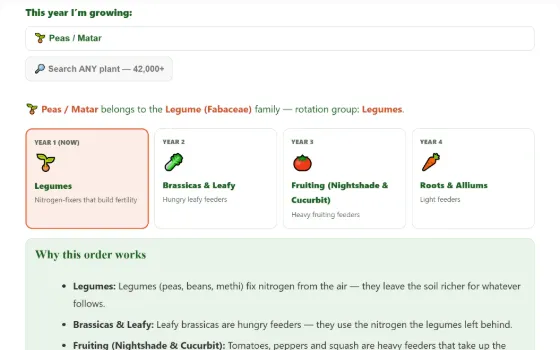
Why this order works
🚫 Golden rule: never grow the same plant family in the same bed two years running — that’s what lets soil pests and diseases build up. Rotate through the four groups, then start again.
🧱 Plan my whole garden — multi-bed 4-year rotation
Pick what each bed grows this year — the planner rotates every bed through the classic legume → leaf → fruit → root order for 4 years, and warns you if two beds share a family. Print it with the buttons below the plan.
💡 One column per bed — each family visits every bed once, then the cycle repeats in Year 5. Save it with 🖨️ Print below.
🧱 Map it to beds → Bed Planner · 🤝 good neighbours → Companion Checker · 🧪 feeding → Fertilizer Calculator
How the crop rotation planner works — and why rotation works
A crop rotation planner stops you growing the same plant family in the same soil two years running. This one builds a 4 year crop rotation for a single crop or for a whole multi-bed vegetable garden rotation, and shows the reasoning beside the crop rotation chart — the plant family rotation that each soil disease actually responds to. Lay the beds out in the garden planner.
Crop rotation is one of the oldest pieces of agricultural science still in daily use — and it works for three concrete, measurable reasons:
- It starves soil-borne diseases and pests. Most serious vegetable diseases live in the soil and can only infect one botanical family. Clubroot spores (brassicas) survive in soil for up to 15–20 years but decline sharply without a host; onion white rot persists 8–20+ years (some studies report spores surviving two decades or more); potato cyst nematodes (“eelworm”) hang on for 7 years or more. Growing the host family in the same bed every year feeds these organisms an annual banquet; moving the family away for 3–4 years cuts their populations dramatically.
- It manages soil fertility. Legumes (peas, beans, methi) host Rhizobium bacteria in root nodules that fix atmospheric nitrogen into the soil — often leaving a measurable nitrogen credit for the next crop. Hungry leafy brassicas use that free nitrogen; fruiting crops take the remaining fertility; light-feeding roots and alliums finish the cycle in leaner soil (freshly manured soil actually makes carrots fork and onions rot).
- It varies root depth and soil structure. Deep taproots (carrots, parsnips) mine nutrients from layers fibrous-rooted crops never reach, and alternating root architectures keeps soil structure open without tillage.
That is why the classic order is legumes → leafy/brassicas → fruiting crops → roots & alliums: each group either leaves behind, or thrives on, exactly what its neighbour in the sequence needs.
Which vegetables belong to which plant family?
Rotation is really about botanical families, because diseases attack families, not garden categories. This is the trap in naive rotation charts: potato sits with root crops in the kitchen but is a nightshade in the soil — plant potatoes after tomatoes and you have not rotated at all. The reference table below is what the planner uses:
| Botanical family | Garden members | Key soil-borne problems | Rotation group |
|---|---|---|---|
| Fabaceae (legumes) | Peas, beans, broad beans, fenugreek/methi, cluster bean | Foot & root rots, pea wilt | Legumes |
| Brassicaceae (cabbage family) | Cabbage, cauliflower, broccoli, kale, radish, turnip, mustard/sarson, kohlrabi | Clubroot (persists 15+ years), cabbage root fly | Brassicas & leafy |
| Solanaceae (nightshades) | Tomato, pepper/chilli, brinjal/eggplant, potato | Potato cyst eelworm (7+ years), late blight, verticillium wilt | Fruiting |
| Cucurbitaceae (gourd family) | Cucumber, pumpkin, squash, melons, bottle gourd/lauki, bitter gourd | Gummy stem blight, fusarium wilt | Fruiting |
| Amaryllidaceae (alliums) | Onion, garlic, leek, shallot, spring onion | Onion white rot (8–20+ years), stem nematode | Roots & alliums |
| Apiaceae (umbellifers) | Carrot, parsnip, celery, coriander/dhania, parsley, cumin | Carrot fly, cavity spot, parsnip canker | Roots & alliums |
| Amaranthaceae (beet family) | Beetroot, spinach/palak, chard, quinoa, amaranth/chaulai | Beet cyst nematode, leaf spot | Roots (beets) / leafy (spinach) |
| Asteraceae (daisy family) | Lettuce, endive, sunflower, artichoke | Sclerotinia (lettuce drop), downy mildew | Leafy |
| Poaceae (grasses) | Sweet corn/maize, wheat, millets | Corn smut, rootworm (few shared with vegetables) | Fits anywhere / fruiting slot |
| Convolvulaceae | Sweet potato | Scurf, sweet-potato weevil | Fits anywhere / roots slot |
| Malvaceae | Okra/bhindi | Fusarium wilt, root-knot nematode | Fruiting |
| Asparagaceae & other perennials | Asparagus, rhubarb (Polygonaceae), globe artichoke | — | Permanent — never rotated |
Two practical notes from this table: radish and mustard are brassicas even though they feel like quick “root” crops, so they count toward the brassica slot; and sweet corn, sweet potato, lettuce and cucurbits are flexible — many growers use them to patch gaps in whichever bed has room, since they share few diseases with the four core groups.
How do I rotate crops in a small garden with only a few beds?
Four beds is the classic setup — assign one group to each bed and everything advances one bed per year, returning to its start in year 5. With three beds, merge roots & alliums into the legume year (RHS-style 3-year plan) — acceptable, but brassica diseases get one year less rest.
With two beds or containers only: rotate what you can (never follow nightshades with nightshades), refresh container compost every year — new compost is a rotation in itself — and lean on the flexible crops above. If clubroot or white rot ever appears, stretch that family’s absence to 5+ years and be strict about not moving soil on tools and boots between beds, which spreads the spores faster than any planting mistake.
Also worth knowing: green manures join the rotation too. A mustard cover crop is a brassica and counts as one; clover and vetch are legumes. And keep a simple garden journal or map — after two seasons nobody remembers which bed the tomatoes were in, and the map is what makes the whole system work.
Can I follow a 3-season rotation in India?
Yes — and India’s three growing seasons actually let you rotate faster than a temperate garden. Because Kharif (monsoon), Rabi (winter) and Zaid (summer) each favour different families, one bed can host up to three different rotation groups in a single year: for example okra or gourds (fruiting) in Kharif → peas or methi (legume) in Rabi → quick radish/greens before the next monsoon. Keep the same family-gap rule across seasons — don’t follow monsoon brinjal with winter potatoes (both nightshades) — and a 4-family cycle completes in under two years instead of four. The same season-stacking logic applies anywhere with a long or year-round season, from Florida to coastal Australia.
How strict do I need to be about rotation?
Rotation is risk management, not ritual. In a young garden with no disease history, a one-off repeat rarely causes visible trouble; in a garden that has ever seen clubroot, white rot or eelworm, strictness pays for itself many times over. The priorities, in order: never repeat nightshades, brassicas or alliums back-to-back in the same soil; keep at least 3 years between those families where you can; treat everything else as flexible glue. Perennials (asparagus, rhubarb, fruit bushes, herbs like rosemary) sit outside the system entirely in permanent positions.
Map your rotation onto real beds with the Bed Planner, check in-season neighbours with the Companion Checker, and match each year’s feeding to its group with the Fertilizer Calculator — legume beds need little added nitrogen, brassica years the most.
Sources: Wikipedia — Crop rotation · Wikipedia — Clubroot · Wikipedia — Nitrogen fixation · Clemson University HGIC — Crop Rotation · Iowa State University Extension — Crop rotation in the vegetable garden
Using the crop rotation planner in 30 seconds
- Say what grew last year. The crop rotation planner works from the plant family, not the crop name.
- Pick single bed or whole garden. A multi-bed matrix covers four years at once.
- Follow the order. Legumes feed, brassicas take, roots break up, fruiting crops finish.
Draw the beds in the garden planner, check neighbours in the companion planting chart, and adjust feeding for each group with the fertilizer calculator. Where a disease is already present, the plant doctor lists how long to wait.
🌍 Works worldwide — metric & imperial
🔄 Updated: 23 Jul 2026 💯 Free to read — no sign-up needed
The 4-year rotation, and what happens if you skip it
Grow the same family in the same soil twice and its specialist enemies compound: nematodes under repeated tomatoes, clubroot under repeated cabbages, white rot under repeated onions — plus the same nutrient layer gets strip-mined. The fix costs nothing: move each plant family one step around a 4-group cycle so no family returns to a bed for 4 years.
The rotation wheel
| Year | Group | Soil effect |
|---|---|---|
| 1 | 🌱 Legumes (peas, beans, methi) | FIX nitrogen into the soil |
| 2 | 🥬 Brassicas & leafy | USE that nitrogen for leaves |
| 3 | 🍅 Fruiting (nightshades, cucurbits) | Heavy feeders — add compost |
| 4 | 🥕 Roots & alliums | Light feeders, clean up the bed |
Container gardeners: the rule still applies — refresh the mix or rotate which family each pot gets. Perennials are exempt; annuale vegetable beds are where rotation pays.
❓ Frequently asked questions
What is crop rotation and why does it matter?
What is the correct 4-year rotation order?
Which vegetables belong to the same family?
Do perennials and flowers need rotation?
I only have containers — can I still rotate?
What if I grew the same crop in the same spot last year?
Can I rotate properly with only two or three beds?
Which crops are the worst to repeat in the same soil?
Where do green manures and cover crops fit in?
Does rotation help with weeds too?
How do I keep track of what was planted where?
🧰 Explore all our free garden tools
Tools hub →Was this tool helpful?