How to Grow Damson
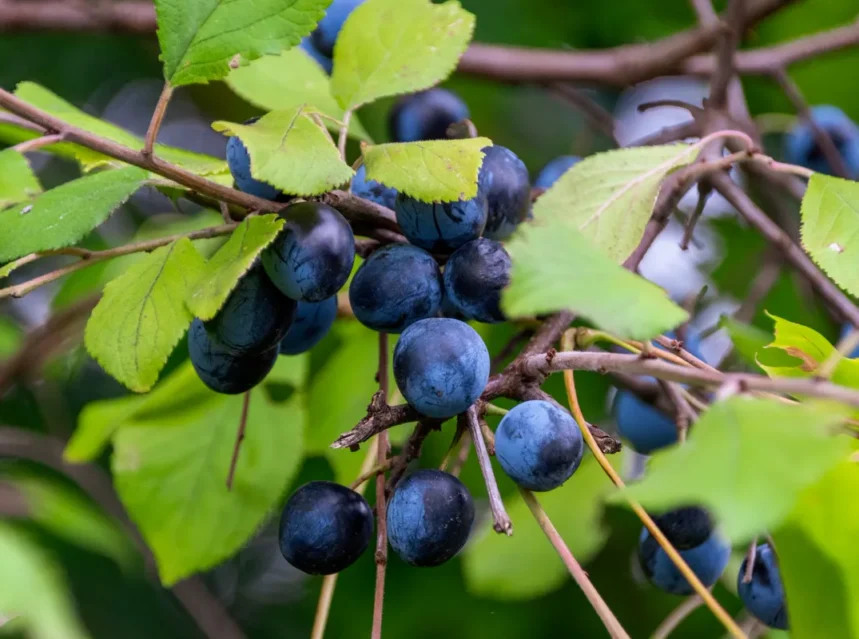
Damson (Prunus insititia) is a tough, self-fertile plum relative that produces masses of small, oval, dark blue-purple fruits. The flavour is intensely tart and complex, which sets damson apart from every other stone fruit. Most people find it too sour to eat raw in quantity. Yet it makes some of the finest jam, gin, fruit cheese, and wine of any garden fruit. The tree is cold-hardy to about -20°C and copes with heavy clay, wind, and neglect. Once established, it needs very little attention. For gardeners who value flavour over size and sweetness, few fruit trees repay you better. Here is the complete guide on how to grow damson, from rootstock choice to the first jar of jam.
Quick start: Plant damson in full sun in any well-drained, reasonably fertile soil. Self-fertile — a single tree fruits abundantly. Flowers early (March-April) before most other stone fruits. Fruits ripen September-October. Hardy to -20°C (USDA zones 5-7; UK H6). Prune in summer only, never in winter. Relatively pest and disease-resistant compared to sweet plum. Outstanding for jam, damson gin, and wine. See related: growing plum trees and growing bullace (the wild relative).
Damson holds a devoted place in British gardening culture. It is one of the few fruits widely agreed to taste better in the jar than on the branch. Damson jam has intense depth, the gin is a hedgerow classic, and the wine carries a complex acidity. Best of all, the tree behind them asks for almost nothing. It crops reliably every year and shrugs off conditions that would defeat a dessert plum. Cumbria’s Lyth and Winster Valleys are seen as the damson capital of England, where old orchards are still celebrated each April at the annual Damson Day festival.
🧰 In a hurry? Jump straight to our tested picks for this guide ↓
Damson at a glance
| Feature | Detail |
|---|---|
| Botanical name | Prunus insititia (family Rosaceae) |
| Common name | Damson, damson plum |
| Plant type | Self-fertile, tough deciduous tree (3-8 m) |
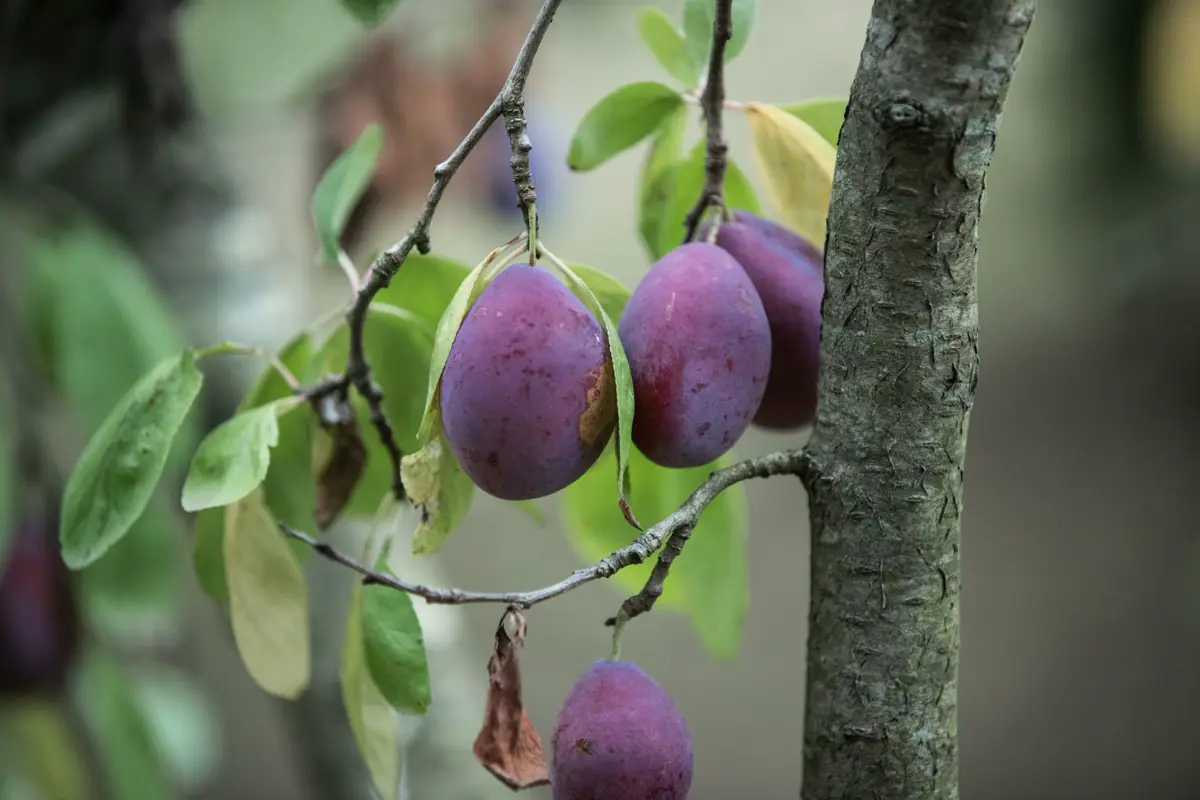
| Fruits | Small (15-30 mm), oval, dark blue-purple; intensely tart; September-October |
| Sun | Full sun (best); tolerates partial shade |
| Soil | Any well-drained, reasonably fertile soil; pH 6.0-7.0; very adaptable |
| Hardiness | Very cold-hardy (USDA zones 5-7; UK H6, to -20°C); ~700 chill hours |
| Time to fruit | 2-5 years from a grafted tree; up to 15 years from a stone |
| Yield | 15-30 kg per mature tree in a good year |
| Key advantage | Self-fertile, tough, productive; outstanding jam/gin/wine fruit |
Damson vs plum, bullace and sloe: how to tell them apart
Damson sits in a confusing family of small dark plums. Because they hybridise and self-seed in hedgerows, even experienced foragers mix them up. This table gives you the quick identification keys.
| Fruit | Size and shape | Tree | Taste and best use |
|---|---|---|---|
| Damson | 15-30 mm, oval, blue-black with bloom | Small tree, no thorns | Tart but rich; the best jam and gin fruit |
| Dessert plum | 40-80 mm, oval to round, many colours | Larger tree, no thorns | Sweet and juicy; eaten fresh |
| Bullace | 20-25 mm, round; purple or yellow-green | Shrubby, occasionally thorny | Sharper; ripens up to six weeks later; cooking only |
| Sloe | 10-12 mm, round, blue-black | Blackthorn bush, fiercely thorny | Mouth-dryingly astringent; sloe gin only |
The fastest field test is the branch, not the fruit. Damson trees are thornless, so if picking shreds your hands, you have found sloes on blackthorn instead. Shape settles the rest: oval fruits point to damson, round ones to bullace.
Popular damson varieties
- “Merryweather” (AGM): The most widely grown damson, introduced in 1907. Large fruits for a damson, sweet enough to nibble raw when fully ripe, and very heavy cropping. The best pick for colder, wetter regions.
- “Farleigh Prolific” (AGM): A 19th-century Kent selection. Very heavy cropping, small fruits, compact growth, outstanding flavour. Best for jam-making where intensity is the priority.
- “Shropshire Prune” (AGM): The classic English damson — small oval fruits with the richest, deepest flavour of any variety. The benchmark for preserving, and the damson American nurseries most often sell.
- “Prune Damson”: Related to Shropshire Prune; late-flowering (useful in frost pockets), very tart, outstanding for gin.
Why grow damson?
- Outstanding culinary fruit. No other cultivated stone fruit matches damson in jam, gin, fruit cheese, and wine. Its jam is darker, richer, and more complex than plum jam.
- Self-fertile. A single tree produces abundant fruit every year without a companion tree.
- Very tough and adaptable. Tolerates poorer soils, heavier clay, more exposure, and colder winters than dessert plum. One of the hardiest stone fruits for difficult sites.
- Early blossom. Masses of white flowers in March-April give a fine spring display and vital early nectar for bees.
- Low workload. No fruit tree of comparable productivity asks for less spraying, feeding, or pruning.
History, origin and traditions
Damson takes its name from Damascus, Syria, via the Latin prunum damascenum, “plum of Damascus” (see the damson entry on Wikipedia). The species probably arose in southwestern Asia from wild crosses between sloe and cherry plum. Britain has grown it for a very long time — damson stones have even been found in Anglo-Saxon excavations at York. Over centuries, selection turned it into a distinctive regional fruit of Westmorland (Cumbria), Shropshire, and the Welsh Marches. English settlers carried it to North America before the Revolution, where it thrived better than most European plums and still grows semi-wild in parts of New England.
Damsons were once an important commercial crop in Britain, grown at scale for jam. A popular story adds that the skins dyed cloth for khaki uniforms; however, a 2005 English Nature review found no documentary evidence for damson dye in the industry, so treat that tale as folklore.
Damson gin, made by steeping the fruit with sugar, is one of the oldest hedgerow traditions, and Cumbria’s Damson Day festival still celebrates the Lyth Valley orchards each April (see the RHS damson guide). In India, true damson is rarely grown. Its ~700-hour winter chill requirement limits it to high Himalayan valleys, where growers in Jammu & Kashmir, Himachal Pradesh, and Uttarakhand already raise plums, apricots, and cherries.
The Indian plum (Prunus salicina) fills the same kitchen role there, and hill gardeners who can source damson stock should treat it exactly like a European plum. The FAO groups damson under “plums and sloes” in world production data.
When to plant damson: best season
Plant damson in autumn (October to November) or late winter to early spring (February to March), while the tree is dormant. Bare-root trees are the cheapest option and establish fastest; specialist fruit nurseries ship them from November to March. Container-grown trees can go in at any time if you keep them watered. In the US, plant in late winter as soon as the ground works. In the Indian hills, plant in January-February before bud break. For the most reliable crops, choose a named, AGM-awarded variety rather than an unnamed seedling.
Which rootstock and spacing?
Like apples, damsons are grafted, and the rootstock — not the variety — decides the final size and how soon you pick fruit. This is the one decision you cannot change later, so match it to your space first.
| Rootstock | Final height | Spacing | First fruit | Best for |
|---|---|---|---|---|
| Pixy (dwarf) | 2-3 m | 2.5 m | Year 2-3 | Small gardens, pots, cordons |
| St Julien A (semi-vigorous) | 3-5 m | 3-3.5 m | Year 3-4 | Standard garden tree, fans |
| Brompton (vigorous) | 6 m+ | 5-6 m | Year 4-5 | Orchards, hedgerows, exposed sites |
St Julien A is the usual choice for damsons. Pixy needs better soil and more watering because its root system is small. For a fruiting windbreak or hedge, plant Farleigh on St Julien A at 1-2 m and let it grow rough.
How to grow damson: planting step by step
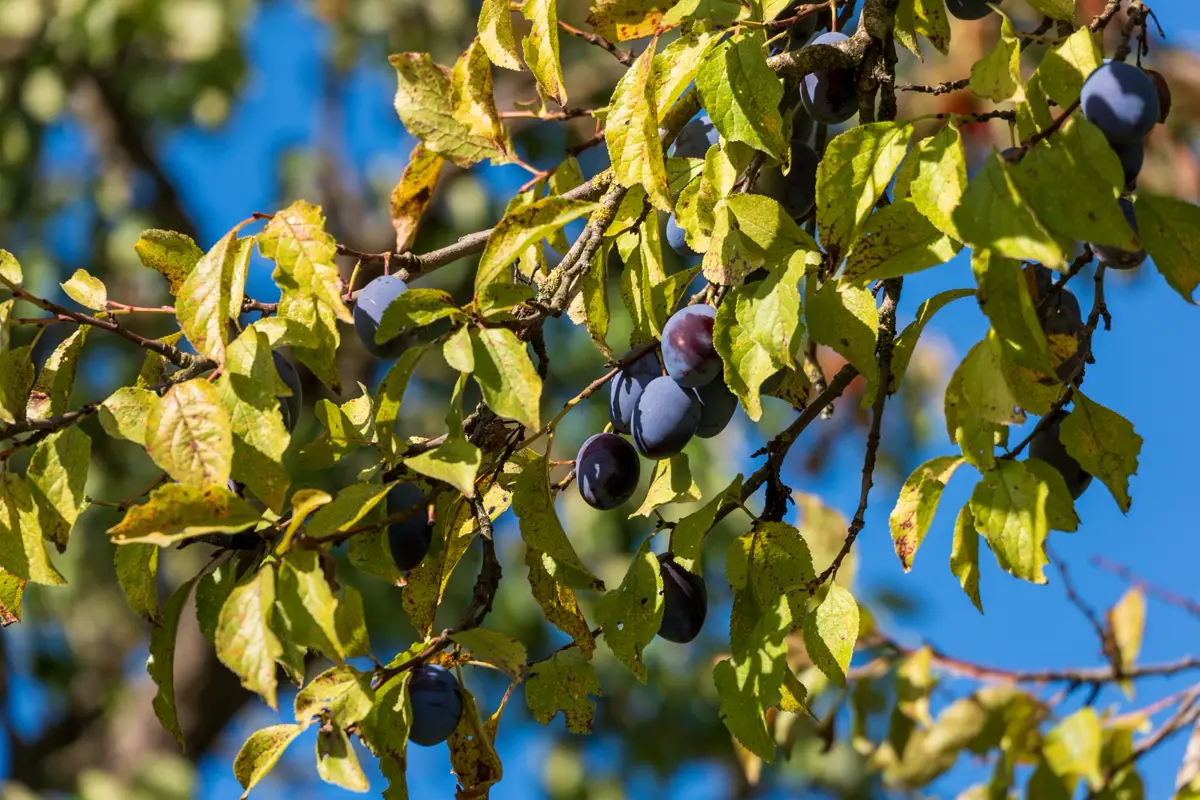
- Pick the spot. Full sun and some shelter give the best crops, because the early blossom needs bees flying in cold weather. Damson tolerates partial shade and exposure better than any other stone fruit, so it also suits the “worst” corner of the garden.
- Dig a square hole twice the width of the root ball but no deeper. Fork the sides so roots can push out. See improving garden soil if your ground is very poor or compacted.
- Set the depth carefully. The graft union (the bulge low on the stem) must sit 5-8 cm above the finished soil level. Burying it lets the variety root and cancels the rootstock.
- Stake and water. Drive a short stake at 45° pointing into the wind, tie loosely, and water in with 10-15 litres.
- Mulch a 1 m circle with compost or wood chips, 5-8 cm deep, kept clear of the trunk. In a lawn, keep this circle grass-free for the first three years — grass out-competes young fruit trees for water and nitrogen.
- Protect the trunk with a guard where rabbits or deer visit; they strip young stone-fruit bark in winter.
Sun, soil, watering and feeding
Sun: Full sun to partial shade. Best crops in full sun; usable crops even on a north-facing wall as a fan.
Soil: Very adaptable — clay, loam, and chalk (with adequate depth) are all tolerated. Good drainage is the only non-negotiable. Aim for pH 6.0-7.0.
Watering: Water weekly through the first summer. Once established, damson is reasonably drought-tolerant. However, water during fruit swell in dry summers, because drought then causes fruit drop and split skins. See how often to water plants.
Feeding: In early spring, spread a balanced fertiliser at about 70-100 g per square metre under the canopy, plus a fresh mulch of compost. On light soils, add sulphate of potash for fruit quality. Go easy on nitrogen — university-extension guidance for stone fruit warns that over-feeding produces lush shoots at the expense of fruit and soft growth that diseases enter.
Pots, fans and small gardens
No room for a tree? Damson on Pixy grows well in a container at least 50 cm wide and deep, in a loam-based compost. Feed fortnightly with a liquid fertiliser from April to August and never let the pot dry out during fruit swell. Expect a pot tree to slow down after 6-8 years as it fills the container; root-prune or pot on.
Against a wall or fence, train damson as a fan — it is hardy enough that even a north-facing wall works, which is rare among fruit trees. Cordons suit narrow spaces and fruit from year two on Pixy. Espaliers do not suit stone fruit, so skip that form. One more small-garden trick: because blossom opens in March, a wall-trained tree is easy to drape with fleece on frost nights, which protects the flowers by roughly 2°C and often saves the whole crop.
Pruning damson trees
Damson needs less pruning than almost any fruit tree, but timing is critical. Prune only in summer (June to August), when active growth seals wounds quickly. Never cut in autumn or winter: dormant-season wounds are the entry point for silver leaf and bacterial canker, the two diseases that actually kill stone-fruit trees.
- Years 1-3: Build a framework. In spring just after bud burst, shorten the leaders to create 4-5 well-spaced main branches with an open centre.
- Established trees: Each summer, remove dead, diseased, crossing, and congested wood. That is all. Damsons fruit on both old wood and new, so hard annual pruning only costs you crop.
- Suckers: Pull (do not cut) any shoots rising from below the graft or from the roots; they belong to the rootstock.
Sterilise tools between trees, and paint over any large cuts on stone fruit. The same summer-only rule applies to plum trees and greengages.
Pests and diseases
- Silver leaf: The main killer. Leaves take on a silvery sheen, then branches die back. Prevention is summer pruning; cure is cutting 15 cm below stained wood. See the common problems section below.
- Bacterial canker: Sunken, gummy bark patches and holed leaves. Cut out infected wood in summer; copper sprays in autumn help in wet regions.
- Plum moth: Pink maggots inside fruit. Hang pheromone traps from May to catch males and monitor; remove infested fruits early. See organic pest control.
- Plum sawfly: Fruitlets fall in early summer with a black hole and sticky frass. Lightly cultivate the soil under the tree in late winter to expose overwintering pupae.
- Aphids: Curled shoot tips in spring. Rub off colonies or blast with water; damage is cosmetic on established trees. See how to get rid of aphids.
- Brown rot: Fruits mummify with grey pustules. Remove every affected fruit, including mummies left after leaf fall, and thin clusters so fruits do not touch.
- Pocket plum: A fungal oddity — fruits grow long, hollow, and stoneless. Pick off and destroy affected fruits and twigs.
- Wasps and birds: Both raid ripening fruit. Pick promptly; net small trees if pressure is heavy.
- US growers: Add plum curculio (a fruit-scarring weevil) and black knot (black galls on shoots — prune out 10 cm below) to the watch list; both are North American problems damsons handle better than most plums, according to extension guidance.
Overall, damson is significantly more disease-resistant than dessert plum. On a healthy tree in a reasonable year, you can expect a clean crop with no spraying at all.
Harvesting
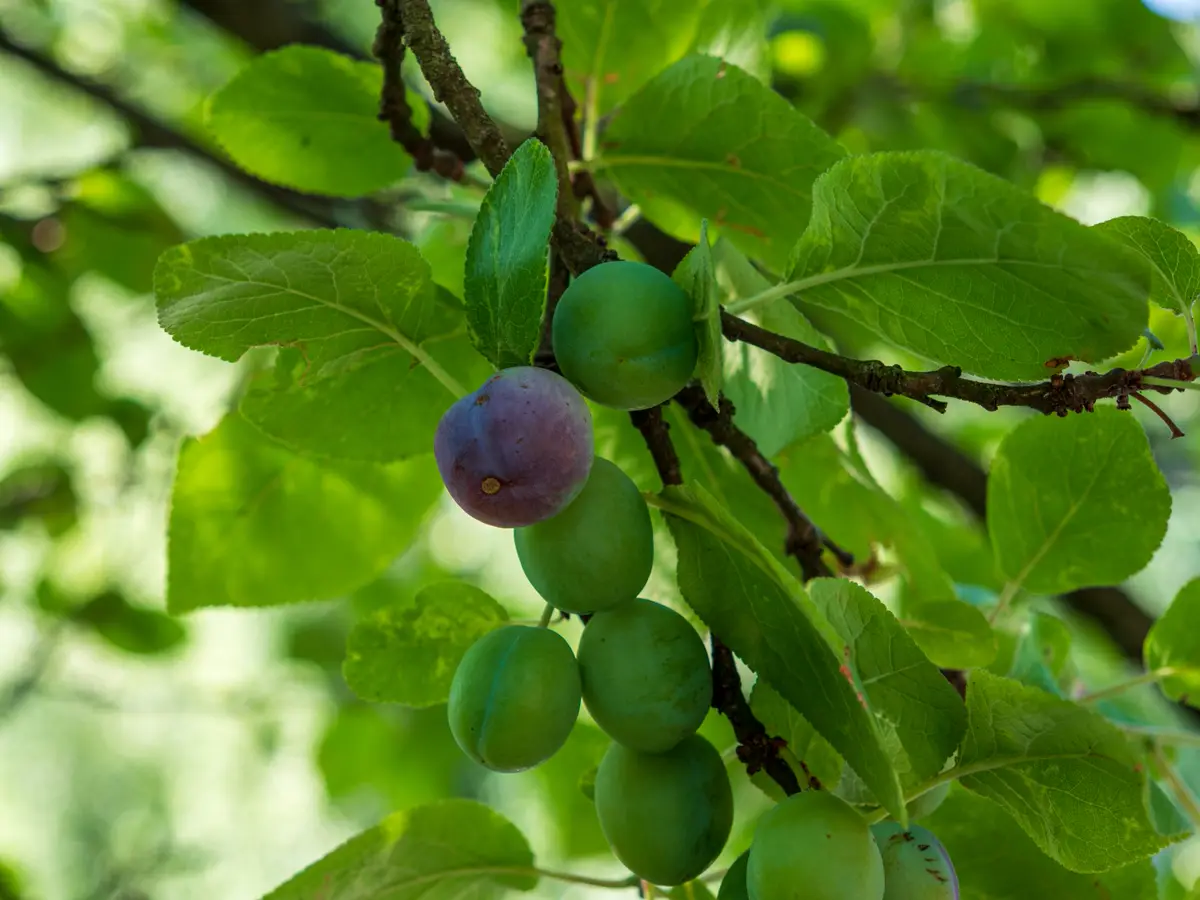
Damsons ripen in September to October, later than most plums, and a mature tree gives 15-30 kg. They are ready when fully dark blue-purple and slightly soft to a gentle squeeze; ripe fruits come away with a light pull. The tree ripens unevenly, so plan on two or three picks a week or two apart rather than one session. Traditionally, growers leave fruit hanging as long as possible — a light frost deepens the flavour — then process straight away, because damsons keep only a few days. For winter cooking, freeze them whole; the stones twist out easily from half-thawed fruit.
For classic damson jam, simmer 2 kg damsons with 300 ml water until the skins split. The stones float, so skim them off. Add 1.5 kg sugar, stir to dissolve, then boil hard to setting point — damson’s naturally high pectin makes this the easiest jam a beginner can attempt. For damson gin, fill a sterilised jar two-thirds with prick-stabbed fruit, add 200 g sugar, top up with gin, and seal. Shake weekly and strain after three months; it improves for a year.
Health benefits and uses
USDA FoodData Central has no record for damsons — a search returns only jams and gins — so every per-100 g figure you will see quoted for them has in fact been taken from ordinary plums. That borrowing is defensible up to a point, because the damson is Prunus domestica subsp. insititia, a subspecies of the domestic plum, though a smaller, drier and far sharper one. What matters is that even the plum figures do not support the usual adjectives. USDA’s “Plums, raw” gives 9.5 mg vitamin C (11% of an adult’s daily value), 1.4 g fibre (5% DV) and 6.4 µg vitamin K (5% DV) per 100 g (see USDA FoodData Central, Plums, raw). None of those is “rich”. Treat them as an approximate ceiling for damsons, not a measurement. What a damson really has over a dessert plum is pigment and acid — the near-black skin is dense with anthocyanins, which USDA does not quantify, and the sharpness is exactly why it cooks so well. The kitchen uses are wide: jam, damson cheese (a firm, sliceable preserve like membrillo), gin, wine, chutney, compote, crumble, and sorbet. In Cumbrian tradition, cooks serve damson sauce with lamb and game — the sharpness cuts rich meat perfectly. One caution: like all Prunus, the kernels inside the stones contain amygdalin, so strain stones out of preserves rather than cracking them.
This article is for general information only and is not medical advice. Consult a healthcare professional for dietary guidance.
Common damson problems
Why is my damson tree not fruiting?
Work through the causes in order. First, age: a new tree needs 2-5 years before cropping, depending on rootstock. Second, frost: March blossom is the crop’s weak point, so a hard freeze during flowering means no fruit that year — fleece small trees overnight. Third, poor pollination: cold, windy springs ground the bees; a sheltered site fixes more barren trees than any feed. Fourth, drought at fruit set sheds the crop. Finally, heavy nitrogen feeding grows leaves instead of fruit. A healthy, sheltered, unfed damson almost always crops.
Silver leaf on branches
Silver leaf enters through pruning wounds in autumn and winter, so prevention is simple: never prune stone fruit in those seasons. Watch for a silvery sheen on leaves and dieback. If it appears, cut the branch 15 cm below the last brown staining in the wood, in dry summer weather, and sterilise tools between cuts.
Very heavy crops causing branch breaking
Damsons set such heavy crops that limbs can snap. After the natural June drop, thin to one fruit every 5-8 cm, or prop heavy branches. Heavy years also drain the tree, so a light year follows — the boom-bust pattern called biennial bearing. Thinning in the heavy year is what evens it out.
Fruits very small and intensely sour
This is normal damson behaviour, not a fault. Small size and high tartness are the species. If fruits are smaller than usual and the crop is enormous, the cause is overcropping — thin next June. The tartness never changes; it is exactly what makes the jam and gin outstanding.
Related stone fruit guides
- How to grow Plum
- How to grow Bullace
- How to grow Sloe
- How to grow Mirabelle Plum
- How to grow Greengage
- How to grow Cherry
- How to grow Beach Plum
- How to grow Cornelian Cherry
How to propagate damson
Damsons are normally bought as grafted trees, because the rootstock — not the variety — decides the tree’s final size and how soon it fruits. But damsons are also one of the easier plums to increase at home, and there is one route that is unique to them.
From suckers, if the tree is on its own roots
Old hedgerow damsons often grow on their own roots and throw up suckers that are genuine copies of the parent. Lift a rooted sucker in the dormant season and replant it. The vital check first: on a grafted tree, any shoot coming from below the graft union or from the roots belongs to the rootstock, not to the damson. Those must be pulled off, not planted — they will never give you damsons.
From cuttings
Half-ripe wood taken with a heel in July or August roots in a frame, and softwood cuttings from strongly growing plants work in spring to early summer. Layering in spring is another option.
From stones
Seed needs two to three months of cold stratification and is best sown fresh in a cold frame; it can be slow, sometimes taking 18 months to germinate. Protect it from mice. Be clear about what you get though: a seedling will not come true, and a stone-grown damson can take up to 15 years to fruit against two to five for a grafted tree.
Source: Plants For A Future — Prunus insititia.
Frequently asked questions
Can you eat damsons raw?
Yes, but most people find raw damsons very sour and astringent — the flavour is intensely tart and the flesh is not as sweet or juicy as dessert plum. Some people enjoy a few raw damsons, particularly the larger “Merryweather” variety when fully ripe; the smaller varieties like “Shropshire Prune” are extremely tart raw. The damson’s culinary excellence lies in processed preparations (jam, gin, wine) where cooking with sugar transforms the tartness into extraordinary, complex flavour. Do not judge damsons by the raw fruit experience alone.
What is the difference between damson and bullace?
Both are Prunus insititia varieties — closely related wild plum types. Damson (P. insititia var. insititia — specifically the cultivated selection) has been more systematically cultivated, selected for named varieties, and is widely available from nurseries. Bullace (P. insititia var. insititia — the wild or semi-wild type) is more variable, often self-seeded from hedgerows, and tends to have smaller, rounder, and sometimes yellow or greenish fruits alongside the dark types. In practice, damsons tend to be the named, selected cultivated forms; bullaces are the wilder, more variable hedgerow types. Both produce outstanding jam and gin.
Do damsons need a pollinator?
No — damsons are self-fertile, which is one of their considerable practical advantages. A single damson tree produces excellent crops without a companion tree. However, having another damson variety or a compatible plum nearby for cross-pollination may marginally improve fruit set and yield in some years. For a single-tree planting, damson is an outstanding choice precisely because of this self-fertility.
When is damson season?
Damsons ripen in September to October — later than most plums, which ripen from July to September. The exact timing varies by variety and region; “Merryweather” tends to ripen slightly earlier (September), while “Shropshire Prune” ripens in October. In a warm autumn, damsons can be left on the tree well into October for maximum flavour development. A light frost often improves the flavour further. In the UK, damson season coincides with the general autumn harvest period for most preserving fruits.
How do you remove the stones from damsons?
The easiest method is to cook the fruit first — simmer damsons briefly and the stones float to the surface, where a slotted spoon skims them off, since the flesh softens and releases the stone as it cooks. For raw fruit, halve each damson with a small knife and twist the two sides apart; the stone usually pulls free, though it clings tighter than on a dessert plum.
Can you freeze damsons?
Yes — freeze damsons whole, unwashed, in a single layer on a tray, then bag them once solid. Frozen fruit keeps for about a year and the stones twist out far more easily once the fruit has half-thawed. Freezing whole is more practical than stoning first, since raw damson flesh clings tightly to the stone until it has been softened by cooking or freezing.
What is the best rootstock for a small garden or container?
Choose Pixy, the dwarf rootstock, which keeps a damson to about 2–3 metres and starts fruiting by year two or three. It suits containers at least 50 cm wide as well as small borders, though it needs better soil and more regular watering than the larger rootstocks because its root system stays small.
How tall do damson trees get and how long do they live?
Final height depends mainly on rootstock, ranging from about 2–3 metres on dwarf Pixy to 6 metres or more on vigorous Brompton. A well-sited damson tree is long-lived and productive for several decades, often 40 years or more, especially where it is pruned lightly and kept free of silver leaf and canker.
Are damsons the same as prunes?
No, though they are related. Prunes are a specific type of plum (mainly Prunus domestica cultivars) that is naturally high enough in sugar to dry successfully without fermenting. Damsons are a separate, more tart species; they are traditionally cooked into jam, gin, and cheese rather than dried, since their acidity and lower sugar do not suit prune-making.
Do damson trees need spraying to crop well?
Usually not. Damson is markedly more disease-resistant than dessert plum, and a healthy tree in a reasonable year often produces a clean crop with no spraying at all. Good hygiene — removing mummified fruit, summer-only pruning, and clearing fallen leaves — prevents most problems without chemical intervention.
What is damson cheese?
Damson cheese is a traditional firm, sliceable fruit preserve, similar to quince membrillo, made by cooking damson pulp down with sugar until it sets solid enough to turn out of a mould and slice. It is a classic way to use a heavy glut, and it is traditionally served alongside cold meats and strong cheeses in Cumbrian cooking.
When is the best time to prune a damson tree?
Prune only in summer, from June to August, while the tree is in active growth and wounds seal quickly. Never prune in autumn or winter, since dormant-season cuts are the main entry point for silver leaf and bacterial canker, the two diseases most likely to kill a stone-fruit tree.
Still stuck? Ask the Plant Doctor
Describe the problem — yellow leaves, holes, no flowers — and get a clear answer in seconds. FreeAI can make mistakes. Answers are guidance, not a guarantee — check anything important against the guide it links to, and always read the label on any product before you use it.