Mirabelle Plum
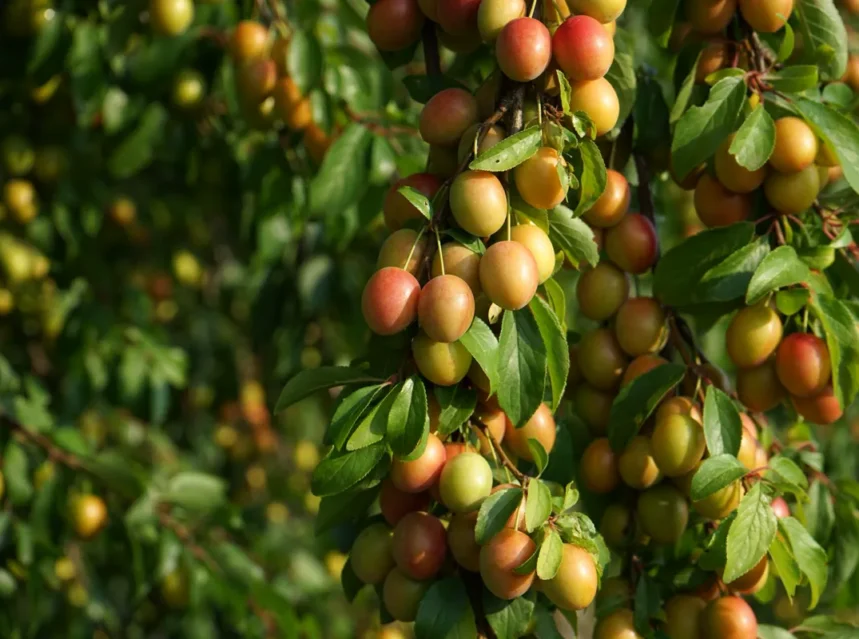
Mirabelle plum (Prunus domestica subsp. syriaca, also classed as Prunus insititia var. mirabelle) is a small, highly productive stone fruit tree. It carries masses of tiny, round, golden-yellow fruits. The flavour is sweet, honey-rich and almost caramelised. This little plum is the pride of Lorraine in northeastern France. About 70% of world production happens there, and mirabelle jam, eau-de-vie and tarts sit at the heart of the region’s food culture.
Mirabelle out-crops the greengage and needs less fuss than a dessert plum. It also looks lovely in spring blossom and again under summer fruit. In short, it is an underused gem of the temperate fruit garden. Here is the complete guide on how to grow mirabelle plum.
Quick start: Plant mirabelle in full sun in any well-drained, fertile soil. Most varieties are self-fertile. USDA zones 5-8. Fruits ripen August-September. The tiny fruits (2-3 cm) are produced in extraordinary quantities — an established tree can carry 30-50 kg in a good year. Thin the fruitlets in June so branches do not snap. Excellent for jam, tarts, eau-de-vie, and fresh eating. Ornamental spring blossom. See related: growing greengage and growing damson.
Mirabelle is almost absent from supermarkets outside France. The tiny fruits simply do not survive commercial distribution. So home-growing is the only real way to taste them beyond Lorraine. In France, the Mirabelle de Nancy and the Mirabelle de Metz are celebrated local products with passionate fans. Each August the Fete de la Mirabelle in Metz draws hundreds of thousands of visitors. The flavour is sweet, honeyed and caramelised, unlike anything else in the fresh-plum world, and that explains the devotion.
🧰 In a hurry? Jump straight to our tested picks for this guide ↓
Mirabelle plum at a glance
| Feature | Detail |
|---|---|
| Botanical name | Prunus domestica subsp. syriaca (family Rosaceae) |
| Common name | Mirabelle plum, mirabelle de Nancy, mirabelle de Metz |
| Plant type | Productive deciduous stone fruit tree (3-6 m) |
| Fruits | Tiny, round, golden-yellow; very sweet, honey-rich; August-September |
| Sun | Full sun (warm position) |
| Soil | Well-drained, fertile |
| Hardiness | USDA zones 5-8 (cold-hardy stone fruit) |
| Pollination | Self-fertile; a second European plum increases the crop |
| Rootstocks | Pixy (2.5-3 m, compact); St Julien A (4-6 m, standard) |
| Yield | Very high — 30-50 kg from an established tree in a good year |
| Keeping quality | Poor — fruit bruises and softens within 48-72 hours of ripeness |
| Notable | Mirabelle de Lorraine holds EU PGI (Protected Geographical Indication) status — not AOC |
Popular mirabelle varieties
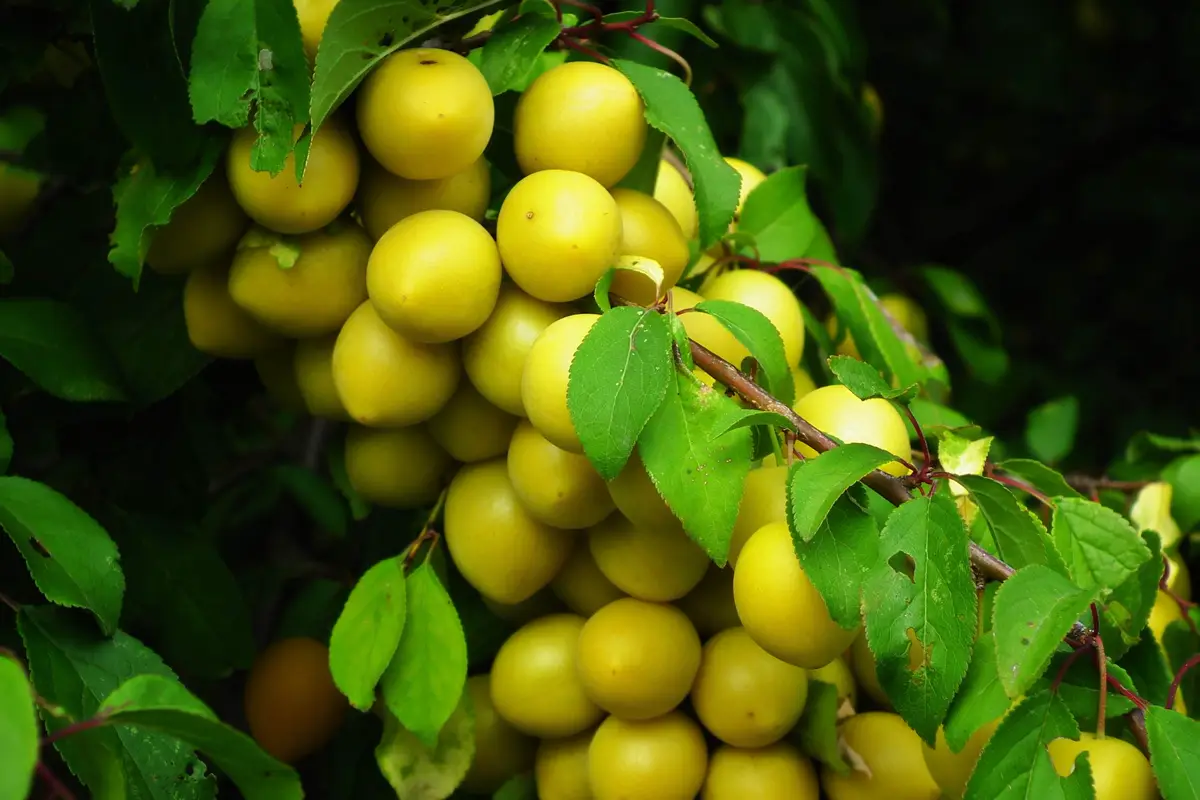
- “Mirabelle de Nancy” (AGM): The classic French variety. Golden-yellow with red-orange speckles at full ripeness. Excellent sweet flavour. The most widely grown and most commercially significant variety. Self-fertile and productive.
- “Mirabelle de Metz”: Smaller and earlier-ripening than Nancy. Fewer red speckles, cleaner golden-yellow. Also outstanding flavour, slightly more delicate. The two classic Lorraine varieties are often grown together.
- “Ruby”: A red-skinned mirabelle type. Less common but attractive ornamentally.
- “Golden Sphere” and other yellow mirabelle types: UK and US nurseries also sell unnamed “yellow mirabelle” or “golden plum” selections. These vary in ripening date and self-fertility, so read the nursery description before buying. For the true Lorraine flavour, ask specifically for Nancy or Metz.
The small stones separate cleanly once the fruit is cooked. That single trait is why mirabelle jam and tart making is so much quicker than working with a full-size dessert plum.
Mirabelle, greengage, damson or bullace: which small plum is for you?
These four get recommended interchangeably and they are not interchangeable at all. The differences that matter to a gardener are hardiness, how much sun the fruit needs to sweeten, and what you intend to do with the crop.
| Tree | Fruit & flavour | Site it needs | Best use |
|---|---|---|---|
| Mirabelle | Tiny, golden, honeyed and floral; stone parts cleanly | Warm and sheltered, but far more forgiving than a gage | Fresh off the tree, jam, tarts, eau-de-vie |
| Greengage | Green-gold, the sweetest of the group at its best | The fussiest — needs real warmth and shelter or it never sweetens | Dessert fruit, eaten fresh |
| Damson | Small, blue-black, sharp and astringent raw | The toughest — takes cold, wind and poor soil | Cooking, jam, gin — rarely eaten raw |
| Bullace | Wild-tasting, sharp, ripens very late | Hedgerow-hardy, essentially unkillable | Cooking and preserves after frost softens it |
The short version: if you want a gage’s sweetness without a gage’s demands, mirabelle is the tree. If your garden is cold, windy or exposed, plant a damson and stop fighting the site.
Why grow mirabelle plum?
- Extraordinary productivity. A mature mirabelle tree produces extraordinary quantities of tiny fruits — hundreds of fruits per tree, year after year. The yield-to-space ratio is outstanding.
- Beautiful ornamental tree. Spectacular white spring blossom (before the leaves), attractive form, and the stunning appearance of branches loaded with golden-yellow fruits in August make mirabelle a beautiful garden tree in multiple seasons.
- Outstanding culinary fruit. The distinctive sweet, honeyed flavour produces outstanding jam (amber, rich, and complex), mirabelle tart (a French classic), mirabelle eau-de-vie, and mirabelle chutney.
- Easier than greengage. More tolerant of cold and exposed positions than greengage while producing a comparable level of sweet, complex flavour. Self-fertile and productive with less fuss.
- Essentially unavailable commercially. The fruit bruises and softens within 48-72 hours of ripeness, so it cannot survive a supermarket supply chain. Outside France, home-growing is the only way to experience it properly.
- Exceptional fresh eating. Most people only meet mirabelle as jam. A sun-warmed fruit picked straight off the tree is sweeter, softer and more floral than any jar suggests — floral and honeyed rather than sharp like a Victoria plum.
History, origin and traditions
Mirabelle is a variety of Prunus domestica that most likely began in western Asia. The “syriaca” subspecies name points to a historical link with Syria. Its distinctive form was then shaped by centuries of cultivation in Lorraine, northeastern France, where the areas around Nancy and Metz refined the definitive varieties over hundreds of years.
One detail almost every English-language mirabelle article gets wrong: the Lorraine protection is a PGI, not an AOC. Since 1996, “Mirabelle de Lorraine” has held an EU Protected Geographical Indication (IGP in French) — a different and less restrictive scheme than AOC/AOP, which ties a product to a terroir far more tightly. The PGI specification is refreshingly concrete: fruit must reach a minimum 22 mm across and meet a minimum sugar content. That is worth knowing as a grower, because it tells you what the French trade considers a properly ripened mirabelle rather than a small one — a useful yardstick when you are deciding whether to pick.
The Lorraine harvest runs from mid-August to mid-September. It yields roughly 15,000 tonnes a year — around 80% of world commercial production, which is why “mirabelle” and “Lorraine” are almost the same word in French cooking. Mirabelle eau-de-vie, a clear brandy distilled from the fermented fruit, is one of the region’s most prized products. In the UK, the RHS advice that applies here is the general plum rule rather than anything mirabelle-specific: plums crop best in a warm, sheltered site in full sun, on fertile, slightly acidic soil around pH 6–6.5, and you should check a variety’s pollination needs before buying rather than assuming self-fertility. The tree probably reached western Europe along ancient trade routes from Asia Minor, long before Lorraine made it famous (see Mirabelle plum, Wikipedia).
In India, small European plums (aalu bukhara) grow commercially in the hill regions of Himachal Pradesh and Jammu and Kashmir. Both European and Japanese types crop well there. Mirabelle itself is not sold as a named type, though similar small yellow plums are grown. The practical Indian route is simple, because mirabelle needs winter chill. That means the Himalayan belt — Shimla, Kullu, Kashmir — not the plains. Gardeners in Delhi, Pune or Bengaluru will get blossom at best and no fruit. Europe’s plum harvest is led not by France but by Romania, which grew 645,090 tonnes in 2023, and Serbia on 362,713 (FAO-sourced production table). France managed 207,580 tonnes that year and Germany 49,630 (FAO crop statistics, “plums and sloes” item). The mirabelle is not counted separately in any of those figures, so its share of the French crop is not officially published.
Best season and when to plant
Plant mirabelle in autumn (October to November) or early spring (February to March). Bare-root trees are the cheapest option and run November to March from specialist fruit nurseries. Container-grown trees can go in at any time. Choose a warm, sunny spot, because mirabelle needs summer heat for the best flavour. In the UK, a south or south-west facing, sheltered position is ideal. For rootstock, St Julien A (4-6 m) is the standard choice. Pick Pixy (2-3 m) for small gardens or wall training.
How to plant and grow mirabelle plum
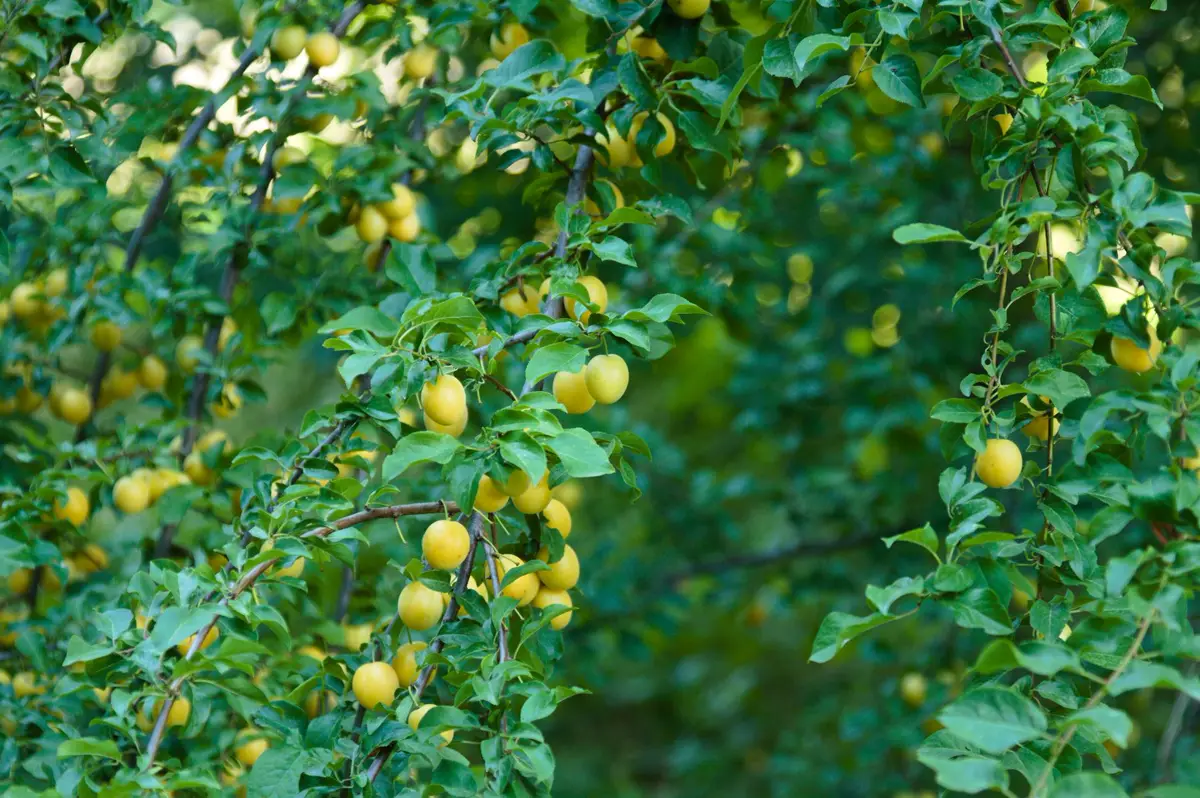
- Full sun in a warm position for the best fruit flavour. Mirabelle is more tolerant of cool conditions than greengage but still performs best with adequate summer warmth. See improving garden soil.
- Soil: well-drained, fertile, deep. pH 6.0-7.5. Incorporates generous organic matter before planting.
- Self-fertile — a single tree produces abundant crops without a companion. Cross-pollination from a second mirabelle variety or compatible plum improves yield further.
- Shelter the tree from late frost. Blossom opens in early April and a hard frost at that moment wipes out the crop. A slight slope or a walled corner helps, because cold air drains away instead of sitting around the tree.
- Thin the fruitlets in June. Remove roughly a third to a half of the pea-sized fruitlets after the natural June drop, leaving about one fruit every 3-4 cm. This is the single most useful job on a mirabelle.
- Prune ONLY in summer (June-July) to avoid silver leaf disease. Mirabelle has similar stone-fruit pruning rules to plum and damson. See our guide to plum tree care and damson growing.
Choose the rootstock to suit the ladder you own. Pixy keeps the tree at 2.5-3 m, which means you can pick a 40 kg crop from the ground. St Julien A gives a bigger, longer-lived tree but the top of the crop will feed the birds.
Sun, soil, watering and feeding
Sun: Full sun; warm position. See soil improvement.
Soil: Fertile, well-drained, deep. Moderately demanding — not as tolerant of poor soil as damson. The RHS figure for plums, slightly acidic around pH 6–6.5, is the target to aim at; our soil and pH calculator will tell you how much amendment a given planting hole needs to get there.
Watering: Consistent watering through the season, especially during fruit development. Irregular watering causes fruit splitting. See how often to water plants, or set a starting interval for your soil and climate with the watering calculator.
Feeding: Use a balanced fertiliser in early spring plus potassium sulphate in late winter. Add an annual compost mulch. A generous feed reflects how heavily a mature mirabelle crops. Go easy on nitrogen, though. Too much pushes leafy shoots at the expense of fruit buds, and it softens growth before winter — our fertiliser and NPK calculator will size the spring dose rather than guessing it.
Frost is the crop-limiting factor, not cold. Mirabelle is hardy, but it blossoms early, and a single frost while the flowers are open removes that year’s fruit entirely. Do not plant it in a frost pocket at the bottom of a slope. Check your own last-frost date against the tree’s bloom window with our frost date finder before choosing the position — it is the one decision you cannot undo later.
Summer drought matters more than most growers expect. A tree carrying a heavy crop can drop fruitlets in a dry spell, simply because it cannot support them. So water deeply in dry weather while the fruits swell, rather than sprinkling a little each day.
Pests and diseases
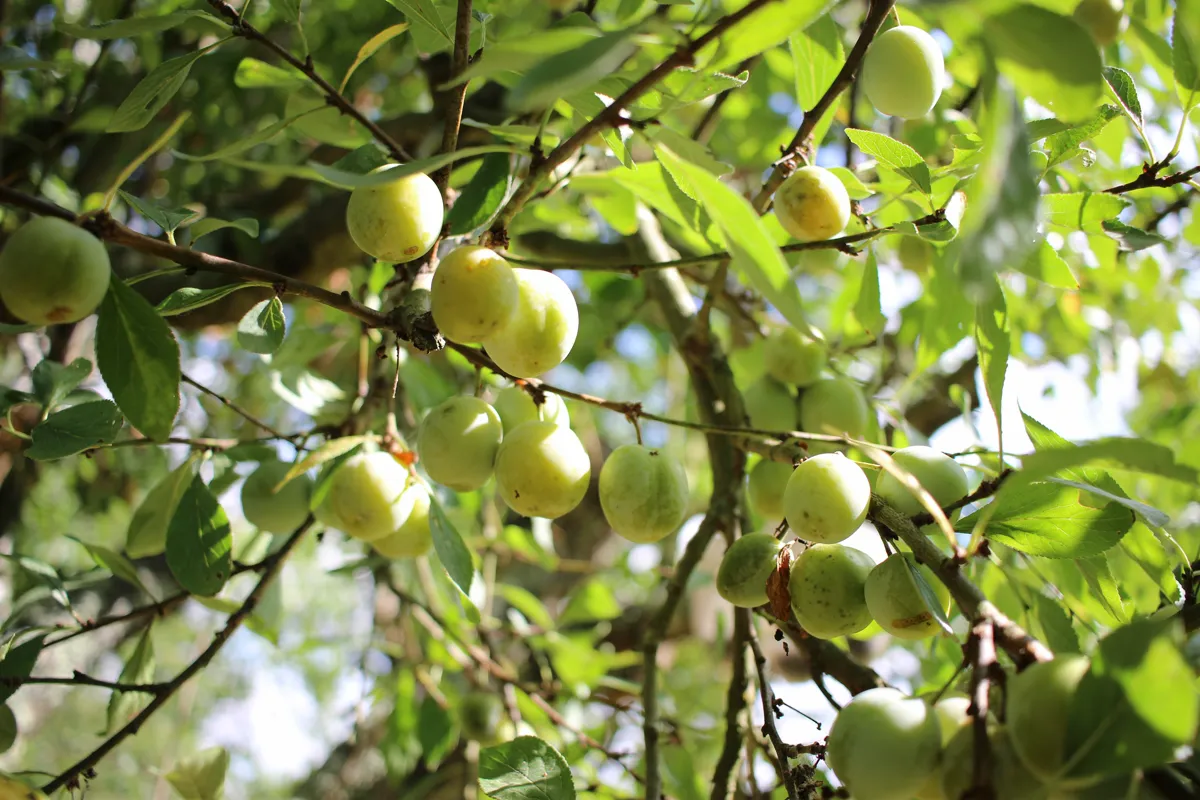
- Silver leaf: Prune ONLY in summer. See organic pest control.
- Plum moth: Monitor with pheromone traps; remove affected fruits. See pest management.
- Brown rot: The main disease risk in a wet summer, because mirabelle’s crowded, touching fruits let the fungus spread from one to the next. Pick off and destroy every rotted fruit — never compost them, and never leave a mummified fruit hanging over winter. June thinning opens the canopy and cuts the risk sharply (see RHS guidance on brown rot).
- Wasps and birds: Both attack ripe fruits heavily. Harvest promptly; wasp traps near the tree. Netting is impractical on a standard-size tree. Sweep up windfalls daily in late summer — fermenting fruit on the ground is what pulls wasps in.
- Mirabelle is generally more disease-resistant than dessert plum and more robust in a range of garden conditions.
Harvesting
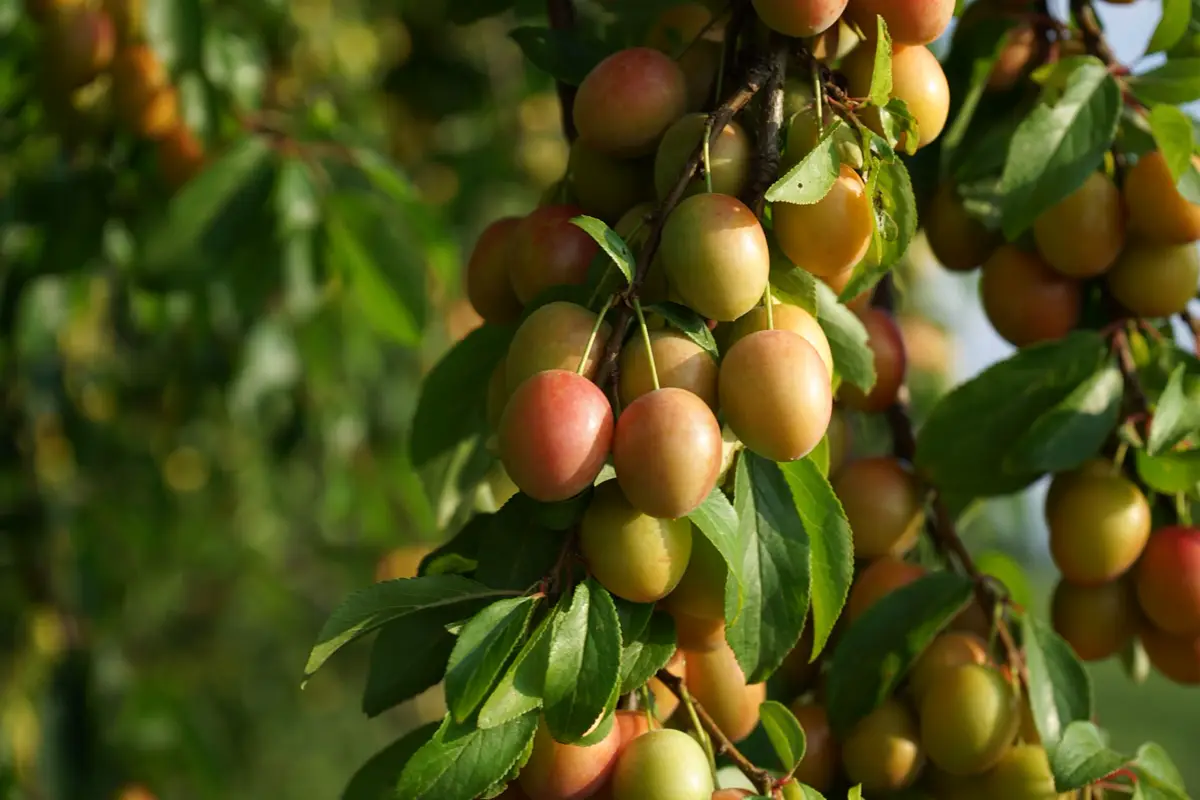
Mirabelle plums ripen in August to September. In a hot summer, the first fruits can arrive from late July. “Mirabelle de Metz” ripens earlier, around mid-August. “Mirabelle de Nancy” follows in late August to September. The fruit is ready when it turns fully golden-yellow, sometimes with red-orange speckles on the sunny side. The flesh should give to gentle pressure and drop from the branch with almost no pull. At that point the flavour is outstanding: intensely sweet, honeyed and caramelised. Like greengage, the eating window is brief, so harvest every day or two at peak season.
Pick over the tree in batches as the fruit colours, and process each batch the same day. Ripe mirabelles do not keep. Whatever you cannot use at once, halve, stone and freeze. Frozen mirabelles hold their flavour well and go straight into tarts and crumbles through the winter.
The classic preparations are simple. Mirabelle jam sets to a beautiful amber and ranks among the finest plum jams. Mirabelle tart is the thin French style with crème pâtissière or a plain butter-sugar filling. Eau-de-vie is the fermented, distilled Lorraine spirit. Beyond that, eat them fresh off the tree, or turn them into a chutney that pairs well with cheese and charcuterie.
Health benefits and uses
The mirabelle is a Prunus domestica cultivar, so USDA’s plum record applies to it: per 100 g, 46 kcal, 1.4 g of fibre, 157 mg of potassium and 9.5 mg of vitamin C — 11% of a day’s requirement, which is pleasant rather than rich (see USDA FoodData Central). Its natural sugar runs high because the fruit is small and its sweetness concentrated. That is exactly why it shines in jam and preserves. Traditional Lorraine uses include confiture de mirabelles, tarte aux mirabelles, clafoutis and, above all, eau-de-vie. Researchers have studied the Metz mirabelle for its aroma compounds, such as beta-ionone and linalool. These give it a honey-and-apricot fragrance. The fruit also supplies a little vitamin K — 6.4 µg per 100 g in the plum row, about 5% DV. Beyond the Lorraine classics, it works well as compote, crumble filling and liqueur.
This article is for general information only and is not medical advice. Consult a healthcare professional for dietary guidance.
Common mirabelle problems
Very heavy cropping causing biennial bearing
Mirabelle can set such a heavy crop that the tree drains its reserves. The result is a much smaller crop the next year. To prevent this, thin the developing fruits after the June drop, leaving one fruit every 3-4 cm. Regular feeding and mulching also eases the stress of heavy cropping. This huge productivity is one of the tree’s best qualities, so managing it sustainably is the main skill to learn.
Branches breaking under the weight of fruit
This is the classic mirabelle failure. An unthinned tree can carry so much fruit that a main limb tears out at the crotch, and the wound then becomes an entry point for silver leaf. June thinning is the cure. If you missed it, prop the heaviest branches with forked poles and pick the low fruit early to take the load off.
Fruit rotting on the branch in a wet summer
Brown rot spreads fastest where fruits touch, and mirabelle fruits touch everywhere. Remove infected fruits the moment you see them and bin or burn them. Thin the canopy so air moves through it. Clear every mummified fruit off the tree in winter — those are next year’s infection source.
Silver leaf infection
Follow the rule for all stone fruits, and prune only in summer (June-July). Never prune in autumn or winter, when silver leaf spores are most active. Remove any dying branch with the tell-tale silvery sheen as soon as you spot it, cutting 15 cm below the discoloured line. Sterilise your tools between cuts. Do not compost the affected wood.
Fruits splitting after rain
Ripe fruit splits when the tree takes up water fast after a dry spell. To avoid it, water consistently and mulch heavily so soil moisture stays even. If heavy rain is forecast, pick the ripe and near-ripe fruit first. Use any split fruit at once, because it will not keep.
Related stone fruit and orchard guides
- How to grow Greengage
- How to grow Damson
- How to grow Plum
- How to grow Bullace
- How to grow Apricot
- How to grow Crabapple
Related plant guides
How to propagate mirabelle plum
A mirabelle you buy is a named variety worked onto a rootstock such as St Julien A or Pixy, because the rootstock is what fixes the tree’s final size. That is also why the tree cannot simply be copied from a stone.
Suckers and layering
Where a mirabelle grows on its own roots, suckers from the base are free plants — lift a rooted one in early spring and replant it. There is one catch worth knowing, and it is the mistake most people make: on a grafted tree, a sucker from below the graft union is rootstock, not mirabelle, so it will never give you the fruit you wanted. Only take suckers from a plant known to be on its own roots. Layering in spring is the other clonal route.
Seed and cuttings
Stones germinate readily enough, but the tree they give is not your variety — expect something large, slow and variable. If you want to try anyway, sow in a cold frame as soon as the seed is ripe; it needs two to three months of cold stratification, is slow, and can take eighteen months to appear. Protect the stones from mice. Cuttings of half-ripe wood with a heel in July or August, or softwood cuttings in spring, will root in a frame — and a rooted cutting is an own-root plant, the kind you can take suckers from later.
Frequently asked questions
What is a mirabelle plum?
A mirabelle plum is a very small, round, golden-yellow stone fruit (Prunus domestica subsp. syriaca) with an intensely sweet, honey-rich flavour — smaller and sweeter than dessert plum, and with a distinctive caramelised sweetness that makes it outstanding for jam, tarts, and eau-de-vie. 70% of world commercial production occurs in the Lorraine region of France, where it has AOC geographical protection. The most famous varieties are Mirabelle de Nancy and Mirabelle de Metz. Despite being one of France’s most celebrated regional fruits, mirabelle is essentially unknown commercially outside France — home-growing is the only way to experience it elsewhere.
Can mirabelle plum grow in the UK?
Yes — mirabelle is grown successfully in the UK, particularly in warmer, sheltered positions. A south or south-west facing wall position provides the warmth needed for reliable fruiting and the best flavour development. “Mirabelle de Nancy” is the variety most commonly recommended for UK gardens. In warm UK summers (such as recent years), open-garden mirabelle in a sunny position performs well; in cool, wet summers, wall training gives more consistent results. Mirabelle is more tolerant of UK conditions than greengage, though less tolerant than damson.
What is the difference between mirabelle and greengage?
Both are small, sweet, complex-flavoured stone fruits of the Prunus domestica group, but they are distinct varieties. Mirabelle (subsp. syriaca) is golden-yellow, round, and tiny (2-3 cm); greengage (italica group) is slightly larger, typically golden-green to yellow-green. Mirabelle flavour is honey-sweet with a caramelised quality; greengage is rich, honeyed, and aromatic with slightly more acidity. Mirabelle is generally more productive and tolerates slightly less warmth; greengage typically needs a warmer position for the best results. Both produce outstanding jam and preserves.
What does a mirabelle plum taste like?
Sweet, soft and floral, with honey and apricot notes rather than the sharp tang of a Victoria plum. The skin carries a faint tartness that balances the flesh. Eaten warm off the tree at full ripeness, it is one of the best fresh fruits a temperate garden can produce — which is exactly why growers put up with the short season.
Is mirabelle the same as a golden plum?
No. Mirabelle is a specific type of European plum (Prunus domestica subsp. syriaca) with very small, round, golden fruits and a particular honeyed flavour. “Golden plum” is a loose shop term for any yellow-skinned plum, and most of them are not mirabelles. Buy a named variety — Mirabelle de Nancy or Mirabelle de Metz — from a specialist fruit nursery.
Why can you not buy mirabelles in a supermarket?
Because they bruise within a day or two of ripening. Supermarket supply chains need several days between picking and shelf, so the fruit either arrives damaged or is picked hard and never develops its flavour. The occasional imported punnet you find outside France is usually a disappointment for exactly this reason.
Do mirabelle plums need a pollinator?
No. Most mirabelles, including Nancy and Metz, are self-fertile and crop well on their own. A second European plum of a compatible pollination group nearby will still increase the set. Given how much fruit one tree already produces, a single self-fertile mirabelle is usually plenty for a household.
How much fruit does one mirabelle tree produce?
An established tree in a good year can carry 30-50 kg — far more than most plums of the same size. Plan for that before you plant. Decide where the jam pan, the freezer space and the ladder are going to come from, and thin the fruitlets in June so the tree does not exhaust itself or break a branch.
When do mirabelle plums ripen?
In the Lorraine region of France (and in UK gardens), mirabelle plums ripen from mid-August to mid-September, depending on the variety. “Mirabelle de Metz” ripens earliest (mid-August); “Mirabelle de Nancy” follows in late August to September. In the Lorraine, the harvest window is celebrated as “la Saison de la Mirabelle” and the Fete de la Mirabelle in Metz draws enormous crowds. In UK gardens, ripening is typically mid-August to September in warm years, slightly later in cool or northern locations.
What can you do with mirabelle plums?
Mirabelles are wonderfully versatile despite their tiny size. Their high sugar and pectin content makes them outstanding for jam, jelly, tarts, and clafoutis, and in Lorraine they are famously distilled into a clear eau-de-vie. Eaten fresh and warm off the tree they are a treat in their own right, but because the crop ripens all at once, most growers preserve the glut by making jam, freezing the stoned fruit, or bottling it. They also pair well with savoury dishes, cutting the richness of roast pork or duck.
Are mirabelle plums good for you?
Like other plums, mirabelles provide dietary fibre, vitamin C, and antioxidant plant compounds, all within a small, naturally sweet package. Eaten fresh they make a healthy whole-food snack, though much of the crop is turned into jam and desserts where added sugar changes the picture. As a fresh fruit they are a sensible part of a varied diet rather than something to eat in great quantity at once. This is general information and not medical advice; anyone with particular dietary needs should consult a qualified professional.
Is any part of a mirabelle plum toxic to pets?
The ripe flesh is safe. The stone, leaves and stems are not. The ASPCA lists plum (Prunus domestica) as toxic to dogs, cats and horses, and mirabelle (Prunus domestica subsp. syriaca) is the same species. Those parts contain cyanogenic glycosides, and wilting leaves after pruning carry the highest risk of all.
A swallowed stone is also a blockage risk for a dog, quite apart from the cyanide. Mirabelles crop heavily and drop a lot of small stones, which makes them easy for a dog to hoover up. So pick up windfalls and rake prunings before you let pets into the area. People should not crack the stone and eat the kernel either. Contact a vet if a pet has swallowed a stone or chewed leaves. This is general information, not veterinary advice.
Still stuck? Ask the Plant Doctor
Describe the problem — yellow leaves, holes, no flowers — and get a clear answer in seconds. FreeAI can make mistakes. Answers are guidance, not a guarantee — check anything important against the guide it links to, and always read the label on any product before you use it.