Root-Knot Nematodes
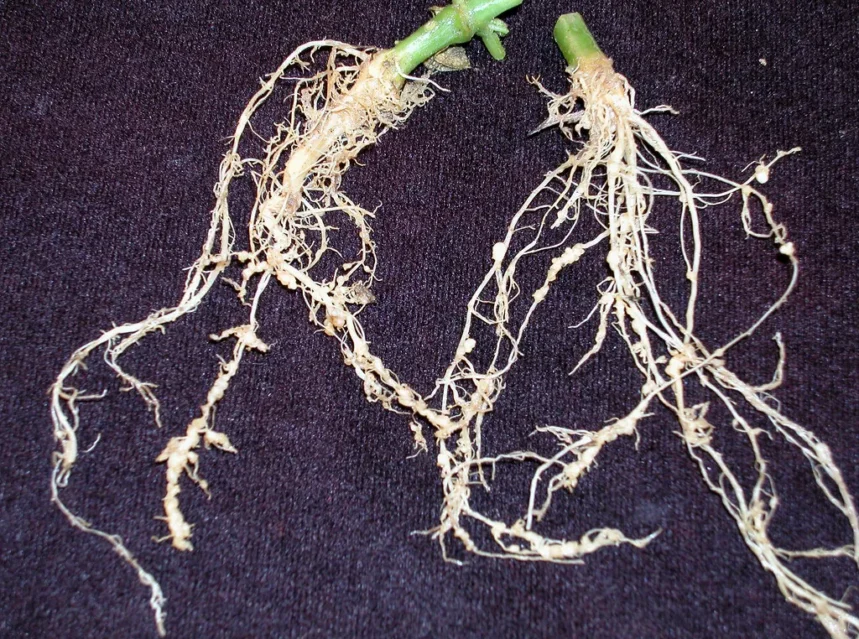
Root-knot nematodes are microscopic soil-dwelling roundworms of the genus Meloidogyne that feed inside plant roots, causing knobbly swellings called galls that starve the plant of water and nutrients.
Root-knot nematodes are one of the sneakiest garden problems. The damage happens out of sight, underground. Above ground you just see a plant that wilts, yellows and refuses to thrive. No amount of water or feed seems to help.
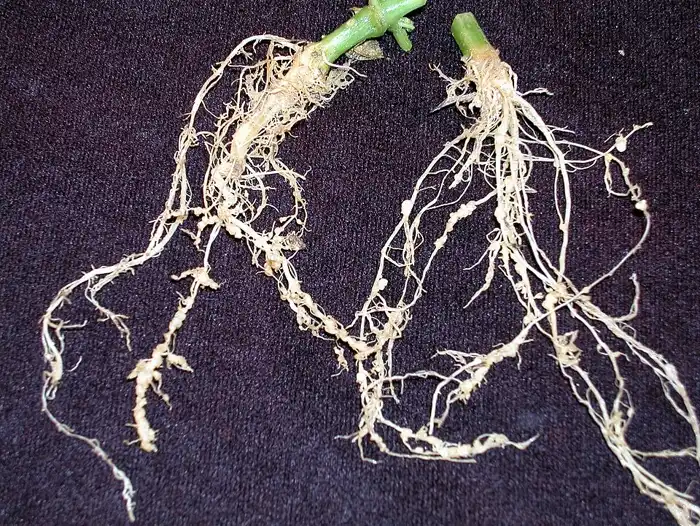
Pull it up, though, and the cause is obvious. The roots are covered in lumpy, beady galls instead of healthy fibres. This guide shows how to recognise root-knot nematodes, manage them, and rebuild soil that fights them off.
Quick answer: There is no instant spray, and no nematicide is sold to home gardeners at all. Remove and bin affected plants. Then rotate to non-host crops, grow a solid block of French marigolds as a break, and add lots of organic matter. In hot climates, solarise the soil. Sow susceptible crops early, before the soil warms past about 18 °C (64 °F). Healthy, living soil is the real long-term answer.
Growers most often report root-knot nematodes in warm, sandy soils — tomato, okra and carrot beds especially. University extension programmes across the American South and Southwest give the same verdict as long-running home-garden trials: you manage this pest with rotation, timing and soil health, never a one-off cure. The gardeners who make real progress are the ones who stack three or four tactics in the same season instead of hunting for a single product.
🧰 In a hurry? Jump straight to our tested picks for this guide ↓
Root-knot nematodes at a glance
| Question | Answer |
|---|---|
| What they are | Microscopic parasitic roundworms, genus Meloidogyne |
| Where they attack | Plant roots, below ground |
| Tell-tale sign | Knobbly galls that will not rub off; stunting above |
| Host range | Around 2,000 plant species worldwide |
| Life cycle | Roughly 3–4 weeks in warm, moist soil |
| Worst conditions | Warm, sandy soils; the same crop grown repeatedly |
| Best controls | Rotation, resistant varieties, marigolds, organic matter, solarisation |
| Quick chemical cure? | No — no nematicide is available to home gardeners |
| Key prevention | Rotation, early sowing, and healthy living soil |
What are root-knot nematodes?
Root-knot nematodes are tiny parasitic roundworms, far too small to see without a microscope. They live in the soil and invade plant roots. Once inside, they force the root to build swollen “giant cells” that act as a private feeding station, and the root tissue balloons around them into a gall.
Those galls block the root’s normal job of drawing up water and nutrients. Worse, each gall is a wound that soil fungi and bacteria can enter, so a badly galled plant often dies of a secondary rot rather than the nematode itself.
The genus is huge. More than 90 Meloidogyne species have been described, roughly 2,000 plant species are susceptible, and the group is blamed for about 5% of global crop loss. Only a handful of species matter to gardeners.
Here is the key point. The visible plant decline is really a symptom of hidden root damage. Because the nematodes are sealed inside the roots, sprays cannot reach them. So the whole approach is about prevention, timing and soil health, not killing them directly.
How do you identify root-knot nematodes?
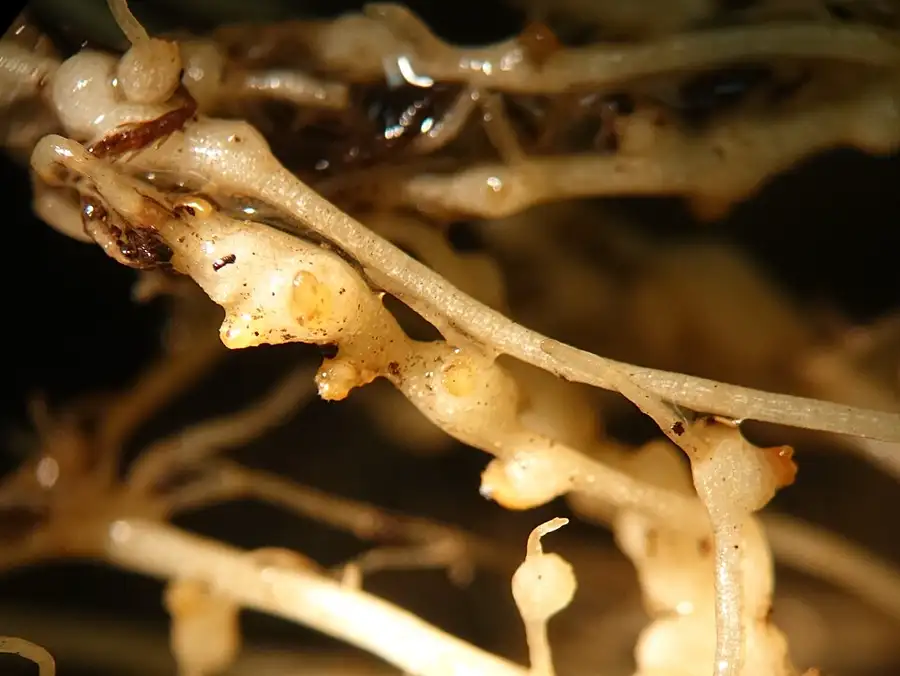
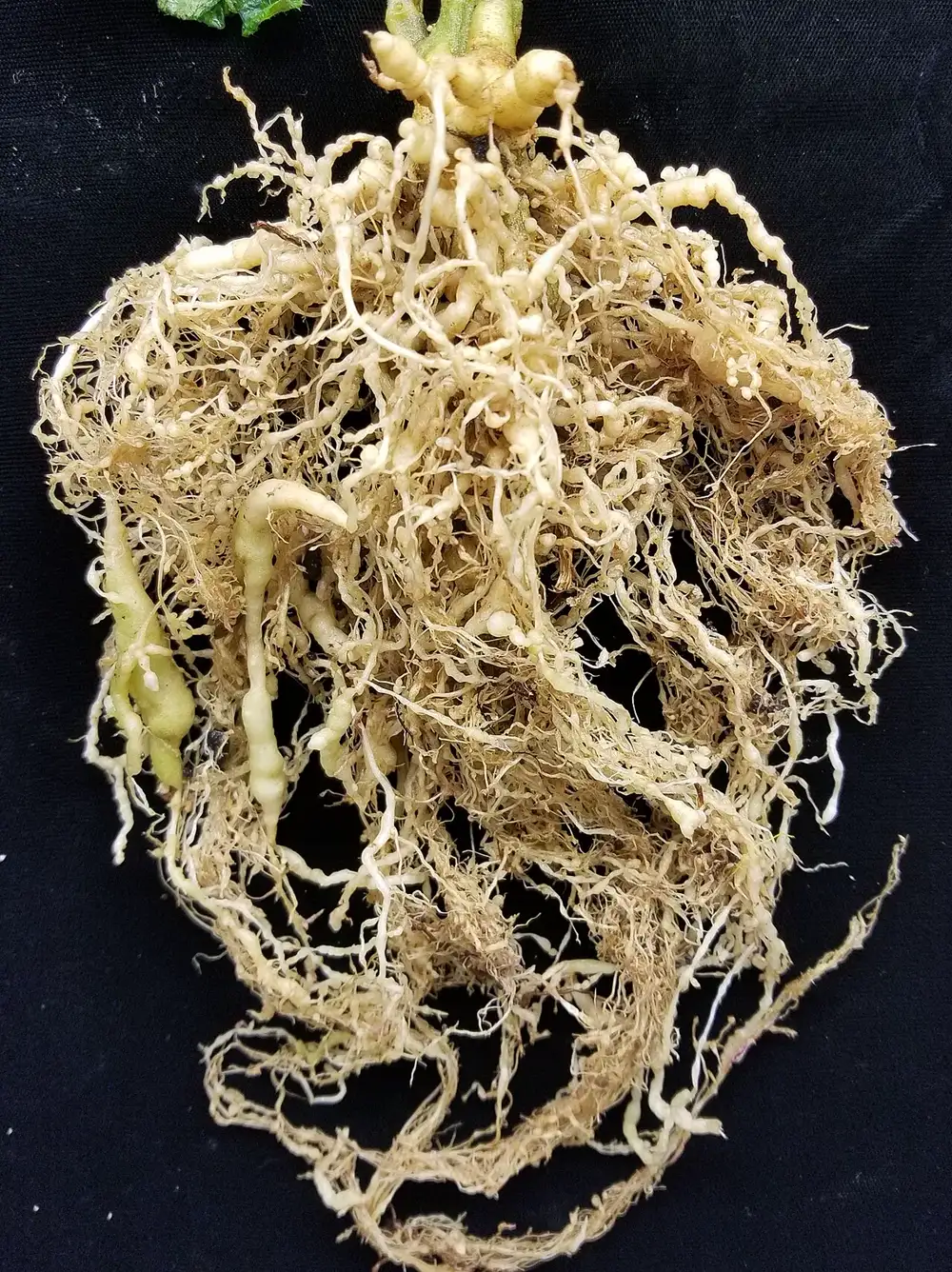
- Knobbly galls — round swellings and beads along the roots. This is the clearest sign, and swellings can reach 2–3 cm across on a badly hit tomato.
- Plants that wilt in the heat of the day even with moist soil, then recover overnight.
- Stunted, yellowing growth and poor yields with no pest visible above ground.
- Patches of weak plants in one part of a bed, usually worse in the sandiest corner.
- On carrots, forked, stubby or hairy taproots instead of clean single roots.
The gall-versus-nodule test
Beans, peas and other legumes carry harmless nitrogen-fixing nodules that look alarmingly similar. The test is simple and definitive. Rhizobium nodules sit on the outside of the root and rub off between finger and thumb. Nematode galls form inside the root tissue and will not come off. Slice a nodule and it is pink or reddish inside; slice a gall and it is the same colour as the root.
One timing nuance that almost nobody mentions: early in the season, galls are often smaller than rhizobium nodules, so size proves nothing. Use the rub test, not the ruler. If you are unsure what you are looking at, our Plant Doctor tool walks you through the symptom checklist.
Which root-knot nematode species do you have?
Most guides stop at “root-knot nematodes”. That costs gardeners money, because the species decides whether resistant seed will help you at all. Four species do nearly all the damage, and they split fairly neatly by climate.
| Species | Common name | Where it dominates | Does “N”-labelled seed resist it? |
|---|---|---|---|
| M. incognita | Southern root-knot | Warm regions; across the southern US, and common in India | Yes |
| M. javanica | Javanese root-knot | Hot, dry regions; Texas, the southeast, much of the tropics | Yes |
| M. arenaria | Peanut root-knot | The peanut belt of the southeastern US | Yes |
| M. hapla | Northern root-knot | Cool-temperate zones, northern US, Canada, northern Europe | No |
| M. enterolobii | Guava root-knot | Spreading invader in the warm southeastern US | No — it overcomes the resistance gene |
Two practical consequences follow. First, if you garden in a cool-temperate region and bought a nematode-resistant tomato that still galled, M. hapla is the likely reason — UC IPM states plainly that resistant tomato varieties do not work against that species. Second, the northern species is also the cold-hardy one: laboratory work on M. hapla juveniles found 50% survival down to about −2 °C. A hard winter does not clear your soil.
The life cycle: why timing beats spraying
The cycle is short and temperature-driven, which is exactly why the pest snowballs. UC IPM records a full cycle “in as little as 3 to 4 weeks when the soil is warm and moist”. North Carolina State Extension puts it at about 25 days on tomato, and University of Maryland Extension at around 27 days, with each female laying an egg mass of 300 to 500 eggs.
Do the arithmetic and a single warm summer allows several overlapping generations. That is why a bed can look fine in May and collapse in August.
The soil-temperature window nobody headlines
Juveniles need warm soil to invade. The northern species gets moving at roughly 13 °C (55–57 °F), while the warm-climate species generally need about 15–18 °C (59–64 °F) before they enter roots. Development for M. javanica runs between 13 °C and 34 °C, peaking near 29 °C.
So there is a free tactic hiding in the calendar. Get susceptible crops planted and well rooted before the soil crosses that threshold, and they build a strong root system before the first wave of invasion. Cool-season crops planted early often crop normally in soil that ruins a June-planted tomato. Our planting calendar helps you pull sowing dates forward without gambling on frost.
What causes a root-knot nematode build-up?
They build up where the same susceptible crop grows in the same soil year after year. Warm, light, sandy ground suits them best, partly because sand lets the juveniles move freely between roots and partly because sandy soil dries fast, so a galled plant hits water stress much sooner.
Each infected plant leaves behind a bigger population for the next one. They also travel on tools, boots, wheelbarrows and, above all, on the root balls of transplants.
In India, root-knot nematodes are a well-known problem in vegetable plots and warm sandy soils. They hit tomatoes, okra (bhindi), brinjal and carrots hard. The long warm season lets several generations build up, so a population can climb sharply within a single bed in one year.
How to manage root-knot nematodes (step by step)
Step 1 — Remove infected plants and their roots
Lift badly affected plants with the whole root ball and bin or burn them. Do not compost galled roots. A home heap rarely runs hot enough for long enough to be certain, and the eggs travel back to the bed with the compost.
Step 2 — Rotate to non-host crops
Stop growing favourites like tomatoes in that spot. Follow with resistant or non-host crops such as small grains, sweetcorn, onions, garlic, brassicas or asparagus. Use our crop rotation guide and the crop rotation planner so a susceptible crop never returns to the same bed too soon.
Step 3 — Grow a marigold break
Plant a dense block of French marigolds (Tagetes patula) as a whole-season cover in the affected bed. Their roots release nematicidal compounds. The details matter enormously, and most gardeners get them wrong — see the marigold section below.
Step 4 — Feed the soil with organic matter
Dig in plenty of compost and well-rotted manure (see improving garden soil). Rich, living soil supports the fungi and predators that keep nematode numbers down. It also holds water, which matters more than people expect: a galled root system cannot chase moisture, so the practical benefit of compost is often that the plant simply stops wilting.
Step 5 — Solarise in hot climates
Where summers are genuinely hot, cover moist, cleared soil with clear plastic through the hottest weeks. The trapped heat knocks back nematodes, weeds and other soil pests in the top layer. It suits Indian summers, the southern US and southern Europe especially well.
Step 6 — Time the next crop
Plant susceptible crops as early as the frost date allows, so roots are established before the soil warms into the invasion window.
Nematode-management kit: a packet of French marigold seeds, some compost, and a roll of clear plastic sheeting for solarising. As an Amazon Associate we earn from qualifying purchases.
Does soil solarisation really work?
Yes, in the right climate — but the internet is full of contradictory instructions, so here are the numbers from the source that measured them. UC IPM’s soil solarisation guidance is the benchmark:
- Use clear plastic, 1–2 mil for a large area or 4 mil for a small one. Black plastic does not work, because it absorbs the heat instead of letting it through.
- Wet the soil to at least 30 cm (12 inches) first. Moist soil conducts heat; dry soil insulates.
- Leave it down for four to six weeks in the hottest part of the year.
- Expect 43–60 °C (108–140 °F) at 5 cm depth, but only 32–37 °C at 45 cm. Control is reliable only in the upper 15 cm or so.
- Bury the edges so the sheet seals, and do not deep-till afterwards. Tilling drags untreated soil back up.
The honest caveat almost every blog omits: UC IPM notes that solarisation is “not always as effective against nematodes” because nematodes are mobile — they move deeper to escape the heat, then return and recolonise. Treat solarisation as a strong knock-back that buys you a good season, not a sterilisation.
You will also see one American extension page suggesting three to five days is enough. That figure sits alone against Alabama, Clemson, Florida, Mississippi State and California, all of which specify four weeks or more. Plan for the longer window.
Marigolds for nematode control: cultivar, spacing and timing
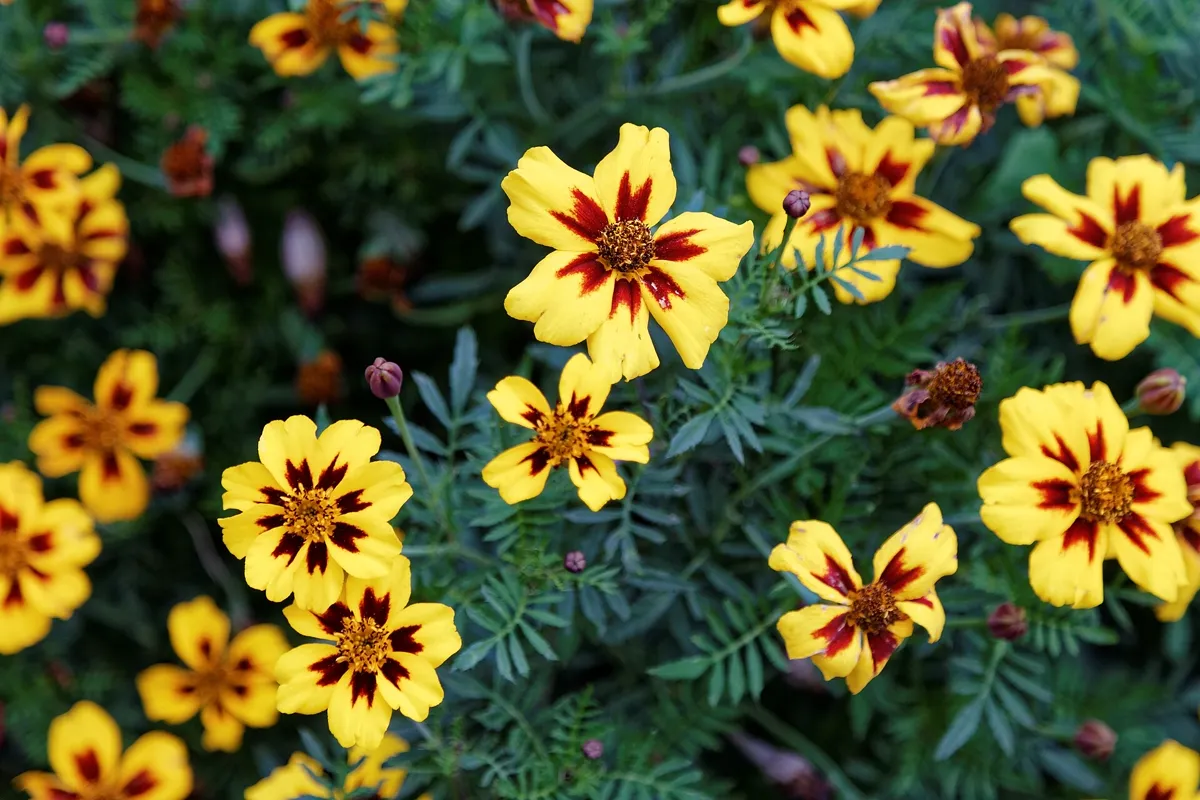
Marigolds genuinely suppress root-knot nematodes, and the active chemistry is understood: alpha-terthienyl from Tagetes roots penetrates the nematode’s outer layer and triggers oxidative stress, killing juveniles at very low concentrations. But three details decide whether you get any benefit.
- Solid planting, not companion dotting. Clemson Extension specifies a solid block with plants no more than 18 cm (7 inches) apart. Two marigolds at the end of a tomato row do nothing.
- At least two months of growth, ideally a full season, kept free of weeds and grass. Weeds inside the marigold block host the nematodes and cancel the effect.
- Cultivar matters. UC IPM names ‘Nemagold’, ‘Petite Blanc’, ‘Queen Sophia’ and ‘Tangerine’ as the most effective French marigolds, and advises against signet marigolds (T. signata). Alabama Extension trials go further and show that suppression is cultivar-specific: ‘Tangerine’ suppressed several species while some other cultivars suppressed none.
Choose a named cultivar rather than a generic mixed packet, and see our marigold growing guide for spacing and sowing. Incorporate the tops at the end of the season instead of pulling and binning them.
Resistant varieties, VFN and the hot-soil trap
Resistant seed is the cheapest defence there is. On a tomato label, V is Verticillium wilt, F is Fusarium wilt and N is nematode resistance. UC IPM has recorded resistant tomatoes yielding almost six times more fruit than a susceptible variety in infested ground.
Two limits are rarely printed on the packet, and both matter.
Limit one: the resistance is species-specific. The Mi-1 gene in tomato works against M. incognita, M. javanica and M. arenaria. It does not protect against M. hapla, and the invasive guava root-knot nematode overcomes it entirely. Florida Extension puts it bluntly: varieties marketed as nematode resistant resist “only one or two species” and may still be damaged by others.
Limit two: the resistance switches off in hot soil. This is the single most useful fact in this article and it is almost absent from gardening pages. Classic work summarised in a 2023 review of temperature and nematode resistance genes found that only 2% of root-knot juveniles developed in Mi-carrying tomato roots at 28 °C — but 87% developed at 33 °C. In a heatwave, or through an Indian or Gulf-coast summer, your resistant tomato is effectively an ordinary tomato.
The practical answer is to stop leaning on resistance alone. Combine resistant seed with early planting, mulch to keep soil temperature down, and rotation. In containers, use fresh mix and see growing tomatoes in pots.
How to get a nematode soil test and read the result
Guessing is expensive. Most land-grant universities and state agriculture departments run a nematode assay for a few dollars, and it is the only way to know the species and the population.
How to take the sample
- Sample in late summer or early autumn, when populations peak, not in spring.
- Take at least 20 cores from the root zone, 10–25 cm (4–10 inches) deep, and mix them into one composite sample of about 500 ml (a pint).
- Include fine feeder roots from a symptomatic plant if the lab allows it.
- Seal the bag. Florida Extension warns that dried-out samples are useless, and that heat and sunlight kill nematodes before they can be counted — so keep the bag cool and post it quickly.
Reading the number you get back
Labs report counts per 100 cc or per 500 cc of soil. Thresholds are crop-specific, and vegetables have the tightest of all.
| Crop group | Count per 100 cc soil | What it means |
|---|---|---|
| Vegetables | 1 or more | The crop will be affected — plan control now |
| Sweetcorn | 1–49 | No action needed |
| Sweetcorn | 50–99 | Damage may begin |
| Sweetcorn | 100+ | Act before planting |
| Turf/lawn | 80+ | Act |
Those action levels come from University of Georgia Extension’s nematode threshold guidance. The vegetable figure surprises people, and it explains a lot: a count that looks trivially small on paper is already enough to cost you a tomato crop.
The no-lab home bioassay
If no lab serves your area, UC IPM describes a simple test. Sow melon seed in pots of your own garden soil and keep them near 27 °C (80 °F). If root-knot nematodes are present, visible galls appear on the roots in about three weeks. It costs nothing but a seed packet and a month.
Cover crops, biofumigation and organic amendments
Beyond marigolds, several cover crops suppress nematode numbers. Mustard and rapeseed release isothiocyanates as their tissue breaks down. Sorghum-sudangrass contains dhurrin, which releases hydrogen cyanide on hydrolysis.
Two rules decide whether biofumigation does anything. The compounds only form when cells rupture, so you must chop and incorporate the green material into moist soil straight away — field trials where the crop was left on the surface failed outright. And potency falls as the crop matures, so cut at flowering rather than at seed.
Now the caveat that keeps you honest. Alabama Extension states that nematode populations “often rebound to pretreatment levels” once a susceptible vegetable follows a suppressive crop. Biofumigation buys a season. It does not reset the bed.
Bio-nematicides based on soil fungi are the most promising newer option. In a controlled trial on brinjal, Purpureocillium lilacinum reduced root galls by 52% and egg masses by 62%. Availability to home gardeners varies by country, and results in open ground are less predictable than in pots. Fold them into an organic pest control routine rather than treating them as a cure.
Containers, raised beds and grow bags
Growing in pots is the fastest escape route, and it works — bagged potting mix is effectively nematode-free. But two mistakes undo it.
- Pots standing on infested ground get recolonised through the drainage holes as roots grow out. Stand pots on slabs, gravel, a bench or matting.
- A raised bed built on infested soil is not a barrier. Roots go straight down through the open bottom. If you build one over a known problem area, line the base with a permeable membrane and fill with fresh mix.
This is also why a terrace garden full of fresh mix so often outperforms a ground bed on the same property.
Which plants do root-knot nematodes attack most?
The host list is enormous, but the day-to-day picture is much simpler. Some crops suffer badly, and a useful group barely notices.
| Badly affected | Usually safe (non-host or resistant) |
|---|---|
| Tomato, pepper, brinjal/eggplant | Onion, garlic, leek |
| Okra, cucumber, melon, squash | Sweetcorn, wheat, barley, rye, oats |
| Carrot, beetroot, lettuce, potato | Broccoli, cabbage, kale, collards, mustard |
| Sweet potato, bean, pea | Asparagus, rhubarb, globe artichoke |
| Rose, gardenia, boxwood, fig | Strawberry, horseradish, fescue grasses |
The common thread among the victims is warm, light soil and repeated cropping. A bed grown with tomatoes summer after summer in sandy ground is the perfect nematode nursery. So keep records of where you grow tomatoes and okra, then move them on a multi-year cycle.
What does not work: myths worth skipping
This is the weakest area of most advice online, so here is a straight list.
- Beneficial nematodes. The Steinernema and Heterorhabditis products sold in garden centres target insect larvae, not plant-parasitic nematodes. Buying them for root-knot is a common and costly mix-up.
- Epsom salts. No credible evidence. It is a magnesium fertiliser, not a nematicide.
- Molasses and sugar drenches. Genuinely mixed evidence. Some pot and field trials reduced galling, but the same work generally did not reduce nematode numbers in the soil. Treat it as unproven rather than debunked.
- Soil fumigants. Not legally available to home gardeners in the US, UK or India, and dangerous to use unsupervised.
- Neem as a spray. Foliar neem oil does nothing for a soil pest. Neem cake worked into the soil is a different product and does have supporting trial data.
- Deep digging to “expose” them. It mostly spreads the infestation through the bed.
A two-year recovery plan for one infested bed
Advice is easier to follow as a schedule. Here is a workable two-year plan for a single bad bed, adapted from the rotation planners published by several extension services.
| Season | Action |
|---|---|
| Autumn, year 1 | Lift and bin all galled roots. Take a soil sample for a nematode assay. |
| Winter, year 1 | Dig in generous compost or well-rotted manure. Leave the bed bare or under a non-host cover. |
| Early spring, year 2 | Sow a non-host: onions, garlic, brassicas or a cereal. Or sow marigolds if the bed is free. |
| Summer, year 2 | Either a full-season solid marigold block, or solarise for 4–6 weeks in the hottest spell. |
| Autumn, year 2 | Incorporate the marigold tops. Re-test the soil. |
| Spring, year 3 | Plant an early, resistant, well-mulched susceptible crop. Keep records. |
One year of fallow or non-host cropping already drops populations enough to grow a susceptible annual again. Two years drops them further. That is the realistic timescale, and no product shortens it.
Root-knot nematodes in Indian gardens
In India, root-knot nematodes are a familiar headache in vegetable plots. They hit tomato, okra, brinjal and carrot in warm sandy soils. Research from Tamil Nadu puts losses in infested tomato crops in a wide band of roughly 40–91%, which matches how sharply a bed can decline.
The long hot season is the problem and also the opportunity. Populations build all year with no cold check — but soil solarisation is unusually effective here. Cover moist, cleared soil with clear plastic through the peak summer heat before the monsoon planting.
Indian research offers a second angle that Western guides never mention. A multi-year ICAR field trial on turmeric combined the soil fungus Pochonia chlamydosporia with neem cake applied before and after the monsoon, plus marigold planted through the beds, and reported roughly 74% reduction in soil populations and 86% in roots — results comparable to the chemical standard it was tested against.
For a sustainable routine, pair solarisation with crop rotation, marigold break crops, neem cake and plenty of compost. You can also grow vulnerable vegetables on a balcony or terrace in fresh potting mix, where pressure is far lower.
How to prevent root-knot nematodes
- Rotate crops every season so susceptible plants never sit in the same soil repeatedly.
- Choose resistant varieties where they exist, and remember the hot-soil limit.
- Plant early, before soil crosses about 18 °C, so roots establish ahead of the first invasion.
- Keep building organic matter to support a predator-rich soil food web.
- Inspect the roots of every transplant before it goes in the ground. This is how most gardens get infested in the first place.
- Clean soil off tools, boots and wheelbarrows between beds.
- Grow a marigold break crop in problem areas on a regular cycle.
- Mulch to keep soil cooler and hold moisture through the hottest weeks.
Why root-knot nematodes keep coming back
The biggest reason gardeners struggle is simple. No spray reaches worms sealed inside the roots. Every infected plant left to mature releases a fresh wave of eggs into the soil. So growing the same host again simply feeds the next generation.
This is why rotation is the heart of control. Deny the nematodes their favourite hosts for a few seasons and the population falls naturally. Combine that with rich organic matter, and the soil’s own predators help keep numbers down.
University extension programmes and the Royal Horticultural Society agree that there is no quick chemical fix for home gardens. The durable answer combines rotation, resistant varieties, timing, organic matter and, in hot climates, solarisation, used together over time.
Frequently asked questions
How do I know it's root-knot nematodes?
Pull up a struggling plant and look at the roots — knobbly galls and swellings (not rub-off bean nodules) plus daytime wilting and stunting point to root-knot nematodes.
Is there a spray for root-knot nematodes?
No effective home spray reaches them inside the roots — control is about rotation, resistant varieties, marigolds, organic matter and soil solarisation instead.
Do marigolds really control nematodes?
Yes — a dense, whole-season block of French marigolds releases root compounds that suppress nematode numbers, making them a proven organic break crop.
Can I reuse soil that had nematodes?
Solarise it in hot weather, mix in fresh compost, and rotate to non-host crops; for pots, it’s safest to start again with fresh potting mix.
Are all nematodes bad?
No — many soil nematodes are harmless or beneficial. Only certain root-feeding types like root-knot nematodes damage plants by forming galls on the roots.
How do you get rid of root-knot nematodes naturally?
There is no quick spray-and-forget fix, but several organic methods stack up well together. Dig in plenty of compost to boost the beneficial soil life that competes with nematodes, grow a solid block of French marigolds as a full-season cover crop, and rotate away from susceptible crops like tomatoes for two or three years. In warm regions, neem cake worked into the soil is a well-regarded organic amendment. The goal is to suppress populations below damaging levels, not to wipe them out entirely.
Does soil solarization kill nematodes?
Yes, in the right climate it is one of the most effective non-chemical tools. Water the bed, cover it tightly with clear plastic, and leave it through the hottest weeks so trapped heat cooks the top layer of soil. Four to six weeks of strong summer sun sharply reduces root-knot nematode numbers along with many other soil pathogens and weed seeds. It works best in hot, sunny areas — much of India, southern Europe, and the southern US — and less well in cool cloudy summers. Bear in mind that nematodes can move deeper to escape the heat and recolonise later, so treat it as a strong knock-back rather than a sterilisation.
What does VFN mean on a tomato label?
VFN on a seed packet or plant tag means the variety carries resistance to Verticillium wilt (V), Fusarium wilt (F), and Nematodes (N) — specifically root-knot nematodes. Choosing VFN-coded varieties is the single easiest defence if you know your soil is infested. Resistant plants may still show a little root galling under heavy pressure, but they generally hold their yield where a non-resistant variety would collapse.
Why did my nematode-resistant tomato still get galls?
There are two usual reasons, and both are well documented. First, the resistance is species-specific: the Mi gene handles the southern, Javanese and peanut root-knot nematodes but not the northern species, and the invasive guava root-knot nematode overcomes it entirely. Second, resistance is temperature-sensitive. Research summarised in a 2023 review found that only 2% of juveniles developed in resistant tomato roots at 28 °C, against 87% at 33 °C. In a hot summer the gene effectively stops working, so mulch to keep the soil cooler and plant as early as you can.
At what soil temperature do root-knot nematodes become active?
Broadly, the northern species starts invading roots at roughly 13 °C (55–57 °F), while the warm-climate species usually need 15–18 °C (59–64 °F). Development runs fastest close to 29 °C. That gives you a genuinely useful tactic: get susceptible crops sown and rooted before the soil warms past about 18 °C, and they establish ahead of the first wave. A soil thermometer costs very little and is one of the better nematode investments you can make.
Do root-knot nematodes spread through the garden?
They do, though slowly on their own — often less than a metre or two in a season. The real spread comes from you: infested soil clinging to tools, boots, wheelbarrows, and especially the root balls of transplants moved from one bed to another. Clean tools between beds, avoid moving soil from a known-infested area, and never share unclean transplants. Contained early, an infestation can be kept to one bed for years.
Does neem cake control nematodes?
Research supports it as a useful organic amendment. Greenhouse and field trials found that adding neem cake to soil substantially reduced root-knot numbers in roots, and it doubles as a slow-release organic fertiliser. It is widely used for this purpose in Indian gardening, often alongside a biocontrol fungus. Treat it as one layer of an integrated approach alongside compost, marigolds, resistant varieties, and rotation rather than a standalone cure. Neem oil sprayed on leaves does nothing here — the pest is in the soil.
Will beneficial nematodes kill root-knot nematodes?
No, and this is one of the most expensive mix-ups in home gardening. The beneficial nematodes sold in packets are Steinernema and Heterorhabditis species, and they parasitise insect larvae such as vine weevil grubs and leatherjackets. They have no useful effect on plant-parasitic root-knot nematodes. If you want a biological option for root-knot, look instead at soil fungi such as Purpureocillium lilacinum or Pochonia chlamydosporia, which do target nematode eggs.
Is it safe to eat vegetables grown in soil with root-knot nematodes?
Yes. Root-knot nematodes are plant parasites and do not affect people or pets, so tomatoes, beans or okra from an infested bed are perfectly safe to eat. The crop will simply be smaller and later. Root vegetables are the exception in practical terms: galled, forked carrots and knobbly potatoes are still edible but are usually unpleasant to prepare, so most gardeners compost the worst of them. Wash produce as normal.
How long do root-knot nematodes survive without a host?
Long enough to be annoying, but not indefinitely. Most hatched juveniles die within weeks if they cannot find a root, and one study group reported that 85–90% of the hatched juveniles die between seasons. Eggs are tougher and persist in soil and in old root fragments. That is the logic behind fallowing: one clean, weed-free year drops the population enough to grow a susceptible crop again, and two years drops it further. Weeds count as hosts, so a “fallow” bed full of weeds achieves nothing.
Do root-knot nematodes survive winter, or does freezing kill them?
Frost helps a little and settles nothing. The northern root-knot nematode in particular is cold-adapted: laboratory work found 50% of juveniles still surviving at about −2 °C, with eggs the hardiest stage of all. In temperate gardens the population overwinters in soil and root debris and starts again in spring. In tropical and subtropical gardens there is no cold check at all, which is why pressure builds faster there and rotation matters even more.
Can root-knot nematodes get into raised beds or containers?
Containers filled with bagged potting mix start out clean, but they do not stay clean automatically. Roots growing out of the drainage holes into infested ground bring the problem straight back in, so stand pots on slabs, gravel or a bench. A raised bed with an open bottom sitting on infested soil is not a barrier at all — roots simply travel down into it. If you are building over a known problem area, line the base with a permeable membrane and fill with fresh mix.
Should I get a nematode soil test, and how?
It is worth it if you have lost a crop and want to know what you are dealing with. Most land-grant universities and state agriculture departments run an assay for a few dollars. Sample in late summer or early autumn when numbers peak, take at least 20 cores 10–25 cm deep, mix them into one pint-sized composite, seal the bag so it cannot dry out, and keep it cool. For vegetables the threshold is strikingly low — a count of one or more per 100 cc is already enough to affect the crop.
Can a plant recover from root-knot nematode damage?
Annual vegetables can often bounce back once the pressure is reduced — improve the soil, water and feed well, and next season’s crop in cleaner or amended soil usually performs far better. A plant already heavily galled this season will not be cured, so focus your effort on protecting future crops. Perennial and woody plants such as fruit trees and berries are more vulnerable to lasting damage, which makes prevention especially important before planting anything permanent.
Sources and further reading
- UC IPM — Root Knot Nematodes (Pest Notes)
- UC IPM — Soil Solarization for Gardens and Landscapes
- UF/IFAS Extension — Nematode management in the home garden
- University of Georgia Extension — nematode assay thresholds
- Root-knot nematode — Wikipedia
- All free Gardening Guider tools
Still stuck? Ask the Plant Doctor
Describe the problem — yellow leaves, holes, no flowers — and get a clear answer in seconds. FreeAI can make mistakes. Answers are guidance, not a guarantee — check anything important against the guide it links to, and always read the label on any product before you use it.