Shrimp Plant
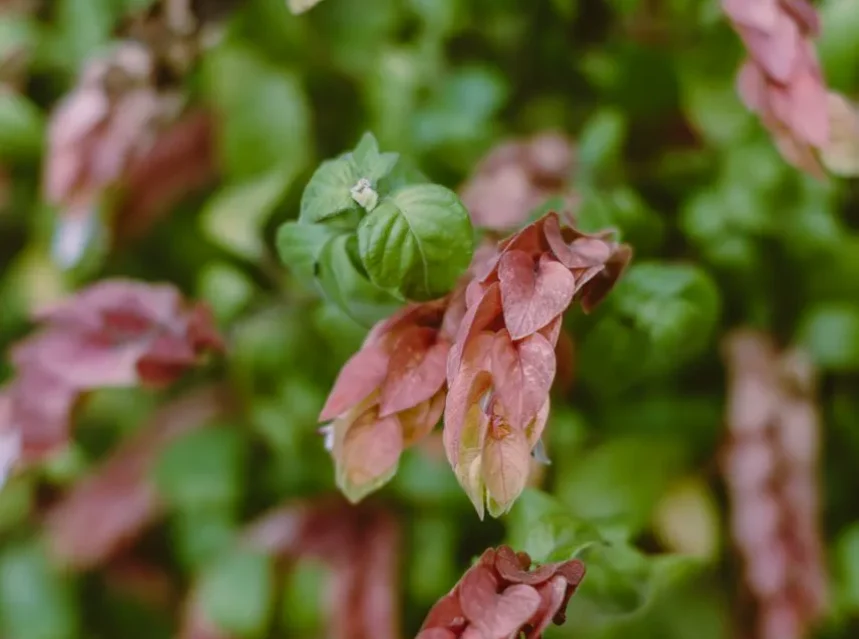
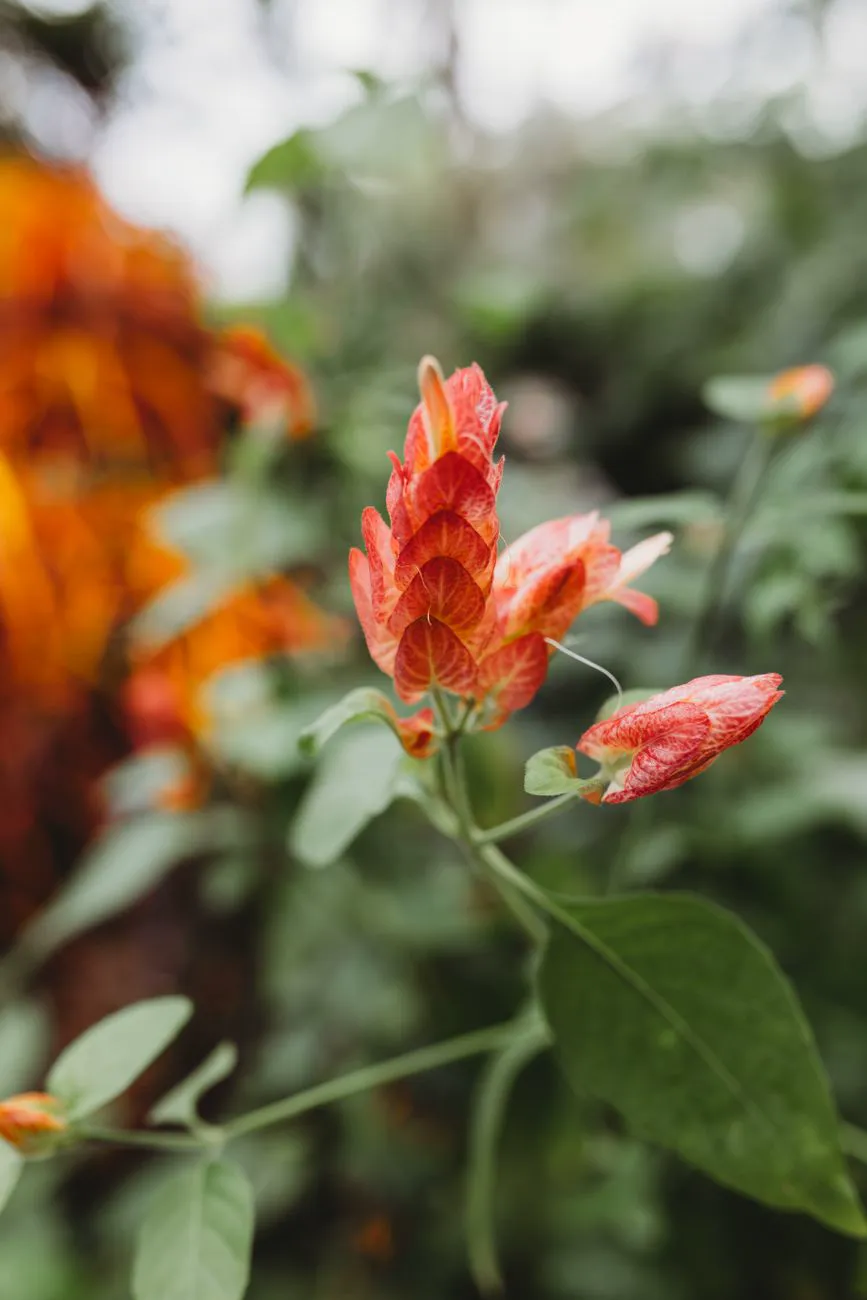
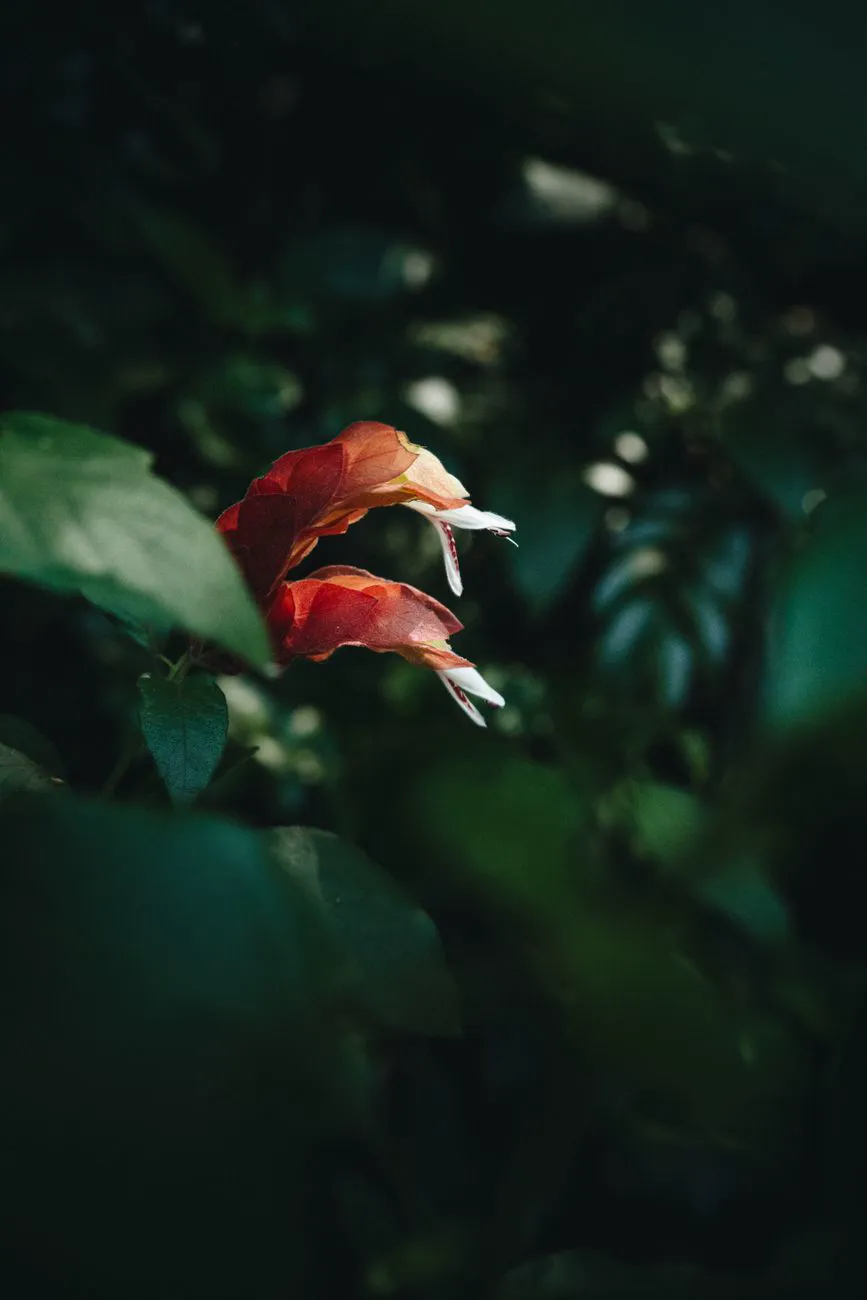
Shrimp plant (Justicia brandegeeana) is a soft tropical shrub from Mexico whose flower heads look uncannily like curled shrimp. The overlapping salmon, rust or chartreuse scales are bracts, not petals, and the small white true flowers slip out of the tip like antennae. Because bracts are tough and long-lived, one “shrimp” stays colourful for weeks after its flowers have dropped — which is the whole reason this plant seems to bloom forever.
Quick start: Give a shrimp plant bright light with gentle morning sun. Keep the soil lightly moist and the air above about 7°C (45°F). Cut the whole plant back by half each early spring, because it flowers on new growth, then pinch the tips through summer. Every trimming roots easily, so one plant becomes a hedge in a couple of seasons.
Growers who keep shrimp plants for years agree on one thing: prune harder than feels reasonable. Unpruned plants turn into floppy tangles that flower only at the tips, because the shrub naturally sheds its lower leaves as it stretches. Botanic-garden guidance is specific about the remedy — cut back to at least two leaf joints so new stems can break from them. The other recurring lesson is that leaves react fast to inconsistent watering: too wet or too dry, and they drop.
🧰 In a hurry? Jump straight to our tested picks for this guide ↓
Shrimp plant at a glance
| Feature | Detail |
|---|---|
| Botanical name | Justicia brandegeeana Wassh. & L.B.Sm. (family Acanthaceae) |
| Older name you will still see | Beloperone guttata — the basionym, published 1912; old books and some nurseries still use it |
| Common names | Shrimp plant, Mexican shrimp plant, false hop |
| Plant type | Tender evergreen flowering shrub |
| Height | 30-90 cm in pots; to about 1.5 m in the open ground |
| Light | Bright with gentle sun; part shade where summers are fierce |
| Soil | Moist, humus-rich, free-draining; roughly pH 6.0-7.0 |
| Bloom time | Nearly year-round in warmth; summer-long in temperate gardens |
| Bract length | From about 2 cm to as much as 30 cm on a well-grown head |
| Hardiness | USDA zones 9-11 outdoors; keep containers above about 7°C (45°F) |
| Pollinators | Hummingbirds in the Americas; sunbirds, butterflies and bees elsewhere |
| Propagation | Tip cuttings (roots in 3-6 weeks), layering, division |
| Award | Holds the Royal Horticultural Society’s Award of Garden Merit |
| Best for | Pots, low informal hedges, mixed containers, bright rooms |
Why grow a shrimp plant?
- The longest flowering season of almost any tender shrub. In frost-free gardens the heads run nearly all year; even on a bright windowsill the display stretches across seasons.
- The colour lasts because it is not petals. The white flowers are short-lived, but the bracts holding them stay bright for weeks. You get the visual reward of a flower with the durability of a leaf.
- It forgives hard pruning. Cut it to stubs in spring and it comes back denser and flowers more. Very few flowering shrubs reward that treatment so reliably.
- Free plants, endlessly. Every prune is a bag of cuttings, and they root readily in water or compost. This is why the plant spreads through neighbourhoods over garden fences rather than through garden centres.
- It feeds nectar birds and butterflies. The tubular white flowers hold nectar at the base — hummingbirds in its native range, sunbirds and butterflies across Asia and Africa.
- It tolerates shade and a degree of neglect, which is unusual in a plant that flowers this hard, and the reason it works indoors where showier tropicals sulk.
History, origin and how it spread
The shrimp plant is native to Mexico, where it grows as forest-edge undergrowth in warm, frost-free country. That origin is the key to its care: an understorey plant expects filtered light and steady moisture, not blazing sun and drought.
The species was first published in 1912 as Beloperone guttata by the American botanist Townshend Stith Brandegee (1843-1925). That epithet simply means “spotted”, for the markings inside the white flowers. The plant then stayed in Beloperone for more than half a century. Only in 1969 did Wasshausen and L.B. Smith move it into Justicia, and the new epithet they gave it — brandegeeana — is the part that actually honours Brandegee. Justicia itself is an enormous genus of over 900 accepted species, named after the Scottish horticulturist James Justice (1698-1763).
The old name has never quite died. If you inherit a plant labelled Beloperone guttata, or find it under that name in an older gardening book, it is the same plant. You will also see the epithet written brandegeana, with a single “e” — that is simply a common misspelling, not an alternative name.
From glasshouse cultivation it moved outdoors into every warm region that would have it. It is now a fixture of Florida and Gulf-coast gardens, a popular conservatory and windowsill plant in the UK — where it holds the RHS Award of Garden Merit — and thoroughly at home across India, edging beds and hedges from Bengaluru to Kolkata.
One honest footnote most guides skip: in Florida it is not a native plant, and it has escaped cultivation and naturalised there — the Atlas of Florida Plants records it as not native to the state. It is not classed as a serious invader, but if you garden on the Gulf coast it is worth siting it where seedlings and layered stems will not wander into natural areas.
Bracts, not flowers: what you are actually looking at
Understanding the structure makes every care decision easier.
- The curved, overlapping “shrimp” is a chain of bracts — modified leaves. They start pale and deepen with age and light, and a single head can run from about 2 cm to as much as 30 cm.
- The true flowers are the slender white tubes, usually spotted inside, that emerge from the bract tips. Each lasts only a few days.
- So a head that has “stopped flowering” has usually not stopped at all. It is between flushes, and the bracts are still doing the display work.
This is also why deadheading is different here. You are not removing spent petals, you are removing a whole bract chain once it fades to buff and starts to shed — and that is what tells the plant to build another.
Shrimp plant, golden shrimp plant and the lookalikes
Half the confusion online comes from three different plants sharing the shrimp name. They are related but not interchangeable, and one of them is not even in the same genus.
| Plant | What it is | How to tell it apart |
|---|---|---|
| Shrimp plant Justicia brandegeeana |
Mexican shrub, family Acanthaceae. The subject of this guide. | Bract chains arch and dangle like a prawn, salmon to rust to brick red. Softly hairy leaves. |
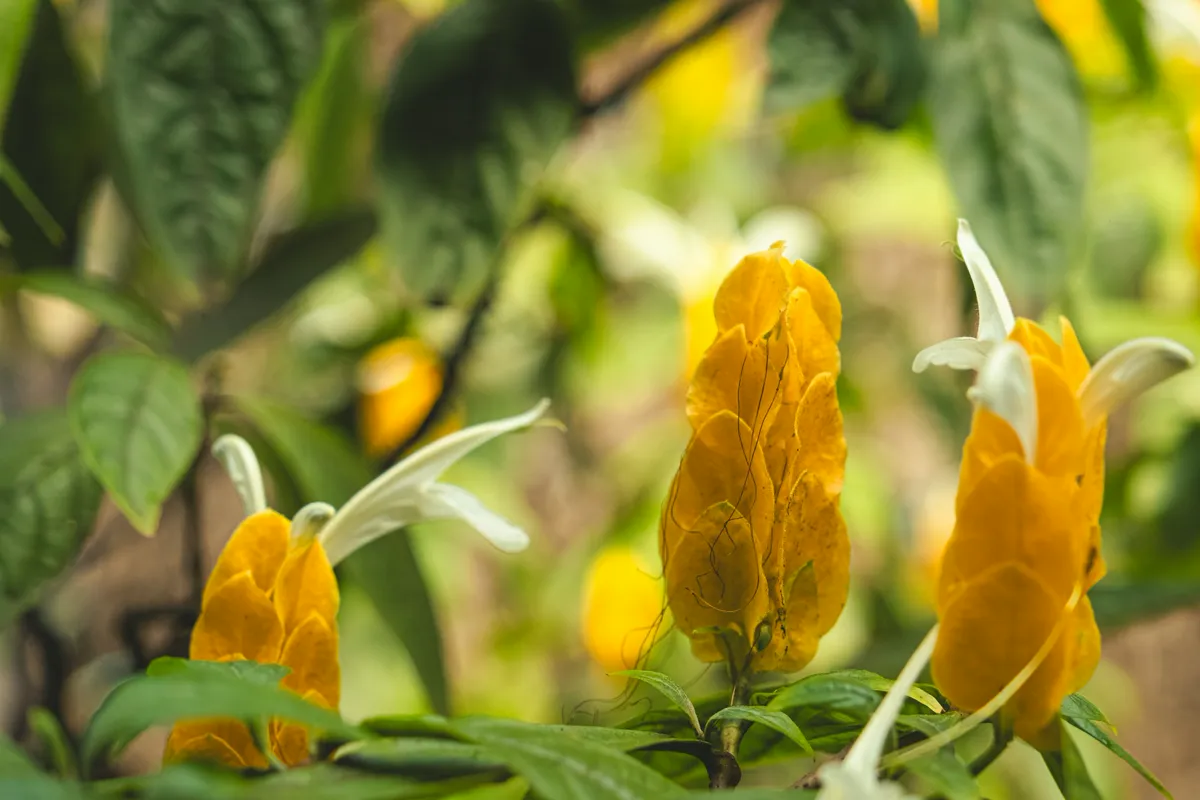
| Golden shrimp plant or lollipop plant Pachystachys lutea |
A different genus, native to Peru. Same family, similar care, sold constantly as “yellow shrimp plant”. | Bracts are bright yellow and held stiffly upright in a cone, not dangling. Glossier, more strongly veined leaves. |
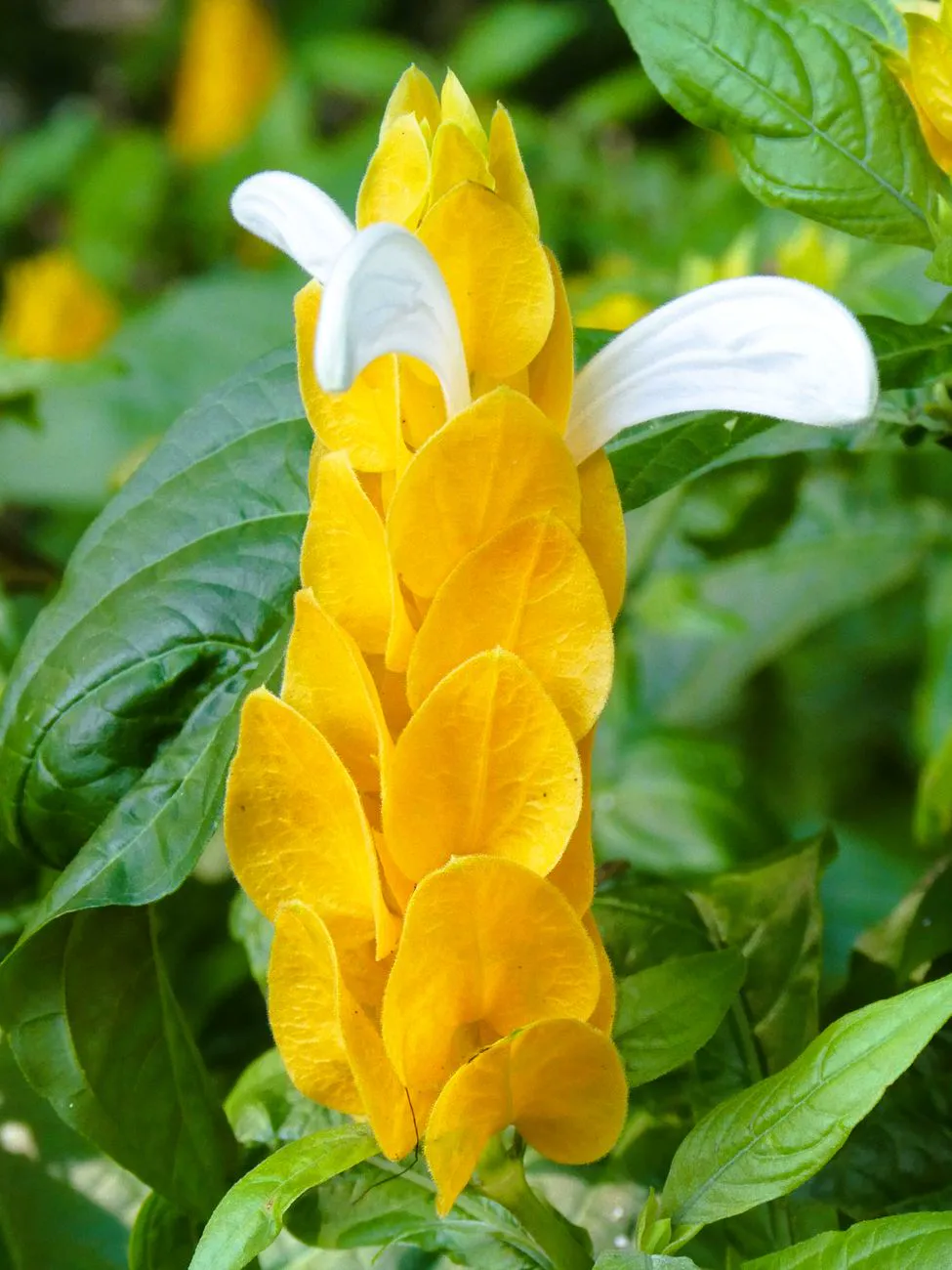
| Yellow-bracted forms of the true shrimp plant | Cultivars of J. brandegeeana with lime-yellow bracts, plus pink and dark brick-red selections. | Still arching, just a different colour. If it dangles, it is Justicia, whatever the colour. |
Why it matters: the care overlaps heavily, but Pachystachys wants a touch more warmth and light and is less forgiving of a cold windowsill. If a plant labelled “shrimp plant” is sulking on care that ought to work, check which one you actually bought.
Best spot and when to plant
Aim for bright light with a few hours of gentle sun — morning sun with bright shade after midday is the sweet spot almost everywhere.
Light and bract colour have a genuinely mixed reputation, and it is worth being straight about it. Botanical references note that the bracts bleach out in full sun, which is why partial shade is the standard recommendation. Other descriptions note the bracts deepen from white toward salmon with increased sun exposure. Both are true at different intensities: colour develops with good light, and burns out under fierce, direct heat. In a cool-summer climate the plant will take near-full sun happily. In an Indian or Gulf-coast summer, the same exposure will scorch the leaves and wash the heads to straw. Judge by your own plant — rich salmon-rust means the spot is right.
When to plant: outdoors, after all danger of frost, which means late spring in the US and UK. In India, plant at the onset of the monsoon or in any mild month, avoiding the peak of pre-monsoon heat. Indoors, pot up in spring as growth restarts. In borderline zones 8b-9, expect the top growth to die back in a cold snap and resprout from the roots, so mulch the crown going into winter as insurance.
How to plant a shrimp plant: step by step
- Pick the container or spot. A 25-30 cm pot suits a mature plant; in the ground, choose a bed enriched with compost, because this shrub likes to eat.
- Mix a rich, free-draining compost — potting soil with about a quarter compost and a handful of perlite. Aim for roughly pH 6.0-7.0. Our soil and pH calculator will tell you how much amendment a given bed or pot needs.
- Plant at nursery depth, no deeper. Space border plants 45-60 cm apart if you want them to knit into a low hedge.
- Water in well and mulch outdoor plantings to keep root moisture even — the single thing this plant is fussiest about.
- Pinch the tips straight away. Setting a bushy framework on day one saves a leggy correction later.
It also takes beautifully to large mixed containers, where the dangling heads spill over the rim among upright companions such as crossandra.
Light, soil, watering and feeding
Light: bright, filtered, with gentle direct sun. Use bract colour as your gauge — deep salmon-rust is right, bleached cream means too much harsh sun, sparse greenish heads mean too little light. Move the plant a metre at a time rather than making dramatic changes.
Water: keep the compost lightly and evenly moist. Water thoroughly once the top 2-3 cm feels dry, and let it drain fully. This plant’s leaves are quick to react to either extreme — botanical guidance is explicit that leaves may drop if the soil is too wet or too dry. It wilts visibly when thirsty and recovers quickly, but repeated drying costs you leaves and a flush of bloom. In summer a container may need water every two or three days; in winter, once a week or less. Our watering calculator will set a starting interval for your pot size and climate. See also how often to water plants.
Feeding: a balanced liquid feed at half strength every two to three weeks through the growing season is plenty. In year-round-warm climates feed lightly but continuously. Too much nitrogen gives you a big leafy plant with few shrimp heads, so if growth is lush and bloom is thin, ease off and switch to something more balanced. Our fertiliser and NPK calculator converts that into a dose for your pot.
Humidity and repotting: average room humidity is fine, which makes this far easier indoors than most tropical bloomers. Do repot every year or two in spring, though — a root-bound shrimp plant sheds leaves, and people usually blame the watering.
Pruning: the secret to non-stop bloom
Two facts decide the whole routine: the shrimp plant flowers on new growth, and its natural habit is to stretch and drop its lower leaves. So:
- Early spring: cut the whole plant back by half. If it has run wild, take it down to a framework of stubs. Cut back to at least two leaf joints, because new stems break from those nodes — a stem cut back to bare wood with no nodes below may not shoot.
- Through the season: pinch tips every few weeks. Every pinch turns one stem into two, and two stems mean two shrimp heads.
- Remove faded bract chains once they go buff and start shedding. That is the signal for the next flush.
- Indoor plants get exactly the same spring haircut, and need it more, because lower light stretches them faster.
Skip a year of pruning and the plant survives perfectly well — it simply flowers at the branch tips while the centre goes bare and woody. Five minutes with secateurs in March buys months of dense bloom.
Shrimp plant propagation
Your spring prunings are the nursery. Cuttings are the standard method because they are quick, free and near-foolproof in warmth.
- Take 10-15 cm tip cuttings from healthy, non-flowering shoots in spring or early summer, using a clean blade and cutting just below a node.
- Strip the lower leaves and remove any bracts — a cutting trying to flower is not putting energy into roots.
- Dip in rooting hormone if you have it, then push into a moist, gritty mix — a 50:50 compost and perlite blend is ideal — or simply stand the cuttings in water on a bright shelf.
- Keep warm, humid and out of direct sun, under a clear cover or a loose bag. Roots usually appear in three to six weeks.
- Pot rooted cuttings individually, pinch the tips early, and expect flowering-size plants within months.
Layering works too and needs no equipment: pin a low stem to the soil, keep it moist, and sever it a month or so later once it has rooted where it touches. Established clumps can also be divided at the start of the growing season.
Cold tolerance and overwintering
Sources disagree on how much cold this plant takes, and the disagreement is worth understanding rather than averaging away.
- For a container plant, treat about 7°C (45°F) as the floor. Below that, growth stops and leaves drop; a cold draught alone will strip a windowsill plant.
- In the ground in a warm climate, it is tougher than that. Botanical-garden observations from north Florida describe it staying evergreen into the mid-20s°F (around -4°C), and gardeners in zone 8b routinely lose the top growth to a freeze and see it resprout from the roots in spring.
The reconciliation is simple: roots and top growth have different tolerances, and a plant established in the ground with a mulched crown survives cold that would kill the same plant in an exposed pot. Do not read a Florida hardiness note as permission to leave a container outside in a British winter.
Two ways to overwinter in a cold climate: keep it as a warm houseplant in good light and carry on watering lightly — or, if space is short, cut it back, reduce watering sharply and rest it somewhere cool and dim until spring, then prune and restart it. The second method is what botanic gardens in cold-winter cities recommend for stored container stock.
Common pests and diseases
- Spider mites in dry indoor air — pale stippled leaves, faint webbing. Raise humidity and rinse the leaf undersides.
- Whiteflies, which are specifically listed as a problem on this species indoors. Yellow sticky traps plus a soap spray, repeated weekly.
- Aphids on soft new growth after a feed. Usually a hose or a finger-and-thumb job outdoors.
- Leaf spot in crowded, damp foliage. Space plants, water at the base rather than over the leaves, and remove affected leaves.
- Root rot from a soggy pot with poor drainage — the most common way an indoor shrimp plant is actually killed.
A weekly insecticidal soap or neem oil spray handles the insect trio, applied at dusk and repeated. If you are not certain what you are dealing with, our free Plant Doctor will narrow it down before you spray. Otherwise this is one of the most trouble-free flowering shrubs you can grow.
Common shrimp plant problems
Leggy stems with blooms only at the tips
Pruning debt, and it is the number one complaint about this plant. It sheds lower leaves as it stretches, so the fix is structural rather than nutritional. Cut back hard in early spring to at least two leaf joints, then pinch through summer. The plant rebuilds dense and flowers along every stem.
Bracts pale and washed out
Usually light, at one extreme or the other. Fierce direct sun bleaches the bracts to cream; too little light gives sparse, greenish heads. Aim for bright filtered light with gentle morning sun, and move the plant gradually. Remember that individual bracts also fade naturally with age after several weeks — regular deadheading keeps the display looking fresh.
Leaves dropping suddenly
Three usual culprits, in order: watering that swung too wet or too dry, a cold draught or chilly night, and a plant that has become root-bound. Check the pot first, because people rarely think of it. Repot in spring every year or two, keep moisture even, and move it away from doors and heating vents.
Yellow leaves
Most often overwatering, especially in heavy compost or a pot without drainage. Let the top few centimetres dry before watering again and check the roots are firm and pale, not brown and soft. A few yellowing lower leaves on a plant that is otherwise growing well is just normal ageing.
Few or no shrimp heads
Too little light, too much nitrogen, or no pruning — in that order of likelihood. Brighten the position, switch to a balanced feed, and give it the spring cut-back. Remember also that the plant flowers on new growth, so a shrub that has not been pruned in two years has very little new growth to flower on.
Related plant guides
- Crown of Thorns care
- Persian Shield care
- How to grow Elephant Bush
- How to grow Desert Rose
- How to grow Marguerite Daisy
- How to grow Aeonium
Frequently asked questions
Why is it called a shrimp plant?
The overlapping salmon-rust bracts arch and curl exactly like a cooked shrimp, with the slender white true flowers emerging from the tip like antennae. The resemblance is strong enough that the same name has been adopted in many languages. It is also sold as Mexican shrimp plant, and occasionally as false hop, because a faded bract chain resembles a hop cone.
Is the shrimp plant a perennial?
Yes — a tender evergreen perennial shrub. It grows year-round in frost-free climates, resprouts from the roots after light frost in borderline zones, and lives for years as a houseplant given a spring prune and a repot every year or two.
What is the difference between shrimp plant and golden shrimp plant?
They are different genera in the same family. The true shrimp plant is Justicia brandegeeana from Mexico, with arching, dangling bracts in salmon, rust or brick red. Golden shrimp plant is Pachystachys lutea from Peru, with stiff, upright cones of bright yellow bracts. Care is broadly similar, though Pachystachys wants slightly more warmth and light. Confusingly, there are also yellow-bracted cultivars of the true shrimp plant — if the head dangles, it is a Justicia whatever its colour.
Is shrimp plant toxic to cats and dogs?
It is not known to be poisonous to pets, but there is no ASPCA listing for it and no major extension service covers its toxicity, so treat it as unconfirmed rather than confirmed safe. Discourage chewing as a general rule, and contact a vet if an animal eats a quantity of any ornamental plant.
How do I make my shrimp plant bushy?
Cut it back by half each early spring, taking stems down to at least two leaf joints so new shoots have nodes to break from, then pinch the growing tips every few weeks through the growing season. Because it flowers on new growth, every cut you make is also creating more flowering stems. A plant left unpruned goes bare in the middle and blooms only at the tips.
Does a shrimp plant prefer sun or shade?
Bright light with shelter from harsh midday sun. Morning sun and afternoon shade produces the strongest bract colour without scorched leaves. Deep shade gives leggy stems and few flowers; all-day fierce sun bleaches the bracts and crisps the foliage. In hot regions, including most of India and the Gulf coast, treat it as a partial-shade plant. In cool-summer climates it will take considerably more direct sun.
How often should you water a shrimp plant?
Water whenever the top two to three centimetres of compost feel dry, then water thoroughly until it drains from the base. In summer a container may need this every two or three days; in winter once a week or less. This plant reacts to both extremes — leaves drop if the soil stays soggy or if it dries out repeatedly — so evenness matters more than frequency. Mulch garden plants to steady the root zone through hot spells.
How do you propagate a shrimp plant from cuttings?
Take 10-15 cm tip cuttings from healthy, non-flowering shoots in spring or early summer, cutting just below a node with a clean blade. Strip the lower leaves, remove any bracts, and dip the end in rooting hormone if you have it. Insert into a moist 50:50 compost and perlite mix, cover to hold humidity, and keep warm out of direct sun. Roots usually form in three to six weeks. Cuttings will also root standing in a glass of water on a bright shelf.
Why are my shrimp plant bracts losing colour?
Light is nearly always the reason, and it can be either too much or too little. Intense direct sun bleaches bracts to faded cream, while low light gives washed-out, sparse heads. Aim for bright but filtered light and adjust the position gradually rather than in one move. Age is a factor too, since bracts naturally fade after several weeks, so deadhead faded chains to trigger the next flush. A balanced feed through the growing season supports strong colour.
Can a shrimp plant survive frost?
Not as top growth. It is reliably hardy only in about USDA zones 9 to 11, and a freeze kills the stems. In borderline areas the roots often survive light frost and resprout in spring, especially with a thick mulch over the crown, and plants in the ground in warm-climate gardens have been recorded staying evergreen down into the mid-20s°F. A container plant is far more exposed, so keep pots above about 7°C (45°F). Across most of India frost is not an issue and it grows outdoors year-round.
Do shrimp plants attract hummingbirds and butterflies?
Yes, in their native range. The white tubular flowers hold nectar at the base and the whole structure — bract tunnel plus protruding flower — is built around hummingbird pollination, which is how it is pollinated in Mexico. Hummingbirds do not occur in Asia, Africa or Europe, so Indian and African gardeners see sunbirds filling the same role, along with butterflies and bees. Either way it earns its place as a long-season nectar plant.
Can you grow a shrimp plant indoors?
Yes, and it is one of the better flowering houseplants because it tolerates lower light and some neglect. Put it near a bright east or west window with a few hours of gentle sun, away from cold draughts and heating vents. Raise humidity with a pebble tray or by grouping plants, pinch the tips regularly so it does not stretch, repot every year or two, and give it the same hard cut-back in spring that an outdoor plant gets.
Why are my shrimp plant leaves turning yellow and dropping?
Start with the watering, because overwatering in heavy compost or a pot without drainage is the most common cause. Then check whether the plant is root-bound — a pot-bound shrimp plant drops leaves, and it is the cause people most often miss. Sudden cold, a draughty position or a big move will also trigger a drop. Fix the drainage and watering rhythm first, repot in spring if the roots are circling, and feed lightly once new growth appears.
Sources and further reading
- Missouri Botanical Garden Plant Finder — Justicia brandegeeana
- University of North Florida Botanical Garden — shrimp plant
- Atlas of Florida Plants — Justicia brandegeeana (status and synonymy)
- Wikipedia: Justicia brandegeeana
Still stuck? Ask the Plant Doctor
Describe the problem — yellow leaves, holes, no flowers — and get a clear answer in seconds. FreeAI can make mistakes. Answers are guidance, not a guarantee — check anything important against the guide it links to, and always read the label on any product before you use it.