How to Grow Beautyberry
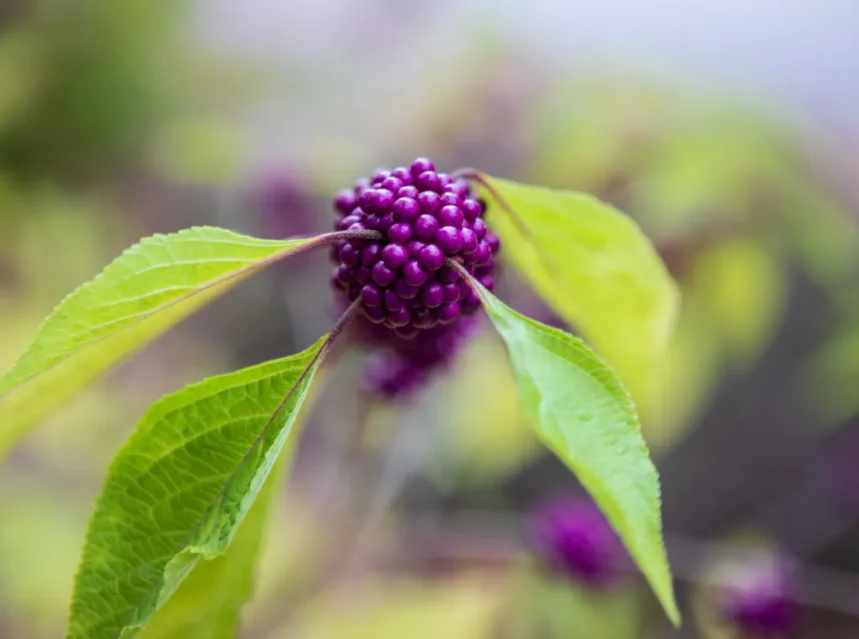
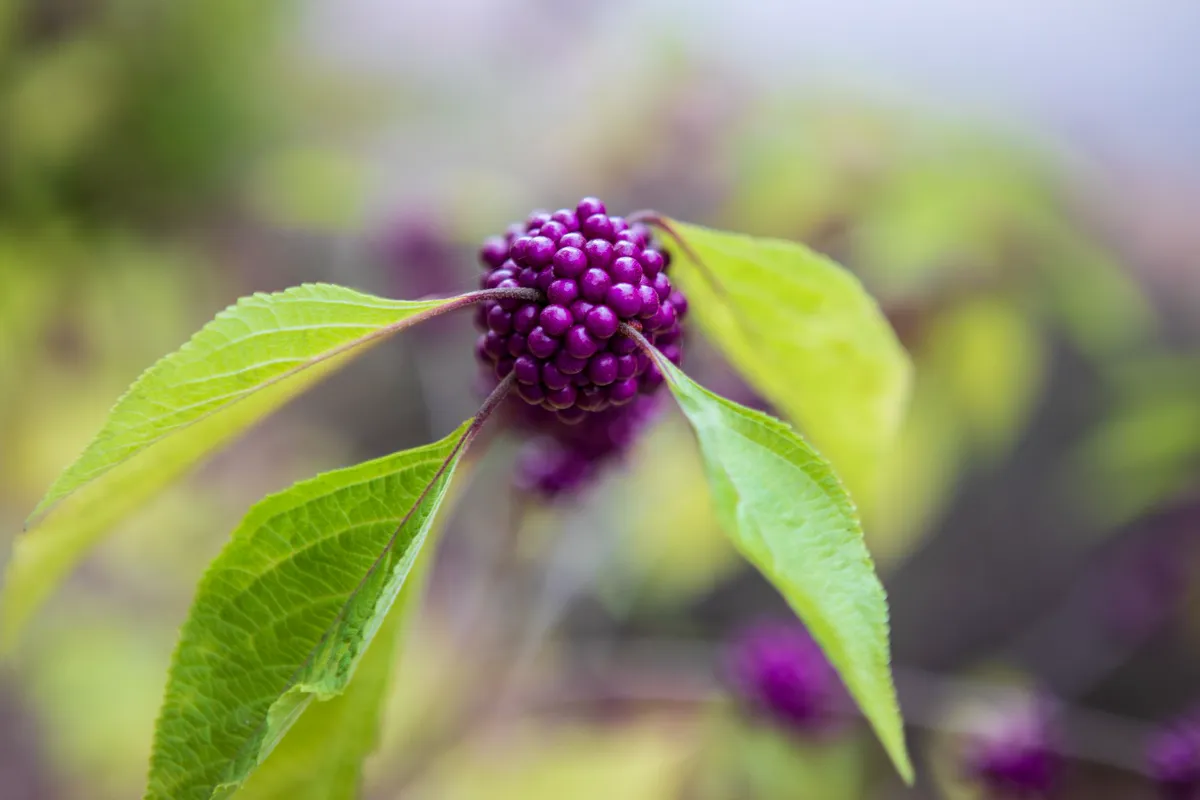
Beautyberry (Callicarpa) is an easy deciduous shrub grown for its astonishing clusters of metallic violet-purple berries. The clusters wrap tightly around the arching stems in autumn, after small pink-lilac summer flowers. Few plants match the impact of this purple berry shrub. The jewel-like fruit lingers after leaf fall, glows on bare stems, and feeds over 40 species of songbirds. Because it is tough, adaptable, and almost pest-free, learning how to grow beautyberry is simple. This guide covers the full job: species choice, planting, pruning, propagation, and troubleshooting.
Quick start: Grow beautyberry in full sun to part shade in moist, free-draining soil. It flowers in summer and fruits in autumn. Because it fruits on new growth, prune it back hard in early spring for the best display. Plant in autumn or spring, water while establishing, and mulch. For the heaviest berry set, plant two or more shrubs nearby to aid pollination. Choose a hardy species for your climate.
Gardeners love beautyberry for delivering a jaw-dropping autumn display from a genuinely easy shrub. Growers on gardening forums — and the Missouri Botanical Garden — highlight two tips for the best berries. First, prune it hard in early spring, since it flowers and fruits on the current season’s growth. Second, plant more than one shrub close together, because berry set is much heavier with cross-pollination. They also note the berries are mainly for show and for the birds rather than for eating raw. Otherwise the plant is trouble-free, tolerating a range of soils and needing little attention once established.
🧰 In a hurry? Jump straight to our tested picks for this guide ↓
Beautyberry at a glance
| Feature | Detail |
|---|---|
| Botanical name | Callicarpa species (e.g. C. bodinieri, C. americana, C. japonica); family Lamiaceae |
| Plant type | Deciduous flowering and fruiting shrub |
| Height | 1.2–3 m (4–10 ft), arching habit; spacing 1.2–1.8 m apart |
| Sun | Full sun to part shade (4–6+ hours of direct light for best berries) |
| Soil | Moist, free-draining; pH about 5.0–7.0; tolerant of most soils |
| Hardiness | Zones 5–8 for Asian species; zones 6–11 for American beautyberry |
| Seasons | Summer flowers, vivid autumn berries that persist after leaf fall |
| Growth & care | Fast-growing; hard prune in early spring; very low maintenance |
| Best for | Autumn colour, wildlife and bird gardens, cut stems, containers (compact types) |
Why grow beautyberry?
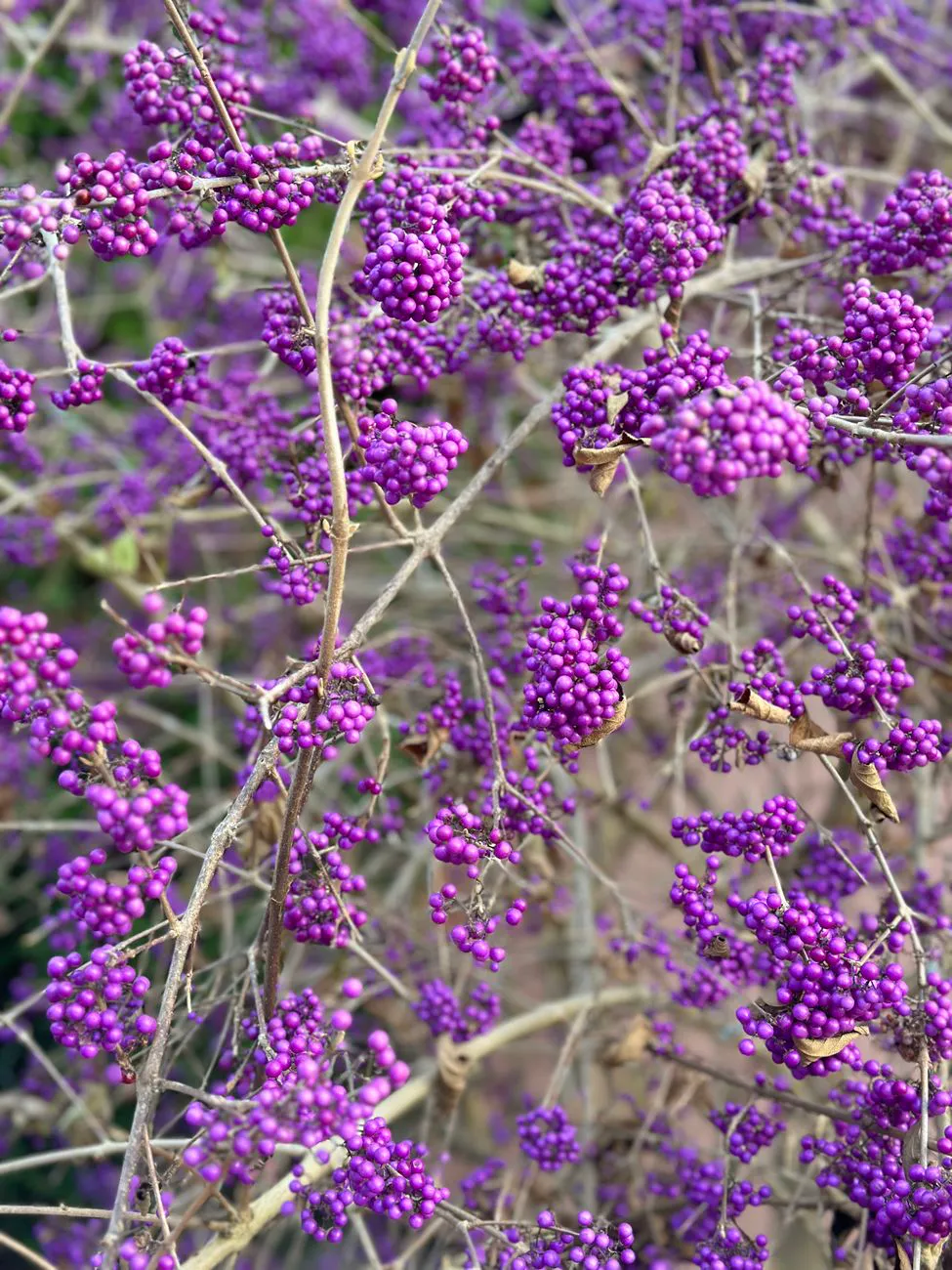
Beautyberry delivers one of the most striking sights in the autumn garden. Dense clusters of small, glossy berries pack tightly along the arching branches, in an almost unreal metallic violet-purple. The colour stops people in their tracks. Better still, the berries persist after the leaves drop and glow on the bare stems well into winter.
It earns its space in other ways too. The small pink-lilac summer flowers feed bees and hoverflies, and the foliage often turns rosy-pink or gold in autumn. The fruit is a late-season lifeline for birds. In its native range, American beautyberry feeds robins, cardinals, mockingbirds, and dozens of other songbirds. Berried stems also cut beautifully for autumn arrangements. Deer usually browse past it, pests ignore it, and it asks for almost nothing. That mix of drama and ease is rare among shrubs.
History & origin
The genus Callicarpa holds roughly 160 species of shrubs and small trees in the mint family. They grow wild across East and Southeast Asia, the Americas, Australia, and Madagascar, mostly at woodland edges (the background on Callicarpa records this range). The name comes from the Greek for “beautiful fruit”, which says it all. The most widely grown garden forms are Asian — C. bodinieri from China and C. japonica from Japan. The American beautyberry (C. americana) is a much-loved native of the south-eastern United States, once called French mulberry by settlers.
American beautyberry carries real folk history. Farmers in the early 1900s crushed the aromatic leaves and tucked them under horse harnesses to keep biting flies away. Decades later, USDA researchers isolated the leaf compounds responsible — callicarpenal and intermedeol. Laboratory tests confirmed genuine insect-repelling activity. In Japan, C. japonica is called murasakishikibu. The name honours Murasaki Shikibu, the Heian-era author of The Tale of Genji.
Asia’s beautyberries reach the Indian subcontinent as well. Callicarpa macrophylla, known as priyangu, grows wild along the sub-Himalayan tract and appears in traditional Ayurvedic texts. The showy garden cultivars suit cool-temperate regions, including India’s hill states. So the genus itself is no stranger to South Asia.
Which beautyberry should you grow?
Choosing the right species is the first real decision in growing callicarpa. Hardiness and size differ more than most guides admit. As a rule, the Asian species take colder winters, while the American species takes more heat.
| Species / cultivar | Zones | Size | Why choose it |
|---|---|---|---|
| C. bodinieri ‘Profusion’ | 5–8 | 2.5–3 m | Heaviest cropper, 30–40 berries per cluster, self-fertile, RHS Award of Garden Merit |
| C. americana (American beautyberry) | 6–11 | 1.2–2.5 m | US native, best for hot, humid regions; big loose berry clusters; top wildlife value |
| C. dichotoma ‘Early Amethyst’ / ‘Issai’ | 5–8 | 0.6–1.2 m | Compact and graceful; fruits young; ideal for small gardens and containers |
| C. japonica ‘Leucocarpa’ | 6–8 | 1.2–1.8 m | Elegant white-berried form for a softer scheme |
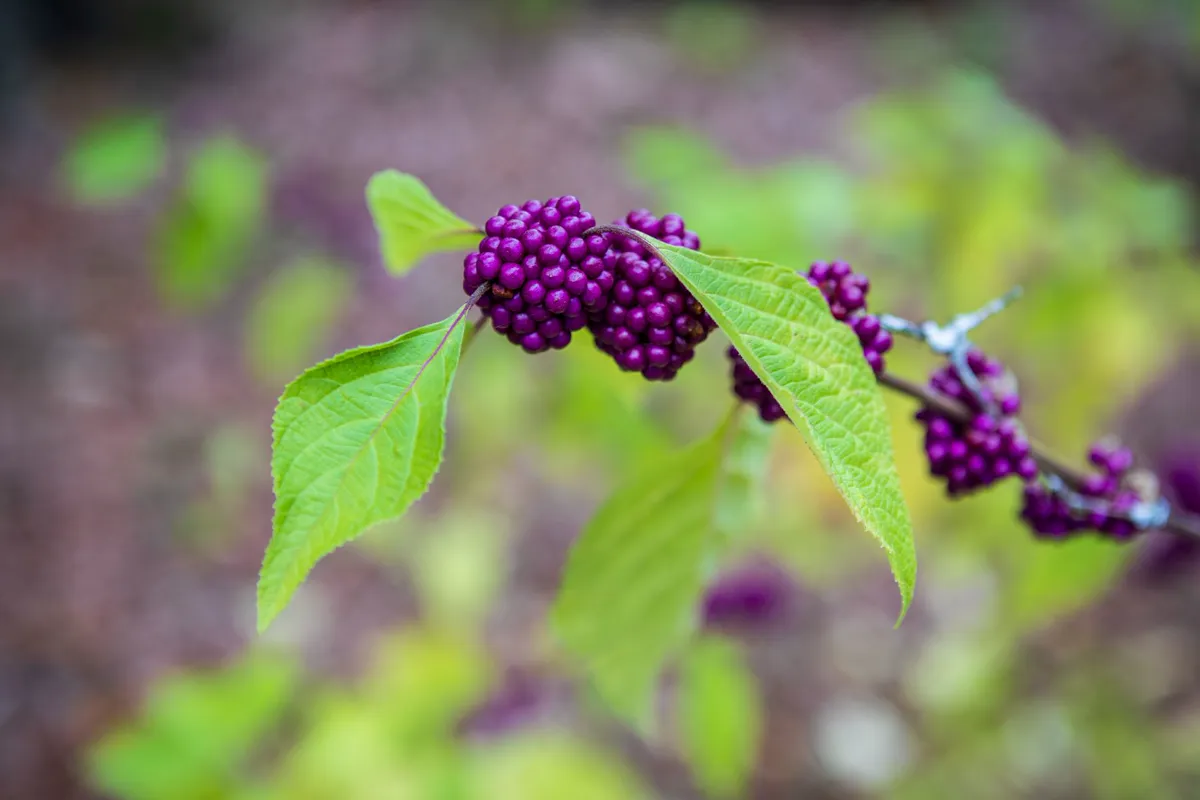
White- and pink-berried forms of the American species exist too (‘Lactea’, ‘Welch’s Pink’). Newer hybrids such as Pearl Glam® add dark purple foliage. If you garden in the south-eastern US, choose the native C. americana. Its berries hug the stem in tight round orbs, and it supports local birds best. The NC State Extension plant profile lists it as a food source for robins, finches, and towhees.
Best season & when to plant
Plant beautyberry in autumn or spring, while conditions are cool and moist. It then establishes before summer heat or hard winter. In cold-winter regions, spring planting gives roots a full season to settle before frost. In hot-summer regions, autumn planting is better. The shrub establishes through the mild months and misses the worst heat.
Beautyberries grow well across the cooler and milder parts of the US, UK, and Europe, and in cool hill regions elsewhere. They flower in summer and fruit in autumn, so they need a decent growing season to ripen the display. In severe cold, stems may die back to the ground. Because the plant fruits on new wood, it usually regrows and still berries the same year.
How to plant beautyberry step by step
Planting a beautyberry shrub is straightforward:
- Choose a spot in full sun to part shade with moist, free-draining soil; 4–6+ hours of direct light gives the heaviest fruiting.
- It tolerates clay, sand, and loam at a pH of roughly 5.0–7.0. Only waterlogged ground and very alkaline, lime-rich soil cause trouble (yellowing leaves).
- Dig a hole wider than the rootball. Plant at the same depth the shrub grew before — never deeper.
- Firm in, water deeply, and mulch 5 cm deep, keeping mulch off the stems.
- Space plants 1.2–1.8 m (4–6 ft) apart, and plant two or more for the best berry set.
- Water deeply every few days for the first weeks, then weekly through the first dry season.
Compact cultivars such as ‘Issai’ also grow happily in a large container. Use a loam-based mix and make sure the pot drains freely. Group several plants together where you can. Improved cross-pollination is the single biggest lever for a heavy crop.
Sun, soil, watering & feeding
Good beautyberry care is mostly about light. The shrub grows in part shade, but berry production drops as shade deepens. So give it as much sun as your climate allows. In very hot regions, morning sun with afternoon shade works well. That mirrors its natural woodland-edge home.
Young plants need about 2.5 cm (1 inch) of water a week while establishing (see how often to water plants). Once settled, beautyberry is genuinely drought-tolerant. It may, however, drop leaves and berries in a severe dry spell. Feeding is where beginners go wrong. This shrub rarely needs fertiliser, and excess nitrogen produces lush leaves at the expense of flowers and fruit. A shovelful of compost in spring is enough on most soils — see how to improve garden soil for building fertility naturally.
Pollination & getting the best berries
The secret to a really heavy crop is cross-pollination. Bees and hoverflies work the flowers. A lone plant sets some fruit, but a group of two or three within a few metres gives far denser clusters. The exception is C. bodinieri ‘Profusion’, which is reliably self-fertile — though even it fruits more heavily in company. Encouraging bees helps too; see how to attract pollinators.
The other key is new wood. Beautyberry flowers — and therefore fruits — on the current season’s growth. Good sun plus a hard spring prune produces plenty of vigorous flowering stems. Keep nitrogen low, keep the light high, and the autumn display will be breathtaking.
Pruning beautyberry
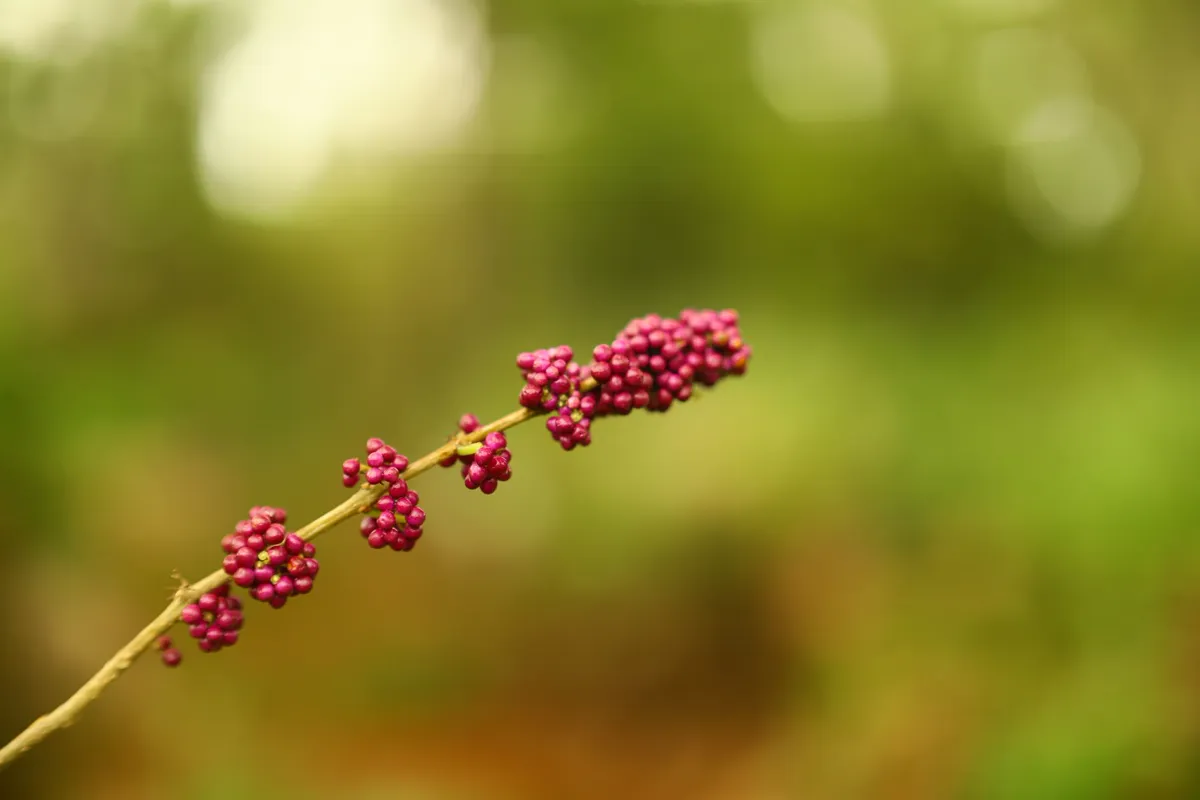
Because it fruits on new growth, beautyberry responds brilliantly to hard pruning in late winter or early spring, before buds break. There are two good approaches, and university-extension guides back both:
- Full renewal: cut the entire shrub back to 15–30 cm (6–12 in) above ground every spring. It regrows into a neat, rounded, berry-laden dome. Best for vigorous plants and small spaces.
- Gradual renewal: remove a quarter to a third of the oldest stems at the base each year, plus anything dead, weak, or crossing. This keeps a larger, more natural shrub and renews it fully every three to four years.
Either way, avoid cutting healthy stems in autumn or winter. You would only shorten the winter berry display. In cold-winter areas, frost sometimes does the “pruning” for you. Simply cut dead stems away in spring, and the regrowth will still fruit that autumn.
How to grow beautyberry from seed and cuttings
Beautyberry propagates so easily that self-sown seedlings often appear under a mature shrub. Potting up these volunteers is the fastest route to new plants. Otherwise, two methods work reliably:
- Softwood cuttings (spring to early summer): take 10–15 cm cuttings of new growth just below a node. Strip the lower leaves, dip in rooting hormone, and insert into moist, gritty compost. Cover with a clear bag for humidity and keep in bright, indirect light. Roots form in about three to six weeks.
- Seed: clean seeds from ripe autumn berries, soak for 24 hours, and sow shallowly (about 2 mm deep) in trays. Germination is slow — often around three months — so patience beats panic. Seedlings reach transplant size within a season.
One caution: this ease cuts both ways. The Asian species self-seed freely and are listed as weedy or invasive in parts of the south-eastern US. If you garden where C. americana is native, plant the native. Elsewhere, deadhead or pull seedlings if spread becomes a nuisance.
Are beautyberries edible? Wildlife & uses
Beautyberries are not poisonous, but raw they are astringent, mealy, and bland. Taste one, then leave the rest. Cooking transforms them. In the American South, foragers simmer the ripe berries into a rosy beautyberry jelly, with a flavour often compared to wild grape and cranberry. Eat only fully ripe berries, in modest amounts, and only from plants you can identify with certainty.
The leaves have their own story. USDA scientists confirmed that leaf compounds — callicarpenal in particular — repel mosquitoes and ticks in laboratory tests. That validates the old harness trick. However, the evidence supports the extracted compounds, not home remedies. Crushed-leaf rubs and sprays are unproven and can irritate some skin. The roots and leaves also appear in Native American and Ayurvedic tradition, where they were traditionally used for fevers and digestive complaints. Modern research is limited, so treat these as heritage, not medicine. This section is for information only, not medical advice — consult a professional before using any plant remedy.
For wildlife, the shrub is a star. Its berries carry more than 40 songbird species through the lean months, and its summer flowers feed native bees. That is one reason extension services promote it so strongly for bird-friendly gardens, much like holly and dogwood.
Common pests & diseases
Beautyberry is about as trouble-free as flowering shrubs get. The RHS lists it as generally pest-free, with only rare susceptibility to honey fungus. Occasionally aphids gather on soft new shoots. In humid conditions, minor leaf spot or a superficial black mould can mark the foliage. None of these normally needs spraying.
Prevention is simple. Give the shrub sun, space for airflow, and free-draining soil, and water at the base rather than over the leaves. Deer largely leave it alone. Birds stripping the berries in winter is a feature, not a problem.
Common beautyberry problems
Few or no berries
Usually a lone plant (poor pollination), too much shade, or no spring pruning. Growers on garden forums repeatedly trace berry failure to sites with only two or three hours of sun. Plant two or more shrubs, give at least four to six hours of light, and prune hard in early spring.
Leggy, sparse growth
Caused by deep shade or skipping the annual hard prune. Cut the shrub back by half to two-thirds — or to 15–30 cm — in early spring. It will rebuild a dense, compact, heavily fruiting framework.
Lots of leaves but little fruit
Almost always over-feeding with nitrogen. Stop fertilising, let the soil lean out, and fruiting resumes the following season.
Yellowing leaves
On very alkaline, lime-rich soil, beautyberry foliage can yellow through nutrient lock-out. Work in organic matter and mulch with compost or pine needles. On chalky ground, choose tolerant species like C. bodinieri.
Seedlings popping up everywhere
Beautyberry self-sows readily, especially the Asian species outside their native range. Hoe or pot up volunteers in spring, and favour the native species where one exists.
Berries gone quickly in autumn
Birds eating them, which is normal and beneficial. For a longer show, heavy-cropping cultivars like ‘Profusion’ hold big crops that birds often leave until later in winter.
Related plant guides
- How to grow hydrangeas
- How to grow dogwood
- How to grow magnolia
- How to grow holly
- How to attract pollinators
- How often to water plants
Frequently asked questions
Do you need two beautyberry plants for berries?
A single plant will set some fruit, but berry production is much heavier with cross-pollination. Planting two or more beautyberry shrubs within a few metres of each other gives far denser, more spectacular berry clusters.
When and how do you prune beautyberry?
In early spring, before growth starts, cut the stems back hard — by about half to two-thirds, or to a low framework. Beautyberry flowers and fruits on new growth, so hard spring pruning drives the vigorous shoots that carry the best berry display.
Can you eat beautyberries?
The berries are mainly ornamental and a food for birds rather than a dessert fruit; they are not pleasant eaten raw in quantity, though the American beautyberry is sometimes made into jelly. Treat the plant as an ornamental and wildlife shrub, and leave the berries for the birds.
Why does my beautyberry have no berries?
The usual causes are a lone plant with poor pollination, too much shade, no hard spring prune, or excess nitrogen feeding. Plant more than one shrub, give full sun, prune hard in early spring, and avoid heavy feeding for a generous crop.
Is beautyberry really deer resistant?
It is widely marketed as deer resistant, and NC State Extension does list it that way, but the same entry notes that white-tailed deer browse the leaves in summer and take the fruit after leaf drop in autumn. In practice that means selective, tolerable nibbling rather than the plant being ignored — a mature shrub shrugs it off, while a newly planted one in an area of heavy deer pressure can be stripped. Protect young plants with a cage or a repellent for the first couple of seasons. Once established, beautyberry is one of the more reliable choices in a deer-troubled garden.
Does beautyberry actually repel mosquitoes?
Partly, and the story is more interesting than the marketing. USDA Agricultural Research Service chemists investigating an old folk practice of crushing the leaves and tucking them under horse harness isolated two compounds, callicarpenal and intermedeol, and found callicarpenal repelled mosquitoes effectively in laboratory bioassays. What that does not mean is that a beautyberry standing in your border keeps the garden mosquito-free — the effect comes from crushed leaf material applied to skin or clothing, not from the intact plant. Crushing a handful of leaves and rubbing them on exposed skin is a genuine field trick, though it is not a substitute for a tested repellent.
Is beautyberry poisonous to dogs or cats?
Beautyberry does not appear on the standard lists of plants toxic to dogs and cats, and the fruit is a major food source for songbirds, foxes, raccoons and opossums. The berries are astringent, so a pet that eats a large mouthful may get a mild stomach upset, which is true of most fruit. It is not a plant that causes the kind of alarm a lily or a sago palm does. As always, this is general information rather than veterinary advice — ring your vet if an animal eats a large amount of anything.
How much sun does beautyberry need, and will it grow in shade?
Beautyberry is unusually adaptable and thrives in light to moderate shade, which is where it naturally grows at woodland edges. For the heaviest flowering and the densest berry clusters, though, plant it in full sun and make sure it gets adequate moisture through the summer. In deep shade you get an open, leggy shrub with a scattering of fruit. Roughly six hours of sun with a mulched, evenly moist root zone gives the best of both.
How big does beautyberry get?
American beautyberry typically makes 1.2 to 1.8 m (4 to 6 ft) tall and about as wide, but Clemson Extension notes it can reach 2.4 to 3 m (8 to 10 ft) in favourable conditions, so give it room. The Asian species are generally more compact — purple beautyberry (Callicarpa dichotoma) settles at around 0.9 to 1.5 m (3 to 5 ft) in both directions and suits smaller gardens. Because all of them flower and fruit on new growth, a hard spring cut keeps any of them to the size you want. Plan on the shrub filling its space within three or four seasons.
How do you propagate beautyberry?
Softwood cuttings taken in early summer root readily — take 10 to 15 cm shoots, strip the lower leaves, dip in rooting hormone and keep them humid and shaded until they take. Named cultivars are normally raised this way, since they will not come true from seed. The species does grow easily from seed: squash the pulp off ripe berries, wash the seed clean and sow it, as young seedlings transplant well in winter. Self-sown seedlings often appear under an established shrub and can simply be lifted and moved.
Is beautyberry invasive?
American beautyberry is native to the south-eastern United States and is not considered invasive there — it self-seeds modestly where birds drop the fruit, and unwanted seedlings pull out easily. The commonly grown Asian species, C. dichotoma and C. bodinieri, are not listed as invasive in North America or Europe either, though they will seed about in mild climates. If volunteer seedlings bother you, strip the berries before they ripen or simply hoe the seedlings off in spring. It is a well-behaved shrub by any reasonable standard.
Can you grow beautyberry in a container?
Yes, particularly the smaller Asian species and dwarf cultivars, which suit a large pot of at least 40 to 50 litres. Use a soil-based compost that holds moisture, since a container plant that dries out in midsummer will drop its developing fruit. Feed lightly in spring, cut the stems back hard each late winter to keep the plant compact and productive, and expect to refresh the top few centimetres of compost annually. In cold regions, move the pot against a sheltered wall over winter, because roots in a container freeze far more readily than roots in the ground.
Still stuck? Ask the Plant Doctor
Describe the problem — yellow leaves, holes, no flowers — and get a clear answer in seconds. FreeAI can make mistakes. Answers are guidance, not a guarantee — check anything important against the guide it links to, and always read the label on any product before you use it.