How to Grow a Peach Tree
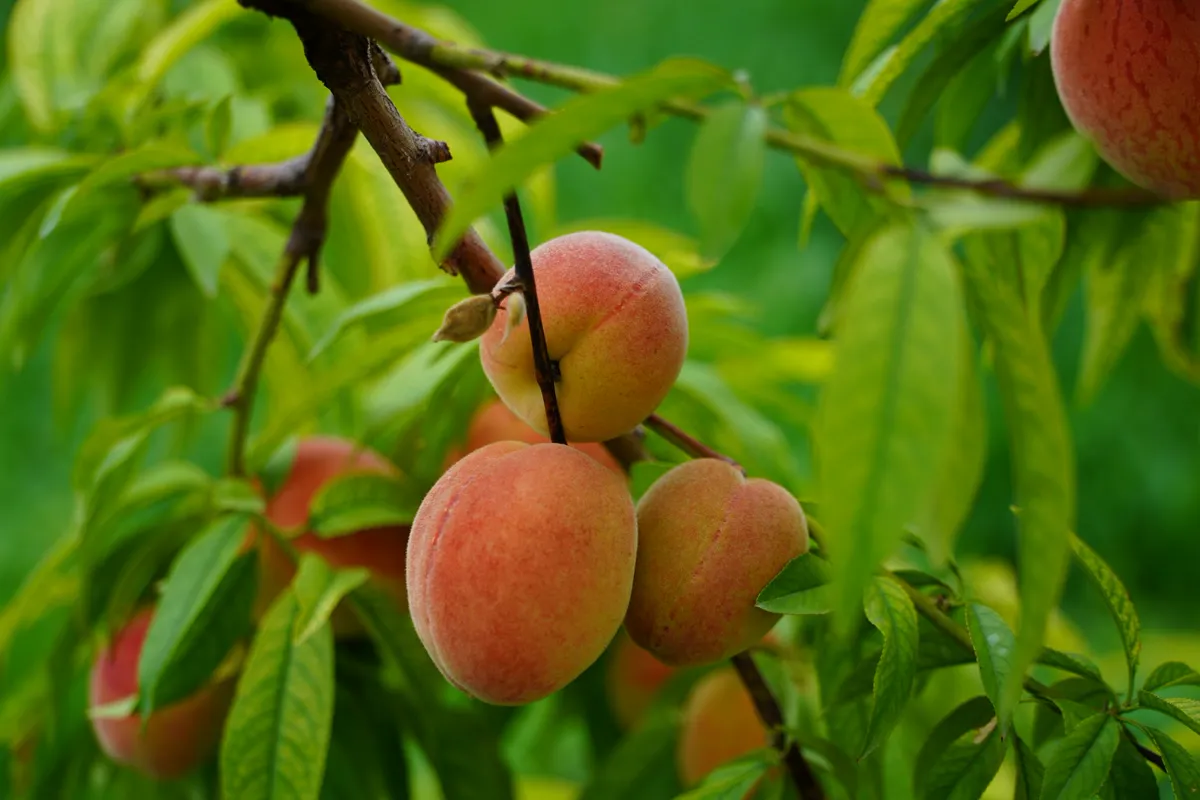
The peach (Prunus persica) is a deciduous stone-fruit tree grown for its juicy, fragrant, sweet fruit — a home-grown peach, picked perfectly ripe and warm from the sun, is one of gardening’s greatest rewards. Peach trees are also beautiful in spring blossom, and most are self-fertile, so a single tree will fruit. With a sunny, sheltered spot, they are very achievable. Here is the complete guide on how to grow a peach tree.
Quick start: Grow peaches in full sun in fertile, moist but free-draining soil, ideally against a warm south- or west-facing wall. Most are self-fertile, so one tree fruits. Plant at the right depth (not deep), prune annually to an open-centre shape, thin the fruit, and protect early blossom from frost. Trees fruit in 2–4 years.
A homegrown peach, picked warm and ripe, is one of the great rewards of the fruit garden, and the trees crop young, often within a few years. The main challenge growers face is peach leaf curl, a disease spread by spring rain, so many grow peaches against a sheltered wall or under a cover during the wet spring weeks. Thinning the young fruit gives fewer but far larger, sweeter peaches. Most are self-fertile, so a single tree will crop, but a late frost can spoil the early blossom.
🧰 In a hurry? Jump straight to our tested picks for this guide ↓
Peach at a glance
| Feature | Detail |
|---|---|
| Botanical name | Prunus persica (family Rosaceae) |
| Plant type | Deciduous stone-fruit tree |
| Sun | Full sun; warm wall ideal |
| Soil | Fertile, moist but free-draining |
| Pollination | Mostly self-fertile |
| Fruits on | Last year’s wood — prune hard yearly |
| Key risk | Frost on early blossom + leaf curl |
| Chill needed | Very low-chill 150–250 h · standard 600–900 h below 7°C (45°F) |
| Spacing | Standard 5–6 m; dwarf 3–3.5 m; fan-trained 4–5 m of wall |
| First fruit | 2–4 years |
| Productive life | 10–15 years of good cropping, sometimes 20 |
Why grow a peach tree?
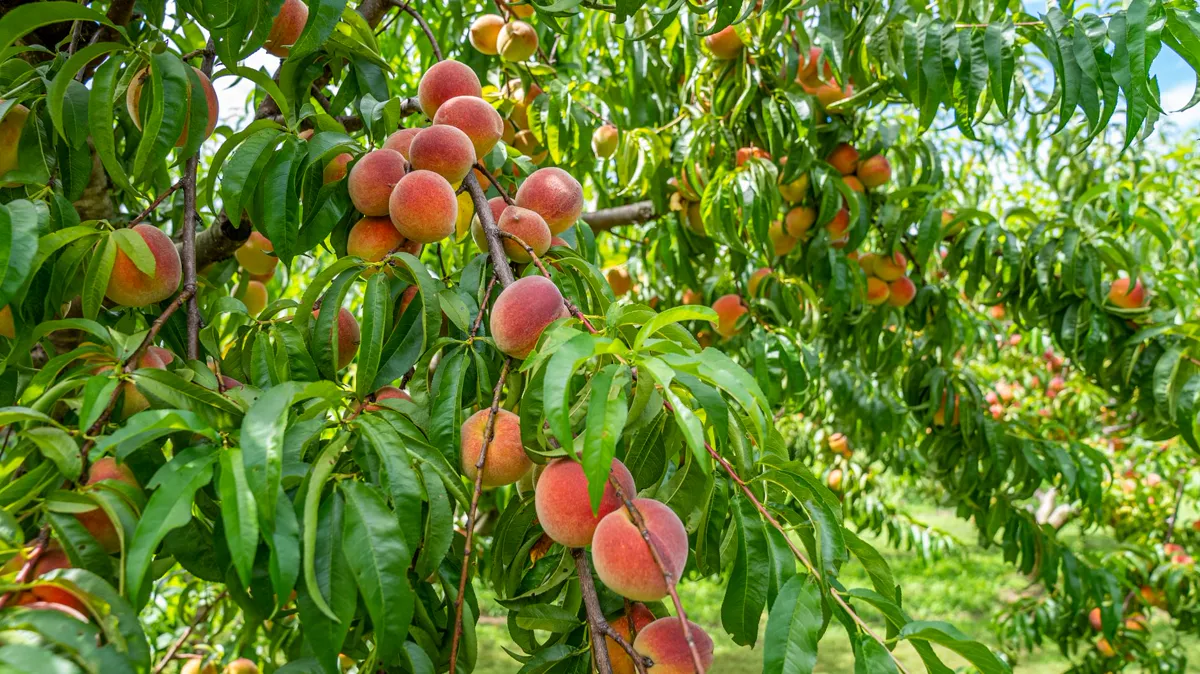
Peaches give incomparably juicy, fragrant fruit. A few reasons to grow one:
- Unbeatable flavour. The fruit simply cannot be bought as good, plus you get gorgeous pink spring blossom.
- Self-fertile. A single tree crops, with no partner needed.
- Space-friendly. Dwarf types suit small gardens, pots and growing against a wall.
- Quick and productive. They fruit relatively fast and crop generously.
History, origin & how peaches spread
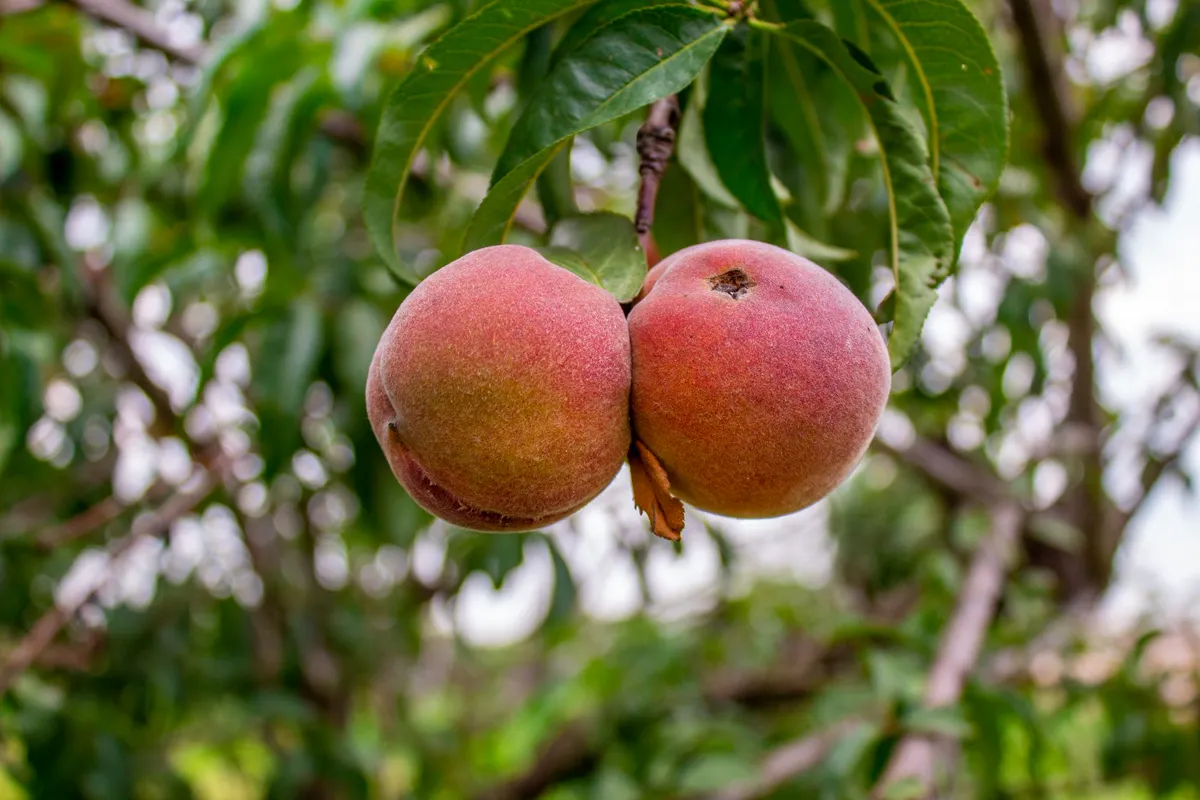
The peach is native to China, and the archaeology is unusually precise about it: peach stones from the Kuahuqiao site near Hangzhou, in Zhejiang province, push cultivation back to roughly 6000 BCE in the Yangtze valley. Chinese growers were selecting for bigger, sweeter fruit thousands of years before the peach left Asia, and the tree still carries its old symbolism of long life. Despite the species name persica, which points at Persia, China is its true home — Persia was simply the stopover that named it for Europe.
The fruit travelled west along the Silk Road through Persia and into the Mediterranean. The Romans spread it across their empire. Later, settlers carried it to the Americas, where it became a major crop in the southern US.
The route west ran through Persia to Greece by about 300 BCE, and on to Rome — Roman wall paintings at Herculaneum, buried in 79 CE, show peaches on the branch. Our word for the fruit comes from the Latin persicum malum, the “Persian apple”. Spain carried peaches to the Americas in the 1500s, where they naturalised so readily that early travellers mistook them for a native tree.
World production now runs near 28 million tonnes a year, with China growing roughly 63% of it, ahead of Spain, Turkey and Italy. Peaches need some winter chill but also warmth and sun to ripen, so in cooler areas they do best in a sheltered, sunny spot or against a warm wall.
Best season & when to plant
Plant peach trees while dormant, in late autumn or early spring. They blossom very early, often from late winter, when frost is still a risk, and the fruit ripens in mid-to-late summer. Trees typically begin fruiting in 2–4 years, and are productive, though not very long-lived, for years.
Chill hours & choosing a variety
A chill hour is one hour spent between about 0°C and 7°C (32–45°F) in winter, and it is the single figure that decides whether a peach will ever crop for you. Give a peach less chill than its variety needs and it leafs out late and patchily, flowers thinly, and sets misshapen fruit. Give a low-chill variety a cold winter and it may bloom dangerously early instead. Match the variety to your winter first, and worry about flavour second.
| Chill band | Hours needed | Example varieties | Suits |
|---|---|---|---|
| Very low | 150–250 | FlordaPrince, TropicBeauty, Eva’s Pride, UF Best | Florida, coastal California, north Indian plains, subtropics |
| Low | 250–600 | Bonanza, Red Baron, Tropic Snow, May Pride | Mild-winter gardens, US zones 8–9 |
| Moderate | 600–750 | Redhaven, Elberta types | Most temperate gardens, southern UK walls |
| High | 750–1,000+ | Cold-hardy northern selections | Genuinely cold winters |
Two more choices worth making deliberately. Freestone peaches part cleanly from the stone and suit eating and freezing; clingstone types hold on to it, and are the ones canneries prefer — most early-ripening varieties are clingstones. And where bacterial spot is a problem, in humid summer climates especially, resistant cultivars such as Redhaven save far more trouble than any spray.
Rootstocks — what your tree is grafted on
Peach rootstocks change less about size than apple rootstocks do — most peaches end up 4–5 m unless pruned — but they decide what your tree can survive in the soil, which matters more than most buyers realise.
| Rootstock | Why choose it |
|---|---|
| Lovell | The dependable general-purpose seedling stock on decent, disease-free ground |
| Nemaguard | Resists root-knot nematode — the standard on sandy southern soils |
| Guardian | Chosen where ring nematode and peach tree short life are a known problem |
| St Julien A | The usual semi-vigorous stock in the UK, and the one to fan-train on a wall |
| Genetic dwarfs | Not a rootstock at all — Bonanza, Honey Babe, Golden Glory and similar are naturally 1.5–2 m trees, self-fertile, and the sensible choice for a pot |
How to plant and grow peaches
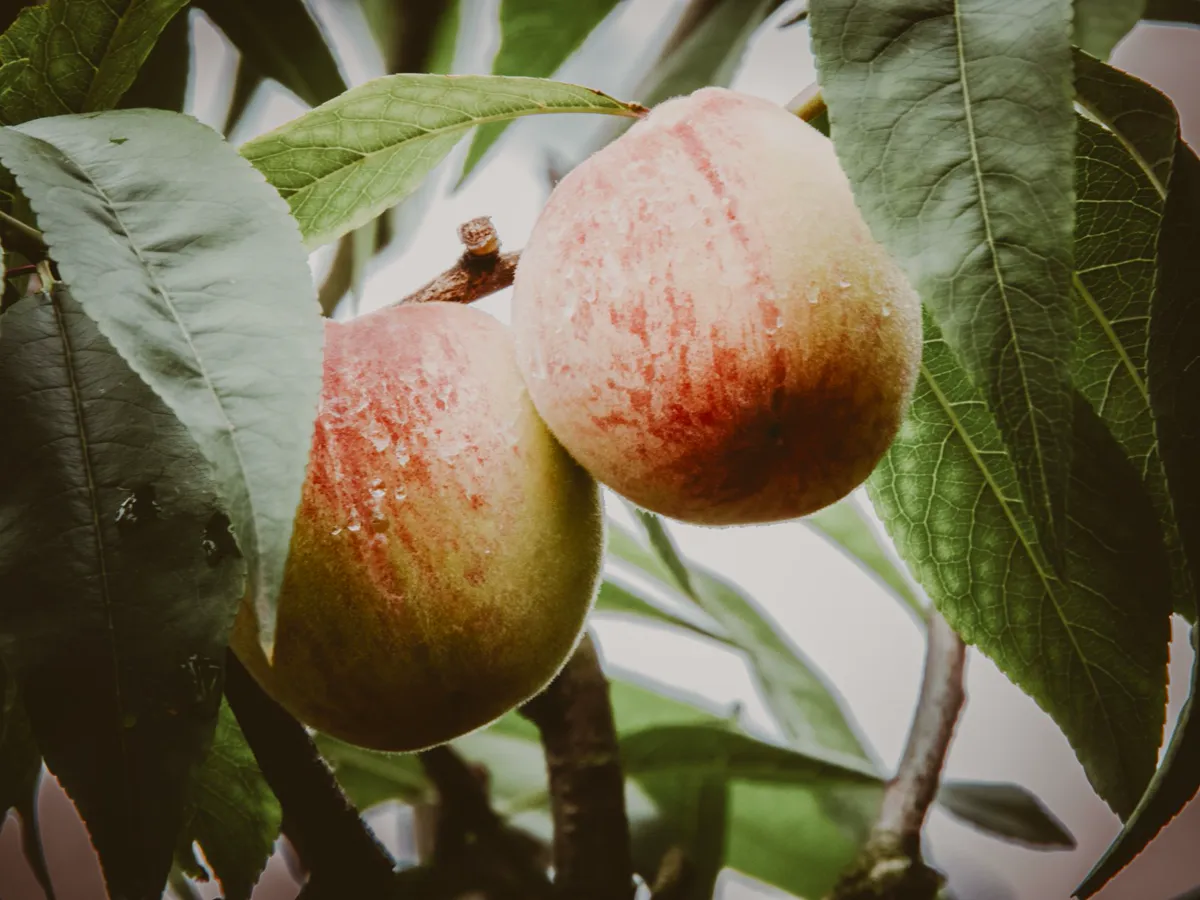
- Choose a full-sun, sheltered spot, ideally against a south- or west-facing wall for warmth, in fertile, moist but free-draining soil (see improving garden soil).
- Do not plant too deep — no deeper than it grew in the pot — and do not fertilise at planting.
- Space standard trees 15–20 feet apart, dwarf trees 10–12 feet; or fan-train against a wall in cool climates.
Watering, feeding & frost protection
Water during dry spells, especially as the fruit swells (see how often to water plants). Mulch in spring or autumn, and as fruit develops, apply a high-potash feed (like tomato food) weekly. Because peaches flower so early, protect the blossom from frost on cold nights with 2–3 layers of horticultural fleece — vital in cool climates.
Pruning & thinning
Annual pruning matters more for peaches than for almost any other fruit tree — see our fruit tree pruning guide for the cuts themselves. The reason is simple and worth understanding: a peach fruits only on shoots that grew last summer. Wood that has carried a crop will never carry one again. If you stop pruning, the fruiting zone marches outwards and upwards year after year, the middle of the tree goes bare, and you end up with a big tree carrying a thin ring of fruit out of reach. Once that interior wood is lost it is very hard to get back.
Timing: prune in late winter to early spring, as late as you can manage but before the blossom opens. Early-winter pruning reduces cold hardiness and opens the door to bacterial canker; in cool, damp climates like the UK, spring pruning also keeps silver leaf out. Autumn pruning is the one thing never to do.
Training an open centre
Peaches are trained to a vase — an open centre — because they crop where light reaches, and light penetrates only about a metre into a peach canopy.
- At planting: cut a young whip back to about 60–75 cm, just above a bud, and remove low side shoots.
- First season: choose three or four strong shoots spaced evenly around the trunk, the lowest around 45–60 cm off the ground, each leaving the trunk at a wide angle — over 45° from vertical. These become the permanent scaffolds. Narrow, upright crotches split under a crop.
- From year two: keep the middle open. Remove upright watersprouts that shade the centre, and cut out shoots that already fruited, back to their point of origin. That single habit is what pushes out fresh fruiting shoots low down.
The shoots you are farming are the pencil-thick ones roughly 30–60 cm long. Anything much shorter than 15 cm carries small, poor fruit and can go.
Thinning — the step that makes the peach
Peaches set far more fruit than they can ripen. Thin about four to six weeks after bloom, once the fruitlets are marble-sized and the tree has finished its own natural drop, leaving one fruit roughly every 15 cm (6 inches) along the shoot. You will remove most of what set, and it always feels wrong. Do it anyway: unthinned trees give small, bland fruit, break limbs under the weight, and are far more prone to brown rot because the fruit touch. A fan-trained tree on a wall follows exactly the same rule.
Peaches vs nectarines
Peaches and nectarines are the same species, separated by a single gene. So they grow and taste almost identically. The one obvious difference is the skin.
A peach has soft, velvety fuzz. A nectarine is smooth and glossy. The flesh of both is sweet, juicy and fragrant.
Their care is the same in every way. Both fruit on last year’s wood, both need hard annual pruning, and both suffer peach leaf curl. So growing one teaches you the other.
Growing peaches in containers
A dwarf peach grows well in a large pot, perfect for a patio or small garden. A container also lets you move the tree under cover. This helps protect the early blossom from both frost and leaf curl.
Choose a genetic dwarf variety — Bonanza, Honey Babe, Golden Glory and their kin are naturally 1.5–2 m and self-fertile, which beats trying to keep a standard peach small by pruning. Start in a pot of about 40 litres and move up to 90–110 litres by the third year, always with real drainage holes. Fill with a loam-based compost such as John Innes No. 3 rather than a light multipurpose mix: it holds water and nutrients better, and its weight stops a fruiting tree blowing over. Stand it in the sunniest, warmest spot you have.
Water it regularly, as pots dry out fast, and feed high-potash as the fruit swells. Prune it each spring to an open shape. Wheeling it under a porch over winter keeps the rain off and prevents leaf curl.
Common pests & diseases
The signature problem is peach leaf curl, and the single most useful fact about it is one most gardeners learn a year too late: by the time you see the red, blistered leaves in spring, that season is already lost. Taphrina deformans infects the buds during wet weather between leaf fall and bud burst, so every effective treatment happens while the tree is bare. Keep winter and early-spring rain off the tree with a cover, a porch or a wall overhang, from leaf fall until the leaves are out — that alone prevents it. Anything sprayed after symptoms appear does nothing that year. The tree usually recovers and re-leafs, but repeated attacks steadily weaken it.
University of California’s IPM programme states it flatly — “Treating after symptoms appear won’t be effective” — and also disposes of the reflex almost every gardener has: “Some people remove diseased leaves or prune infected shoots, but this has not been shown to improve control.” Picking off the curled leaves feels productive and changes nothing.
Here is the number that explains the whole calendar. Infection needs more than 12.5 hours of wetness — rain, dew or irrigation — at temperatures below about 16 °C (61 °F), landing on swelling buds. That is a specific weather event, not a season, and it happens long before any symptom is visible.
So the treatment has to be already on the bark before that window opens. UC IPM’s timing is “just after leaves have fallen, usually late November or December”, with an optional second application late in dormancy as the flower buds begin to swell.
The easier route is to sidestep it. Resistant peaches include Frost, Indian Free, Muir and Q-1-8, and Redhaven and most of its descendants are tolerant; among nectarines, Kreibich is the resistant one. In a wet-spring climate a resistant variety plus a rain cover will do more than any spray programme.
| Problem | What you see | What actually works |
|---|---|---|
| Peach leaf curl | Puckered, thickened leaves flushed red, dropping in early summer | Keep rain off the bare tree; dormant treatment only, never in leaf; grow under glass or a fixed shelter in wet springs |
| Brown rot | Fruit rotting on the branch into grey-fuzzed “mummies”; blossom and twigs die back | Pick off and bin every mummy, on the tree and on the ground; thin so fruit never touch; prune for airflow |
| Peach tree borer | Gummy frass in a ring at the trunk base, at or just below soil level; young trees dying outright | Inspect the trunk base in late summer and probe holes with a wire; beneficial nematodes drenched at the base; keep mowers and strimmers off the bark |
| Peach twig borer | Wilting shoot tips (“flags”) in spring; grubs entering fruit near the stem | Prune out flagged shoots as they appear; dormant oil; Bacillus thuringiensis or spinosad timed at bloom |
| Plum curculio | Crescent-shaped scars on young fruit; fruitlets dropping | Collect dropped fruitlets promptly; treatment window is petal fall, not later |
| Bacterial spot | Small purple-black leaf spots that drop out, pitted fruit | No practical home cure — grow resistant cultivars such as Redhaven and avoid overhead watering |
| Gummosis / canker | Amber gum oozing from bark, often around a wound | Prune only in late winter or spring, never autumn; avoid bark injury; keep the tree unstressed — there is no spray for it |
| Aphids | Curled shoot tips, sticky leaves | Water jet, natural predators, no soft nitrogen-fed growth (see aphid control) |
Open-centre pruning, good airflow, prompt sanitation and the methods in our organic pest control guide do most of the work. If you treat at all, treat before bloom or at petal fall — never while the tree is in flower and bees are on it.
Thinning: the two numbers that decide your peach size
Everyone agrees peaches need thinning. What the guides do not agree on is how far apart — and the published advice ranges from 3 inches to 8 inches, which is roughly 2.7 times as much fruit per branch at one end as the other. That is the difference between golf balls and tennis balls, not a rounding error.
Clemson Extension gives a clean instruction: “Hand-thin the tree about four weeks after full bloom, spacing the peaches about 6 inches apart on the limb.” Other extension services land at 6–8 inches, and the RHS says 20 cm. Somewhere in 6–8 inches (15–20 cm) is the honest answer.
| Question | Answer |
|---|---|
| When? | About four weeks after full bloom, when fruitlets are roughly 2 cm across |
| How far apart? | 15–20 cm (6–8 in) along the branch |
| Cost of dawdling | Roughly 3–6% of final fruit size per week of delay |
| Point of no return | By about 30 days after petal fall, most of the benefit is gone |
That last pair is why “thin in four to six weeks” is soft advice: the back half of that window is already costing you. Do it at four weeks and be ruthless. A branch that looks bare after thinning is a branch that will carry fruit worth eating.
One footnote on pollination. Peaches are self-fertile, which is why a single tree crops — but it is not quite universal. The old variety ‘J.H. Hale’ produces sterile pollen and will set nothing on its own, so if you are buying that particular heritage peach for its large fruit, it needs another peach nearby.
Growing peaches in India
Peaches suit India better than most temperate fruits, because low-chill breeding has taken them well beyond the hills. Traditional high-chill varieties belong to Himachal Pradesh, Jammu & Kashmir, Uttarakhand and the Nilgiris, but low-chill cultivars needing only about 75–200 chill hours crop in the sub-mountainous belt and the plains of Punjab, Haryana and adjoining states, up to roughly 1,200 m.
- Varieties that perform: Florida Prince ripens around the fourth week of April and is the standard commercial choice for the Punjab plains; Shan-e-Punjab follows in the first week of May with big, freestone, red-blushed fruit; Sharbati and Pratap are also widely grown. Mature trees of these types commonly yield 70–100 kg each.
- Soil and site: deep sandy loam rich in organic matter, pH about 5.8–6.8, with drainage that genuinely works — peach roots die fast in standing water.
- Planting: budded plants go out in December–January while dormant, commonly at about 6–6.5 m spacing on the square system.
- Feeding: farmyard manure scaled with age, from roughly 10–15 kg on a young tree to 25–30 kg once mature, with NPK increased in step over the first five years.
- Water: drip is the efficient choice. The two windows that decide the crop are flowering and the final fruit swell.
Two honest warnings for plains growers. The fruit ripens in the pre-monsoon heat, so it softens fast and must be picked and sold or eaten quickly. And warm, humid conditions favour brown rot and bacterial spot, which makes sanitation and airflow more important here than any spray schedule.
Two things Indian growers are told that do not apply on the plains
Most peach advice online is written for California, Britain or the American Midwest, and two pieces of it travel badly to India.
1. “Leaf curl” means two completely different problems, and Indian sources blur the names. The disease described earlier in this guide is Taphrina deformans, a fungus. What growers in Punjab and the sub-mountainous belt usually meet in March to May is the peach leaf-curl aphid — an insect. Both make young leaves curl, and there the resemblance ends.
| Leaf-curl fungus (Taphrina) | Leaf-curl aphid | |
|---|---|---|
| What it is | A fungal disease | An insect |
| What you see | Thick, puckered, red-blistered leaves | Curled leaves with colonies of small insects on the undersides, often sticky |
| When | Appears in spring from an infection that happened while the tree was bare | Builds up on new growth as it emerges, March–May |
| What works | A dormant spray applied months earlier; nothing helps once symptoms show | Treat the insects when you see them — this one is worth acting on in season |
Check the underside of a curled leaf before you do anything. If there are insects on it, you have the aphid, and a dormant fungicide programme would have made no difference at all.
2. The plains usually do not need the dormant copper calendar. Fungal leaf curl needs a very specific event to infect — more than 12.5 hours of wetness at temperatures below about 16 °C, landing on swelling buds. In the north Indian plains that combination rarely coincides with bud swell, which is why the disease is largely a hill problem here rather than a Punjab one.
So copying a Californian or British spray schedule onto a plains orchard mostly buys you an unnecessary spray. In the hills, follow the dormant programme. On the plains, watch for the aphid instead, and put your effort into drainage and brown rot as the fruit ripens.
There is a related piece of luck worth knowing: because the low-chill varieties ripen in April and May, the plains crop is largely off the tree before the monsoon arrives. That timing, more than any spray, is what keeps rot losses down.
Harvesting
A peach is ripe when the background skin turns from green to gold or cream, it smells fragrant, and it gives gently to a soft squeeze near the stalk, then lifts away with a slight twist. Ignore the red blush. Modern varieties colour up red long before they are ready, and picking on redness is the commonest reason home-grown peaches taste of nothing — it is the background colour behind the blush that tells the truth.
There is one more thing worth knowing, because it changes when you pick. A peach does not get any sweeter after you pick it. Unlike an apple or a pear, it stores no reserve of starch to convert, so all the sugar it will ever have is made on the tree. A picked peach softens, gets juicier and smells better — which reads like ripening — but a fruit taken green stays bland forever. Leave them as long as you dare.
Pick with your whole hand rather than fingertips, since ripe peaches bruise where you press. Firm-ripe fruit keeps around ten days at 0–2°C; softer fruit belongs in the fridge and on the table within two or three days. To finish slightly under-ripe peaches, leave them at room temperature, out of the sun, ideally in a paper bag.
Health benefits & uses
A peach is mostly water — 39 kcal per 100 g, with 1.5 g of fibre, 6.6 mg of vitamin C (7% DV), 16 µg of vitamin A and 190 mg of potassium. Modest on every line, which is fine: you grow peaches for the fruit, not the nutrition label, plus the polyphenols concentrated in the skin (see USDA FoodData Central). As with most fruit, the sound general finding is that diets rich in whole fruit are associated with better long-term health; claims about any single fruit curing or preventing a specific disease run well ahead of the evidence. Eat the skin — that is where most of the antioxidants sit — and wash the fruit well.
In the kitchen they are sublime fresh, and go into pies, crumbles, jams, chutneys, grilling and preserving; they also freeze and bottle well, which matters with a fruit that ripens all at once. The early blossom is valuable forage for bees at a lean time of year (see attracting pollinators).
This article is for general information only and is not medical advice. Talk to a qualified professional before using any plant medicinally.
Common peach problems
Red, blistered leaves
Peach leaf curl. Keep winter and spring rain off the tree (a cover or growing under glass) to prevent it.
Small, crowded fruit
Not thinned. Thin four to six weeks after bloom to one fruit every 15 cm along the shoot — most of the crop comes off, and what stays doubles in size.
Frost-killed blossom
It flowers very early. Cover it with fleece on frosty nights, especially in cool climates. In a cold garden, choose a later-flowering variety and avoid planting in a dip where cold air settles.
Fruit rotting on the branch, grey and furry
Brown rot. Every shrivelled “mummy” left hanging over winter is next year’s spore supply, so pick them all off the tree and off the ground. Thin so no two fruit touch, prune for airflow, and handle fruit gently — the fungus enters through bruises and insect punctures.
The whole tree fails in its third or fourth year
Look at the trunk base. Peach tree borer grubs feed on the cambium at and just below soil level, and a ring of gummy frass there is the giveaway. They can girdle a young tree completely. Check in late summer, probe any holes, and drench with beneficial nematodes; keep mowers and strimmers away from the bark, since every wound is an invitation.
Related plant guides
- How to grow Almond
- How to grow Loquat
- How to grow Nectarine
- How to grow Apricot
- How to grow Apple
- How to grow Plum
How to propagate a peach tree
Peaches are propagated by budding or grafting onto a rootstock, which is why the tree you buy is a named variety on a named rootstock — and why this guide spends a section on rootstocks rather than on rooting cuttings. Cuttings are not a realistic home route: Plants For A Future rates half-ripe cuttings taken in July or August as giving “a very low percentage”, with softwood cuttings in spring to early summer the only other option.
Growing from a stone is the fun experiment, and worth knowing what it involves. The seed needs two to three months of cold stratification and is best sown in a cold frame as soon as it is ripe; stored seed does better with about two months warm followed by three months cold. Protect it from mice, and be patient — it can take up to 18 months to germinate. The catch is the one every stone-grower meets: the seedling will not come true to the fruit you ate, and it will crop years later than a grafted tree.
Frequently asked questions
Do I need two peach trees?
No — most peaches are self-fertile, so a single tree will fruit.
Why are my peach leaves red and blistered?
That is peach leaf curl, a fungal disease — prevent it by keeping rain off the tree over winter and early spring.
How do I get big, sweet peaches?
Thin the young fruit to one per cluster, prune hard each year (peaches fruit on last year’s wood), and feed high-potash.
Can I grow peaches in a cool climate like the UK?
Yes — grow them in a sheltered, sunny spot or fan-trained against a warm wall, and protect the early blossom from frost.
How long does a peach tree live?
Peaches are productive but not long-lived, often cropping well for around 10 to 15 years. Good care and pruning get the best from them.
Why is annual pruning so important for peaches?
Peaches fruit on last year’s wood. Removing old wood each year forces fresh new shoots. Without it, the crop moves to the tips and drops off.
Can I grow a peach from a stone?
You can, and it is fun, but the fruit may not match the parent. For reliable, named fruit, a grafted tree is far better.
How do I get sweeter peaches?
Thin the young fruit hard, so each remaining peach gets more energy. Give it full sun and a warm wall. A high-potash feed as the fruit swells helps too.
Why is my peach tree not producing any fruit?
Work through the causes in order of likelihood. A young tree simply may not be old enough, since most peaches need two to four years after planting before they crop. Far more often the blossom was lost to a late frost, because peaches flower very early and even a brief dip below freezing at petal fall destroys the crop while leaving the tree looking perfectly healthy.
Next check the chill hours for your variety against your winters, then look for signs of borers or bacterial canker at the trunk, and finally review your feeding — a tree pushed with nitrogen-rich lawn fertiliser makes shoots instead of flower buds. Heavy or badly timed pruning that removed last year’s wood is the remaining common reason.
What are chill hours, and how many does a peach tree need?
Chill hours are the accumulated hours a tree spends between roughly 0 and 7 degrees Celsius in winter, and peaches use that cold to break dormancy and flower evenly in spring. Varieties are sold with a chill rating that ranges from around 100 to 200 hours for low-chill types up to 800 or 1000 hours for northern ones.
Give a high-chill variety a mild winter and it will flower raggedly over weeks, drop buds, and leaf out poorly; give a low-chill variety a cold winter and it will bloom dangerously early and lose everything to frost. Matching the rating to your local winter is the single most important choice you make when buying a peach tree, and it matters more than the fruit description on the label.
When and how should I prune a peach tree?
Prune in late winter to early spring as the buds swell, or immediately after harvest, and avoid pruning in autumn or in wet weather because open wounds in cool damp conditions invite silver leaf and bacterial canker. Peaches are trained to an open-centre or vase shape with three to five main scaffold limbs and no central leader, which lets light reach the inside of the canopy where the fruit is set.
Because peaches fruit only on wood grown the previous season, the annual job is to remove roughly a third of the older shoots so the tree keeps generating fresh replacement growth. Cut out anything dead, crossing, or growing inwards, and keep the tree low enough to reach from the ground.
Why is my peach tree oozing sticky sap or gum?
Clear or amber gum on a peach trunk or branch is called gummosis, and it is a symptom rather than a disease in itself. Clean sap oozing from a wound or pruning cut is often just the tree sealing damage and needs no action. Gum mixed with sawdust-like frass near the base almost always means peach tree borers, and the grubs must be dug out or the trunk protected before they girdle the tree. Gum on sunken, dark, foul-smelling patches on branches indicates bacterial canker, in which case you cut well below the affected area in dry summer weather and burn the prunings. Avoid mechanical damage from strimmers, keep the trunk base clear, and never leave ragged pruning cuts.
Why are my peach tree leaves turning yellow?
Yellowing across the whole tree in midsummer usually points to roots in trouble — waterlogged or compacted soil, or drought at the other extreme — rather than to a leaf problem. Yellow leaves with green veins on the newest growth suggests iron or manganese lock-out, which is common on alkaline or limy soils and is helped by chelated feeds and by mulching to acidify slowly. Older leaves yellowing and dropping from the inside of the canopy outwards is often plain nitrogen shortage, or simply shading in an overgrown tree. Yellowing with sticky residue means aphids, and blistered red-and-yellow puckered leaves in spring is peach leaf curl rather than a nutrition issue.
How do I actually prevent peach leaf curl?
Peach leaf curl is caused by the fungus Taphrina deformans, and the crucial point is that infection happens very early, as the buds swell in late winter, whenever they stay wet in cool weather. By the time the puckered red leaves appear it is far too late to spray anything useful.
The practical defences are keeping rain off the buds from midwinter until leaves are fully out, which is easy on a fan-trained tree under a simple polythene shelter and hard on a free-standing one, picking off and destroying affected leaves, and feeding well so the tree can produce a healthy second flush. Growing a resistant variety such as Avalon Pride, or siting the tree under a house eave, saves a great deal of effort in wet regions.
What rootstock should I choose, and can I grow a peach in a pot?
Rootstock controls the final size and how the tree copes with your soil, so it deserves as much thought as the fruit variety. Vigorous stocks make a large tree that is slow to crop, while dwarfing and semi-dwarfing stocks produce a tree you can prune, net, and pick from the ground, which is usually what a garden needs.
Some stocks tolerate heavy or wet soils much better than others, so ask the nursery what suits your ground. Genetic dwarf peach varieties grow happily in a large container of 45 to 60 litres, which has the real advantage that you can wheel the tree under cover in late winter to dodge both frost and leaf curl — though a potted tree needs regular watering and feeding, and repotting or root-pruning every few years.
What is the difference between freestone and clingstone peaches?
The names describe how the flesh behaves around the stone. In a freestone peach the halves twist apart cleanly and the stone lifts out, which makes them the obvious choice for eating fresh, slicing, and freezing. A clingstone holds tightly to the pit, so you have to cut the flesh away, but the flesh is usually softer, juicier, and higher in sugar, which is why most tinned peaches are clingstones. There is also a middle group, sometimes sold as semi-freestone, which clings when picked early and releases once fully ripe. Clingstones generally ripen earlier in the season and freestones later, so a home orchard with one of each spreads the harvest.
How do you know when a peach is ready to pick?
Size and red blush are unreliable, because the blush is a variety trait and appears long before the fruit is ready. Judge instead by the background colour, which should shift from green to a warm creamy yellow or gold, and by the flesh at the shoulder near the stem, which should just start to soften under gentle thumb pressure. A ripe peach also smells sweet at the stem end and lifts away with a slight upward twist rather than a tug. Pick over the tree several times across a week or two, because peaches on one branch will not all ripen together.
How do you ripen peaches after picking?
Stand them shoulder down, stem end up, in a single layer at room temperature and out of direct sun, and check them daily. To speed things up, put them in a loosely closed paper bag with a banana or an apple, since the ethylene those fruits give off pushes the peach on, but check twice a day because a bagged peach can go from perfect to overripe in hours.
What ripening cannot do is add sugar — a peach stops receiving sugars the moment it leaves the tree, so it will soften, become juicier, and smell better, but a fruit picked hard and green will never taste like one that ripened on the branch. Never refrigerate an unripe peach, as chilling below about 10 degrees Celsius causes mealy, dry, flavourless flesh.
Why are my peaches small and hard, and why do they never ripen properly?
The usual culprit is simply too many fruit for the tree to finish. A peach that has not been thinned sets far more fruit than it can fill, and the crop competes for the same limited sugars, leaving you with dozens of golf balls instead of a few dozen proper peaches. Thin ruthlessly about four to six weeks after flowering, leaving one fruit every 15 to 20 cm along the branch. Drought during the last few weeks of swelling, shade from an overgrown canopy, and a shortage of potassium all do the same thing, so water deeply in dry spells, open the tree up with pruning, and use a high-potash feed rather than a nitrogen-rich one.
How do you store peaches, and can you freeze them?
Keep unripe peaches at room temperature and only move them to the fridge once they yield to gentle pressure, where they will hold for around three to five days. Store them in a single layer rather than piled up, because bruising spreads rot quickly. For freezing, freestone varieties are far easier: dip the fruit in boiling water for 30 to 40 seconds and then into iced water so the skins slip off, halve or slice, toss with lemon juice or ascorbic acid to stop browning, and open-freeze on a tray before bagging. Frozen peaches keep good flavour for several months and are excellent in crumbles and smoothies, though they will not be firm enough to eat raw once thawed.
Which peach variety should I grow — yellow, white, or donut?
Yellow-fleshed peaches are the familiar type, with a firmer texture and a tangy sweetness that holds up well to cooking, baking, and preserving. White-fleshed peaches are lower in acid, so they taste sweeter and more floral even at the same sugar level, but they bruise easily and do not keep as long, which is why they are rarer in shops and a genuine treat from your own tree. Flat donut or Saturn peaches are white-fleshed, very sweet, almost fuzz-free, and popular with children, though they crop lighter. Whichever you choose, the more important decision is matching the variety’s chill requirement and ripening date to your own climate, because a late-ripening peach in a short, cool summer never finishes.
Is any part of a peach tree toxic to pets?
The ripe flesh is safe. The rest of the tree is not. The ASPCA lists peach (Prunus persica) as toxic to dogs, cats and horses. Stems, leaves and stones contain cyanogenic glycosides, and wilting leaves after pruning are the most dangerous of all. So rake up fallen stones and prunings before you let a dog into the area. People should not crack open the stone and eat the kernel either. Contact a vet if a pet has chewed leaves or swallowed a stone. This is general information, not veterinary advice.
Still stuck? Ask the Plant Doctor
Describe the problem — yellow leaves, holes, no flowers — and get a clear answer in seconds. FreeAI can make mistakes. Answers are guidance, not a guarantee — check anything important against the guide it links to, and always read the label on any product before you use it.